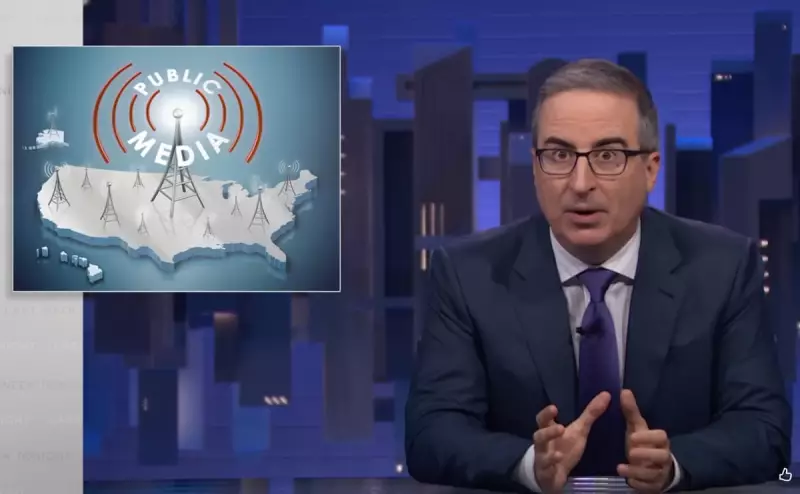
In a powerful segment on his show Last Week Tonight, John Oliver delivered a scathing critique of the mass defunding of public media in the United States, labelling the move as 'just stupid'.
The host detailed the precarious state of American public broadcasting, which largely operates under the Corporation for Public Broadcasting (CPB). Until recently, this body distributed funding to over 544 radio and TV grantees, representing more than 1,500 locally managed stations that reach over 99% of the US population with free programming.
The Vital Role and Imminent Threat
Oliver highlighted the 'truly innovative' nature of US public media, which has pioneered services like closed captioning and provides programming in diverse languages such as Haitian Creole, Navajo, and Vietnamese.
'But as you undoubtedly know, it is now facing a serious threat,' Oliver stated. He was referring to a Congressional vote this past summer to eliminate $1.1 billion in funding allocated for public broadcasting over the next two years. Former President Donald Trump publicly boasted about these cuts.
Oliver quipped that this is 'one of many egregious actions this administration has taken', suggesting the top Google search might soon be: 'Wait, can the government do that?'
Who Gets Hurt? Rural and Tribal Communities
The consequences of these cuts will be severe and widespread. 'These cuts will be felt all over, but especially in rural, remote and tribal communities,' Oliver explained.
An analysis cited on the show predicts that 115 stations serving 43 million Americans will likely close by mid-2026. This constitutes a 'gigantic blow' to a service that provides incredible benefits.
Oliver traced the history of US public media back to 1967, when President Lyndon B. Johnson signed the Public Broadcasting Act, creating the CPB, which in turn established PBS and NPR. He noted that the CPB's funding model, tied to the annual congressional appropriations process, has made it a perennial 'punching bag for Republicans' since its inception, with President Richard Nixon attempting to halve its funding just two years after it was founded.
The Real Impact: Local News and Emergency Alerts
Oliver dismantled the argument of 'liberal bias' used to justify the defunding, pointing out that such criticisms often mask bigotry against content acknowledging America's history of racism or the existence of gay people.
More importantly, he detailed where the federal money actually goes: over 70% of CPB funding is distributed directly to local public radio and TV stations. This money is used to produce local programming, buy equipment, and acquire content like the PBS Newshour.
Defunding these stations will have the opposite of the intended effect, Oliver argued, forcing them to rely more on federal programming from so-called 'liberal echo chambers'.
The cuts critically endanger local news. A Northwestern University analysis revealed that in nine US counties, public broadcasting is the only source of local news coverage. In 47 others, it is one of only two sources.
Perhaps most critically, local public broadcasters are essential during emergencies, such as hurricanes, distributing vital alerts and telling residents where to find resources like fresh water—a service national news outlets do not provide.
Oliver concluded by pointing out the stark contrast in funding between the US and other nations. Even before these cuts, federal spending on public media was about $1.60 per capita, compared to nearly $100 or more in the UK, Norway, and Sweden.
'Frankly, it’s always been a bit weird how little we fund public media, given how vital it can be,' Oliver said, citing research that links strong public media to a healthy democracy—something he described as currently resembling a precarious photo of Prince Philip.