A groundbreaking new exhibition at the National Gallery of Victoria in Melbourne is set to captivate fashion enthusiasts and art lovers alike. For the first time on such a grand scale, the revolutionary work of two of the most influential designers of the past half-century, Vivienne Westwood and Rei Kawakubo, will be displayed side by side. Titled 'Westwood | Kawakubo', the blockbuster show opens to the public on 7 December 2025 and runs until 19 April.
A Radical Juxtaposition of Fashion Icons
The exhibition represents a historic moment for the fashion world. As Katie Somerville, the NGV's senior curator of fashion and textiles, explains, placing these two visionaries together is "a thrill for a curator". Their parallel yet distinct careers, both born from a rejection of the mainstream, are explored through a stunning array of garments. The NGV team has meticulously considered the presentation of each designer's work. Westwood's outfits are displayed in full, glorious detail, accessorised with original shoes, hats, and pieces by renowned milliner Stephen Jones. In contrast, Kawakubo's Comme des Garçons creations are presented with a more spare, abstracted approach, reflecting her minimalist aesthetic.
A significant coup for the exhibition was the acquisition of 45 works directly from Rei Kawakubo's personal archive, 37 of which feature in the show. This extraordinary gift, highlighted by curator Danielle Whitfield, provides an unparalleled insight into the designer's creative process.
Punk Roots and Avant-Garde Beginnings
Both designers famously arrived at fashion from unconventional paths. Vivienne Westwood, a former primary school teacher, began creating and selling clothes from her London flat and later the iconic boutique 'Sex' in the 1970s. Her designs became the uniform of the punk movement. "She was using what she was creating... as a way of confronting what she saw as the rotten status quo," Somerville notes. Similarly, Rei Kawakubo had no formal training. Her 1982 'Holes' collection for Comme des Garçons, featured in the exhibition, introduced a radical aesthetic defined by black, distressed fabrics and asymmetry—a stark antithesis to the opulent couture of the era.
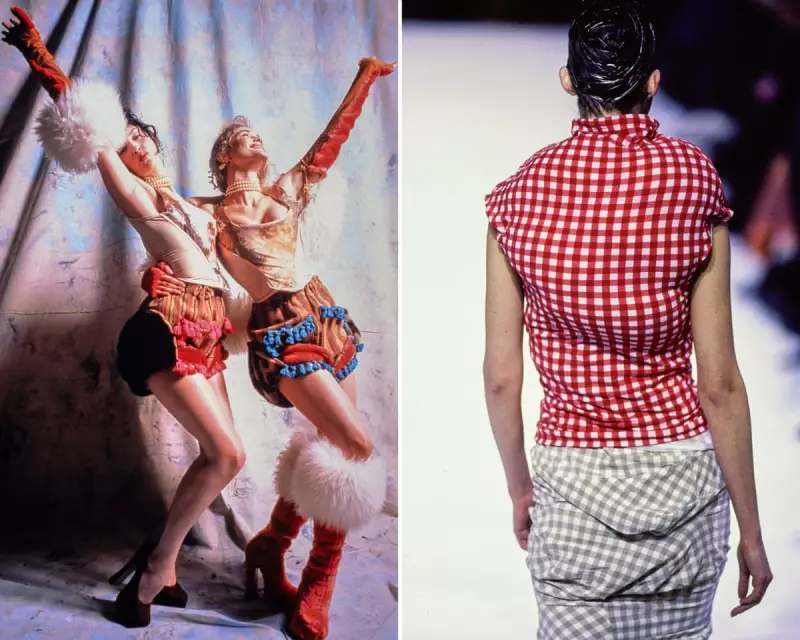
Westwood's runway debut, the 1981 'Pirate' collection, documented by photographer Robyn Beeche, caused a sensation with its flamboyant historical references, swiftly adopted by the New Romantic music scene. This relish for history became a hallmark. The exhibition includes an early NGV acquisition: a toga-style dress by Westwood, based on classical drapery, gifted by Beeche herself.
Challenging Form and Embracing Activism
The exhibition delves deep into how each designer reconfigured the relationship between clothing and the body. Kawakubo's seminal 1997 'Body Meets Dress–Dress Meets Body' collection used padding to distort silhouettes, while gingham fabric questioned domestic ideals. Her exploration pushed further into abstraction, as seen in a 2017 dress with no armholes—a "wearable object" with "no function". Conversely, Westwood's approach was often more direct, referencing classical Greek statues, though no less provocative, as tabloid frenzy over her revealing designs attested.
In their later careers, both used fashion as a powerful platform. Westwood became a vocal activist, travelling on a protest bus against fracking, her message embodied in what she wore. Kawakubo's recent collection titles allude to global events and the human condition. The final room, 'The Power of Clothes', examines how both used fashion as a tool for protest and to express core values.
The exhibition design creates a distinct rhythm, moving from the lush, immersive 18th-century-inspired room to a clean, laboratory-like space showcasing tailoring. With never-before-seen archival pieces and a unique curatorial vision, 'Westwood | Kawakubo' at the NGV offers a once-in-a-generation opportunity to witness the defiant, creative spirits that forever changed the landscape of modern design.