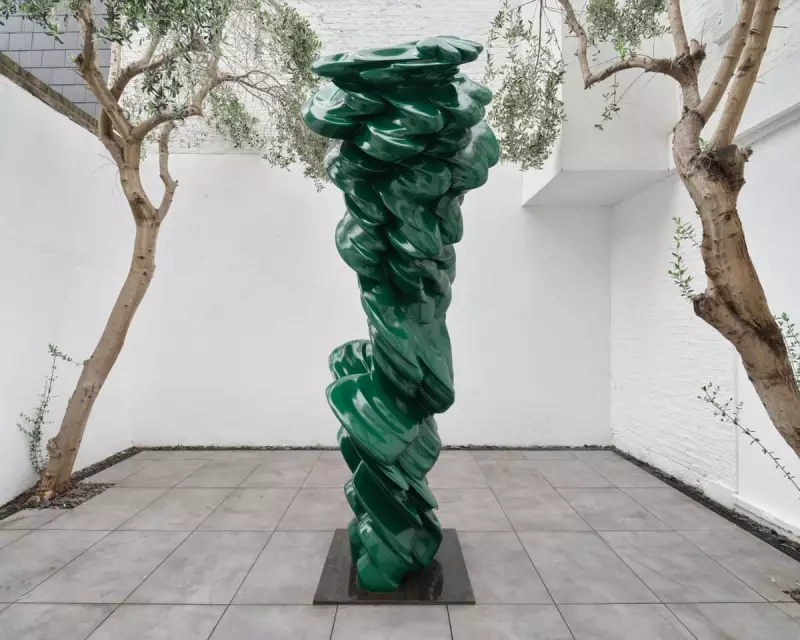
Renowned Turner Prize-winning sculptor Tony Cragg has returned to London with a major new exhibition at Lisson Gallery, showcasing works that the artist describes as resembling "twisted skeletons" in their dynamic, free-standing forms.
From Laboratory to Gallery: Cragg's Unconventional Journey
The 76-year-old Liverpool-born artist, who could easily pass for twenty years younger, recalls his unlikely path to artistic success. His father, an electrical engineer, was "bitterly disappointed" when young Tony announced his desire to become an artist, considering sculpture "a very dull and unnecessary activity." Cragg's first job was in a laboratory, giving him a unique perspective on the relationship between science and art.
Despite initial family resistance, Cragg persisted, eventually winning the Turner Prize in 1988 and establishing himself as one of Britain's most significant contemporary sculptors. He has lived in Wuppertal, Germany for many years but maintains strong connections to his homeland.
Embracing the Selfie Generation
In an era where gallery visitors often prioritize photographs over contemplation, Cragg displays surprising tolerance. "No, I don't have a problem with that," he says of visitors taking selfies with his work. "People are bound to respond in different ways."
This open-minded approach contrasts with his criticism of audio guides, which he believes interfere with the direct dialogue between viewer and artwork. "If you have a picture on a wall," he explains, "it doesn't matter what the artist's intention was. A hundred people stand in front of it and they will tell you a hundred different things about it."
British Roots and Brexit Regrets
Despite decades living abroad, Cragg retains strong affection for Britain. "I've lived abroad for the main part of my life, but I still feel very British," he confesses. "When I come back to Britain, immediately I'm more relaxed. I love British humour. I love the weather. I love the food."
He remains a devoted Liverpool FC supporter, rueing their recent form while drawing parallels between football and art: "Someone once told me, as an artist you're only as good as your last show, and in football you're only as good as your last game."
Cragg expresses disappointment with Brexit, describing it as his "most bitter disappointment." "This idea of isolationism, stepping back – I think it's bad for the general population," he says, noting concerning nationalistic tendencies.
Evolution of Artistic Vision
Cragg's early work addressed social issues in Britain, including Riot, a frieze created after the 1984 miners' strike and clashes between police and youths in Brixton. He left Britain in 1977, partly due to what he saw as "the destruction of the arts schools" and "a very extreme form of capitalism that paid no regard to the needs of the wider population."
The sculptor maintains that simply representing reality is "a senseless activity, a vain attempt by humans to parody or copy nature." While acknowledging masters like Bernini, he believes the time for traditional figurative sculpture has passed, praising artists like Damien Hirst for taking readymades "to another dimension with a shark in a tank."
Art's Essential Role in Society
Cragg passionately advocates for art education, arguing that "art is one of the best ways for people to have a better existence. It makes life more livable." He considers the neglect of arts education in Britain "almost criminal," noting that while STEM subjects are crucial, children need art to visualise what they're learning.
The artist remains remarkably productive, generating numerous new ideas constantly. When shown a list of potential sculpture titles including Recall, For a While, Long-stop, and Way to Go, he reveals they represent just one night's creative output.
Cragg marvels at contemporary art's current popularity compared to when he began his career. "When I was in France, the arts bodies were trying to take modern art out into the countryside – but the people threw food at it!" he recalls with amusement.
Tony Cragg's sculptures remain at Lisson Gallery in London until 31 January, offering British art lovers a chance to engage with works by one of the country's most distinguished artistic exports.