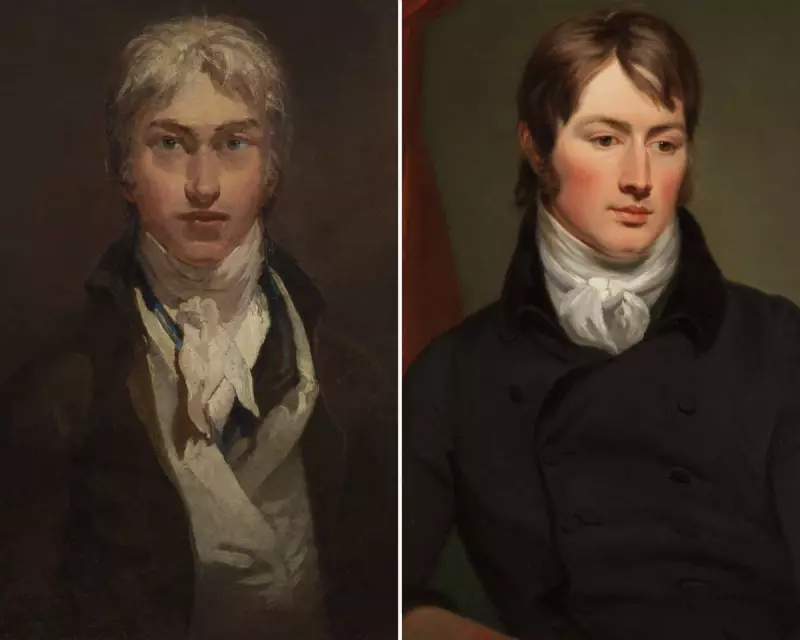
The age-old question of whether rivalry fuels artistic greatness takes centre stage at Tate Britain's latest exhibition, pitting two titans of British art against each other: JMW Turner and John Constable. Their legendary competition, while perhaps less dramatic than some Renaissance conflicts, represents a fascinating chapter in art history that continues to captivate audiences today.
The Infamous 1832 Confrontation
One of the most telling moments in their relationship occurred at the 1832 Royal Academy exhibition. John Constable famously remarked that Turner had "been here and fired a gun" after witnessing his rival's strategic artistic manoeuvre. Rather than an actual shootout, Turner had simply added a bold splash of red paint to his seascape, strategically drawing attention away from Constable's canvas displayed beside it.
This calculated move exemplifies the subtle yet intense competition between these masters of landscape painting. While they never engaged in the violent confrontations that characterised some Renaissance rivalries, their artistic duel played out through brushstrokes and colour choices rather than weapons.
Historical Precedents of Artistic Conflict
The tradition of artistic rivalry stretches back centuries, with Renaissance Italy providing particularly dramatic examples. Benvenuto Cellini, the fiery sculptor, literally carried weapons and reportedly contemplated murdering his rival Baccio Bandinelli, whom he described as "full of badness." Cellini allegedly spotted Bandinelli across a quiet piazza and reached for his dagger, only to spare him at the last moment.
The Renaissance period was defined by such intense competitions: Michelangelo versus Raphael, Michelangelo versus Bramante, and perhaps most famously, Michelangelo versus Leonardo da Vinci. Their feud included public humiliations, with Michelangelo accusing Leonardo of failing to complete his bronze horse commission in Milan, while Leonardo suggested Michelangelo's David needed "decent" bronze underpants.
Artistic competition in this era could turn deadly. When Artemisia Gentileschi moved to Naples, she required a weapons licence in a city controlled by an art mafia known as the Cabal. This group, led by painter Jusepe de Ribera, violently menaced rivals, severely wounding Guido Reni's assistant in 1621 and potentially lethally poisoning another outsider artist, Domenichino.
Modern Manifestations of Creative Competition
The dynamic between Francis Bacon and Lucian Freud demonstrates how rivalry can influence artistic development across generations. After Bacon's death in 1992, Freud's work notably blossomed, with the younger artist creating his monumental nudes of Leigh Bowery and Sue Tilley. Their relationship contained elements of friendship and possibly love on Bacon's part, yet Freud seemed somewhat constrained by Bacon's brilliance during his lifetime.
The opposite pattern emerged with Picasso and Matisse. Following Matisse's death, Picasso's art reportedly became "flabby" without his creative counterweight. Their decades-long rivalry began when Matisse gave Picasso a painting in 1907, which gossip suggested Picasso used as a dartboard. Despite this, their competitive relationship pushed both artists to greater heights throughout their careers.
Not all modern artistic relationships were defined by rivalry. The Impressionists and subsequent avant-garde movements often saw themselves as collaborative groups united against bourgeois conventions. While Gauguin and Van Gogh's famous falling out resulted from Vincent's illness rather than professional competition, and Picasso collaborated harmoniously with Braque to develop cubism despite his rivalry with Matisse.
Contemporary Shifts Towards Collaboration
The current art world shows a marked preference for collaboration over competition. In a striking departure from tradition, the 2019 Turner Prize nominees chose to share the award as a "collective", with Helen Cammock, Oscar Murillo, Tai Shani and Lawrence Abu Hamdan all receiving the honour. While charmingly democratic, this approach raises questions about whether eliminating competition diminishes the creation of artistic heroes.
This shift away from rivalry may explain why the Turner Prize sometimes feels less relevant today. As T.S. Eliot noted, someone who likes all poetry would be dull to discuss poetry with. Similarly, artistic appreciation requires discrimination and choice. Exhibitions that explore historical rivalries help viewers develop critical perspectives rather than simply admiring everything equally.
The Tate Britain's pairing of Turner and Constable invites visitors to take sides, to engage in the same critical evaluation that defined their era. If you emerge from the exhibition admiring both artists equally, you might have missed the point entirely. And if you find yourself preferring Constable over Turner, as the article suggests, it might be time for "pistols at dawn" in the realm of artistic debate.