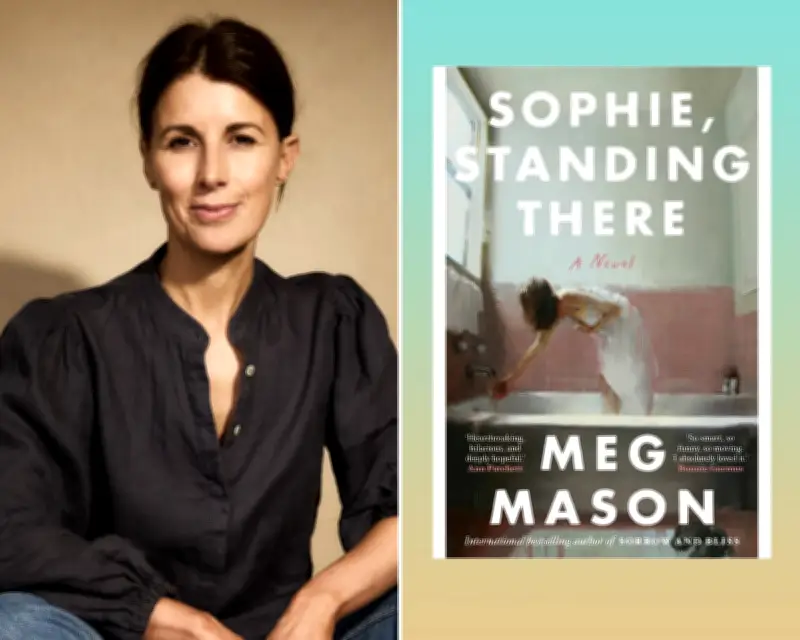
Meg Mason's new novel, Sophie, Standing There, the follow-up to her 2020 tragicomedy Sorrow and Bliss, centers on an invisible woman. Sophie works as a technical assistant at literary festivals, shuffling up to famous writers before events to slide microphone cables down their shirts while they chat with chairs or accept mineral water. No writer is a hero to the technical staff lurking in the wings.
A Series of Teasing Cameos
Mason's opening pages present a teasing series of cameos of real writers: George Saunders insisting on swapping his headset for a lapel mic at an inconsiderately late stage, Ann Patchett being frosty with a fan, and Mick Herron accidentally stepping on someone's foot without apologizing. Sophie lurks in the wings of her own life, too. She likes her job but has much to be sad about.
Not long ago, her husband ended their relationship with oafish callousness—she was in the shower; he didn't bother to take his earbuds out while delivering the news—and with it her hope of becoming a mother. Now her beloved books are in storage in the garage of her old house, and she lives alone in a dingy rental flat owned by her husband. The water in Sophie's glass tastes like pipes. She feels very tired. The coffee table is actually a cable spool with '12 AWG' spray-painted on the drum.
Wan and Witty Prose
Mason's prose is wan and witty, handling the admixture of pathos and bathos well. Her sinuous sentences capture the wavering movements of thought with less fuss and more laughs than Virginia Woolf. As a bookish person inhabiting a lightly metafictional narrative, Sophie is glumly aware of her literary analogues. There is a lot of sad girl fiction on her Kindle. She reflects on Eleanor Oliphant Is Completely Fine: 'That was the worst. Even though it was extremely well written and Sophie had recommended it to about 10 people when it first came out, in this moment, she wished she'd never heard of it and couldn't recall the cheese scones and those cappuccinos Eleanor always ordered, the saddest of all the coffees.'
Mason is brilliant at describing the small but intense joys of everyday life—getting your scalp massaged at the hairdresser, or owning one really nicely designed pair of trousers. She is likewise good at life's routine humiliations and inanities, such as bumping into your ex with a leaky bottle of coconut water in your handbag, or asking a favour from someone whose text messages you have been ignoring, or realising how much it costs to take an Uber back from Ikea.
The Engine of the Plot
The plot is driven by a parasocial relationship, but an old-fashioned one: Sophie becomes obsessed with a famous writer. The writer is just 'the author' for the first part of the book, but then Mason gives her a name, Lilac Dunne. Sophie rereads her books, talks to an imaginary version of Lilac, and spends hours scrolling images of her and listening to her on podcasts. Fantasy and reality collide when, to Sophie's terror, Lilac is booked to appear after Elizabeth Strout drops out of an event.
An infatuation with the idea of Lilac—with her public persona and authorial voice—is complicated by a first glancing and then apparently deepening encounter with the real thing. Lilac takes Sophie up a little, and Sophie is flattered and flustered. She thinks of herself as a nobody, but Lilac seems not to. And then ... well, no spoilers.
A Fault in the Character of Lilac
If there is a fault in this continuously witty and touching narrative, it is in the person of Lilac. As a writer, she appears unstuffy, poised, wise, and at ease in the world; Sophie is not the only one to fall for her. When we encounter Lilac in person, she is harder and more ruthless than her public persona but no less impenetrable, with none of the psychological complexity or vulnerability displayed elsewhere. She is more deus ex machina in Sophie's story than a fully realised character.
But perhaps that is by design. In this Bridget-Jones-meets-Pirandello caper, Mason is nothing if not knowing. As she writes in one of the closing chapters, opening a little postmodern mise en abyme: 'If someone wrote a novel about Sophie, which they wouldn't, but if they did, it could end there.' It doesn't.
Sophie, Standing There by Meg Mason is out now in Australia (HarperCollins) and will be published in the UK on 27 August (Bloomsbury).