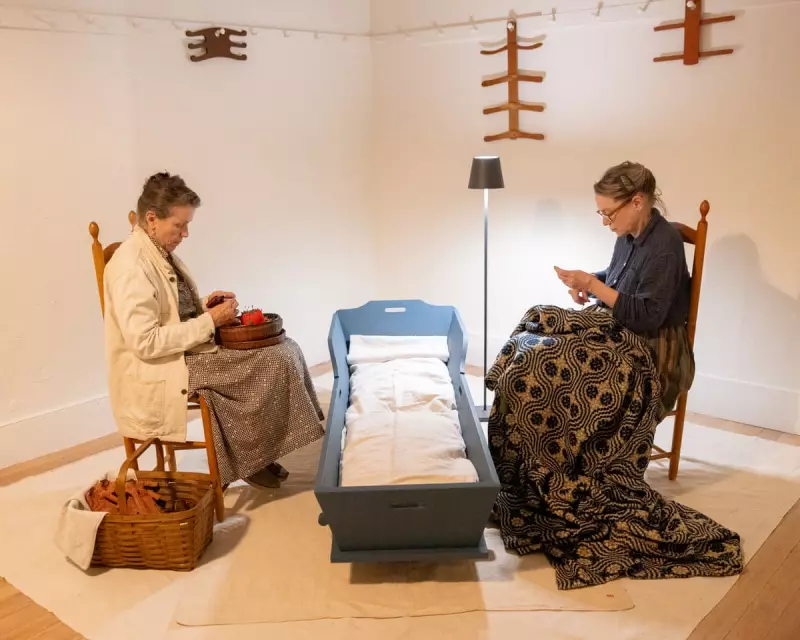
Academy Award-winning actress Frances McDormand, celebrated for her deeply empathetic portrayals in films like Fargo and Nomadland, has ventured into the art world with a profound new installation. She has collaborated with conceptual artist Suzanne Bocanegra on 'Cradled,' an exhibition now open at the Hauser & Wirth gallery in Downtown Los Angeles.
The Inspiration Behind the Cradles
The project draws its inspiration from the Shakers, a Christian sect formally known as the United Society of Believers in Christ's Second Appearing. While the Shakers are often remembered for their simple furniture and ecstatic worship, this exhibition highlights a lesser-known aspect of their culture: their compassionate approach to end-of-life care. The last active Shaker community in Sabbath Day Lake, Maine, now has just three members, yet their legacy is gaining fresh attention, partly through a new film, The Testament of Ann Lee, starring Amanda Seyfried.
McDormand's fascination with the Shakers began during a theatrical performance based on songs from Shaker oral history. This led her to the Shaker Museum, where she encountered the adult-sized cradles that form the heart of the exhibition. 'I was drawn to the adult-sized cradles in the collection because it was something that was provocative in its size and in its use for the infirm and elderly,' McDormand explained.
More Than an Object: The Cradle's Purpose
The exhibition features four authentic Shaker cradles on loan from museums across the United States. Bocanegra points out the central paradox of the object: 'It's something we associate with an infant and yet, for the Shakers, it was used more for adults and for the end of life.' This was not merely a practical item but a symbol of community and tender care.
Experts from the Shaker Museum elaborate on this significance. Sharon Koomler, a collections manager with a nursing background, notes that rocking helped prevent pressure sores. More importantly, as director Jerry Grant emphasises, the cradle represented a 'two-person activity,' ensuring that those who were ill or dying were never left alone. The act of rocking provided purpose and connection for both the carer and the cared for.
An Immersive, Experiential Space
McDormand is keen to distinguish the installation from a performance. 'It's not performative; it's more experiential,' she states. Visitors are encouraged to engage actively with the space, which includes rocking chairs and baskets filled with mending projects, reflecting the Shaker value of practical work. The environment is enriched by a haunting 'end-of-life lullaby' composed by David Lang, with sound design by Oscar-winning editors Skip Lievsay and Paul Umstron.
The Shaker philosophy, encapsulated in mantras like 'Hands to work, hearts to God,' prized utility and simplicity, which often resulted in objects of spare beauty. McDormand compares this aesthetic to Japanese and Scandinavian design. Beyond their craftsmanship, the Shakers were also surprisingly entrepreneurial, with the museum archive even revealing a 1960s Barbie doll dressed in a custom Shaker outfit created for sale.
While McDormand doesn't subscribe to the Shaker theology, which included celibacy, she strongly identifies with their ethos. 'I like to call us Shaker-adjacent,' she reflects, admiring their communal spirit and self-sufficient success which lasted for over two centuries. The 'Cradled' exhibition is on display at Hauser & Wirth in Los Angeles until 4th January, offering a contemplative space to explore these enduring values.