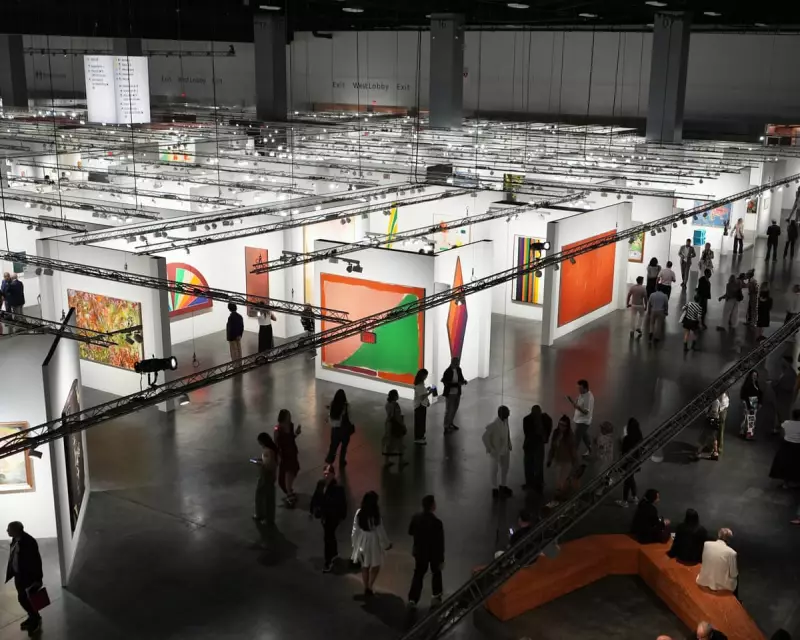
The 2025 edition of Art Basel Miami Beach has opened with a powerful focus on Latin American creativity, placing artists from Brazil, Mexico, Argentina, and Panama at the forefront of the prestigious event. This year's gathering in Florida is distinguished by a wave of artists who are masterfully reinterpreting their cultural legacies, transforming them into surprising and fantastical artworks that challenge and captivate viewers.
Provocative Reinterpretations from Mexico and Brazil
Mexican artist Renata Petersen, hailing from Guadalajara, presents a compelling booth featuring three interconnected collections. Her work includes intricate tile murals subverting religious cult iconography, 80 chrome-blown glass pieces inspired by sex toys, and ceramic vases with carefully arranged motifs. Petersen's unique perspective stems from her childhood accompanying her anthropologist mother on fieldwork, fostering a detached, analytical view of religious movements.
"My life story was really influenced through my mom’s story, always asking questions, never judging," Petersen explained. Her work serves to preserve the history of these subcultures, exploring how humanity makes the sacred corporeal. Her glass creations, crafted with artisans from Jalisco, are described as being "somewhere between stupas and butt plugs" – temples to human sexual drive.
From São Paulo, Brazilian painter Thalita Hamaoui draws on national traditions and Impressionist influences to create vibrant, imaginary landscapes. Her striking oil paintings, which eschew a traditional vanishing point, are sensuous melanges of texture and colour that capture the fleeting, chaotic experience of Brazil's environment. "In Brazil you can have so many different kinds of weather in the same day, it’s all so much," she noted, describing her search for an instantaneous moment in a landscape.
Adobe, Soil, and Shared Humanity
Argentinian artist Gabriel Chaile creates formidable sculptures from adobe, a material deeply connected to his childhood and his Indigenous grandmother's bread-making tradition. His mysterious, hearth-like forms are covered in archaic markings, suggesting a visual culture that points to a shared humanity transcending borders. "Studying images enables me more and more to observe these forms of all of 'America' with a certain brotherhood," Chaile shared.
His work also includes drawings and photos inspired by the No Kings Day protests witnessed in Bozeman, Montana. He was struck not by the politics, but by "the gesture that this group of human beings was making when they came together to fight to maintain a true coexistence."
Panamanian artist Cisco Merel has literally brought a piece of his homeland to Miami, mixing Panamanian soil with resin and local Miami mud to create a beautiful wall covering for his booth. "The idea is to take the soil from Panama and the soil from Miami, to try to bring us together," he said. This use of soil references the Panamanian tradition of Junta de Embarra, a community house-building ritual.
Merel's booth is completed with paintings of "impossible structures", abstract reflections on the precarious, mysterious nature of Panamanian society where, as he says, "everything is built, but nobody knows how it’s working."
A Defining Moment for Regional Art
This year's Art Basel Miami Beach signifies a major moment for Latin American art on the global stage. The artists showcased are not merely presenting cultural artefacts; they are actively deconstructing and reimagining heritage, history, and social commentary through diverse mediums—from adobe and soil to glass and oil paint. Their works provoke questions about faith, community, identity, and the human condition, demonstrating the region's vital and evolving contribution to the international contemporary art dialogue. The focus offers collectors and enthusiasts a profound insight into the innovative and critical voices shaping the art world's future.