The lobby of Kettle's Yard in Cambridge resonates with an unexpected soundtrack: the sound of artist Harold Offeh humming and ummming fills the space. Sometimes sensual, sometimes sleepy, these vocalisations form the disembodied overture to his compelling exhibition, Mmm Gotta Try a Little Harder, It Could Be Sweet.
Two Decades of Performance and Identity
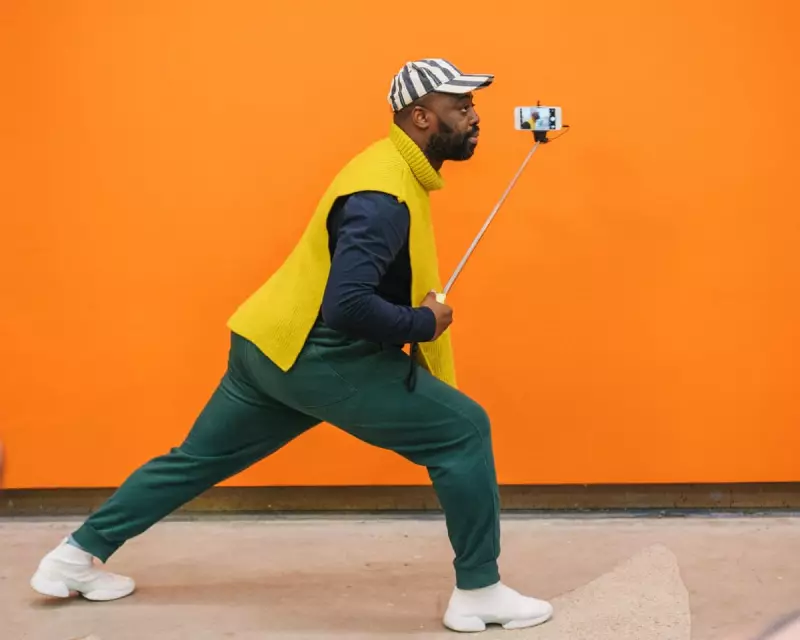
For over twenty years, Harold Offeh has been a dynamic presence in the art world, using his body as a primary medium. The Ghanaian-born artist's work spans continents and personas. In 2003, he became Haroldinho in Rio de Janeiro, shuffling samba steps in blue worker's overalls. Across British cities like Walsall and Liverpool, he wore a Victorian magnifying lens that distorted his features, often attracting suspicious glances that highlighted everyday racism.
The exhibition's earliest work, Smile from 2001, shows a close-up of Offeh maintaining a sardonic grin while listening to Nat King Cole's version of the Charlie Chaplin-composed song on repeat. This exploration of performed emotion continues with his mimicry of Hattie McDaniel's racially stereotyped performance as Mammy in Gone With the Wind, where he meticulously recreates her exaggerated facial expressions.
Disco Divas and Impossible Poses
Offeh's Covers series forms a central pillar of the exhibition, featuring drag impersonations of Black R&B and disco stars. Wearing an "I LIKE BOYS" T-shirt or snapping his fingers like a disco diva, he channels the energy of 1970s and 80s music icons. The artist adopts their record-sleeve postures throughout his home – performing Marlena Shaw's stylised pose in his cluttered loft and attempting Grace Jones's anatomically impossible montaged pose from her Island Life album cover, for which he slathered himself in oil while naked in his bathroom.
These performances blend parody, vulnerability, homage and critique, with more than a hint of desire. Offeh has also re-performed these works as staged photographs, creating a lasting document of these transient moments.
Vulnerability and Social Engagement
In his early 2002 work Four Ways to Feel Amazing, Offeh listens to self-help advice in various vulnerable situations: naked in his bath, standing alone on a street, and on the toilet with his trousers down. The final vignette shows him staring at a digital clock in a bare room, creating a crushing sense of futility and stalled time that evokes Samuel Beckett's bleakest moments.
While Offeh performs less nowadays, the exhibition maintains its energy through graphic razzmatazz and installational complexity influenced by Afrofuturism and Brazilian Tropicália. His recent focus has shifted toward community-based projects, including work with young people for the London Underground and a playground design influenced by Sun Ra and George Benson.
The exhibition at Kettle's Yard in Cambridge continues until 1 March, offering visitors a comprehensive overview of an artist who continues to probe questions of identity, race, and queer experience with both joy and underlying pain.