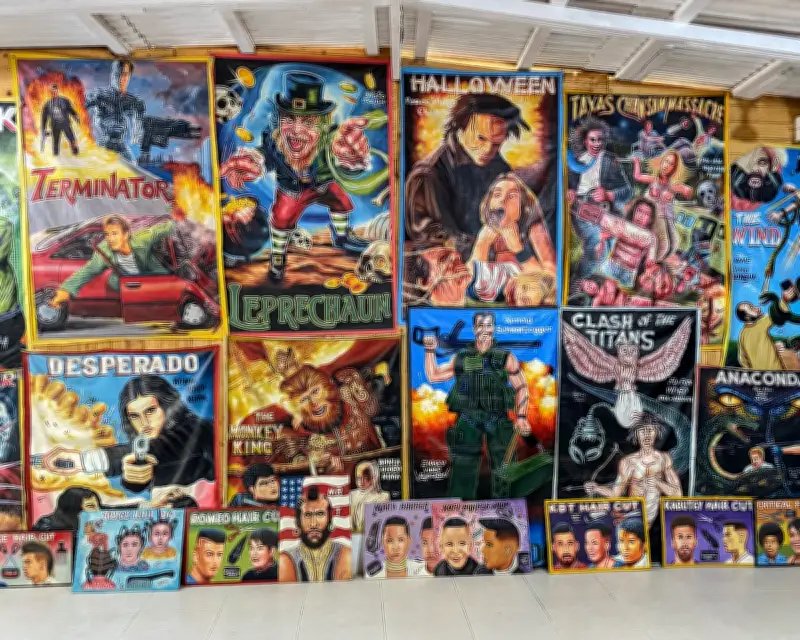
Hand-painted film posters, a hallmark of Ghanaian film culture from the late 1970s to early 2000s, are experiencing a revival driven by online marketing and Western demand. Deadly Prey Gallery, co-founded by Robert Kofi and Brian Chankin in 2012, works with 15 artists to preserve the tradition, with commissioned pieces starting at $600 (£450).
Artists reinterpret films with surreal flair
Jeaurs Affutu, known as Heavy J, was painting a poster for The Little Mermaid on his porch in Teshie near Accra. His version featured a man wielding a bloody knife and a skull—elements absent from the animated fairytale. “We add more to make people interested,” said Heavy J, who has been painting posters for four decades.
Plot lines are merely starting points for humorous and surreal flights of fancy. Artists competing for different video clubs aimed to create the best “forgery,” as they called their interpretations. Exaggeration draws from an African tradition of “visualising the invisible,” according to Joseph Oduro-Frimpong, director of the Centre of African Popular Culture at Ashesi University. “They will highlight these things and in doing so incorporate things that are not in there. There is a kind of sensationalism to it,” he said.
Revival driven by US demand
The practice waned around 2000 as more Ghanaians got electricity and TVs, but posters gained global interest through books and exhibitions. Deadly Prey Gallery now connects artists to online customers, with most orders from the US. Old action, science fiction, and horror films are in highest demand, including The Exorcist, Star Wars, and Terminator franchises.
Kofi, based in Accra, acts as manager and editor, identifying suitable artists and reviewing works in progress. In Ashaiman, artist Stoger (Benjamin Amartey) worked on commissions for Poltergeist and Gummo. Kofi advised making cat scenes “uglier” and spaghetti “dirtier” for the Gummo poster. “I use my imagination to make scenes that will attract people,” Stoger said.
Risks of creative liberty
The reinterpretations sometimes provoked threats, insults, and physical attacks from viewers who felt misled. Kofi recalled an incident in the 1990s when he was beaten after people saw Double Impact and realised Jean-Claude Van Damme did not perform a beheading shown on the poster. At the Centre for National Culture in Accra, dozens of colourful posters are displayed, including Jennifer Lopez launching an arrow at a snake in Anaconda and a mouse emerging from Jamie Lee Curtis’ mouth in Halloween. “We are preserving a tradition,” Kofi said. “We are preserving a history.”