Brooklyn's Wall of Tears: A Monumental Tribute to Gaza's Lost Children
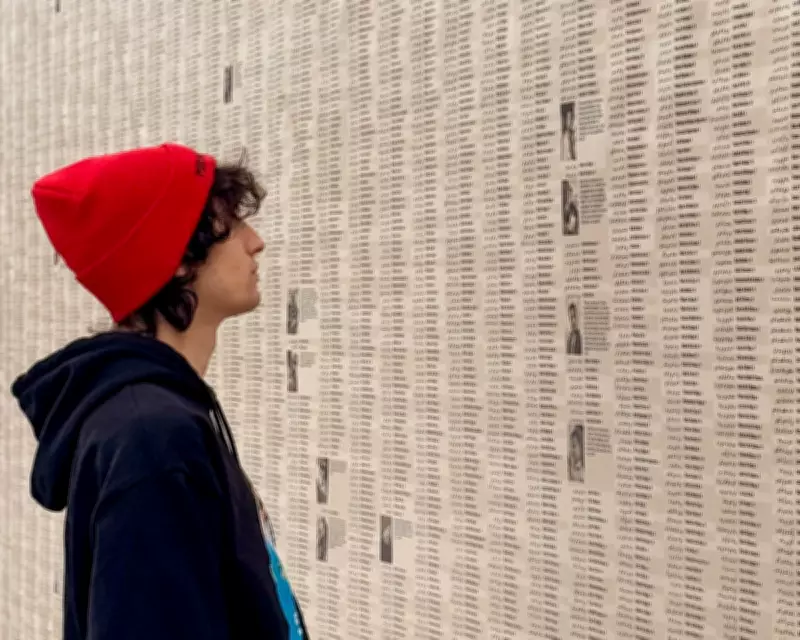
A striking new art installation has emerged in Brooklyn, transforming a city street into a solemn memorial for the youngest victims of the Gaza conflict. The Wall of Tears, a monumental 50-foot-long mural, meticulously documents the names of 18,457 children killed between October 2023 and July 2025, based on data from the Gaza health ministry.
A Personalised Memorial in Urban Space
Created by veteran artist Phil Buehler, the installation opened adjacent to Pine Box Rock Shop bar at 12 Grattan Street in Brooklyn. The sand-coloured mural, constructed from durable waterproof and UV-coated vinyl, stands 10 feet tall and arranges the children's names chronologically by their date of death. The artwork begins with Wesam Iyad Mohammed Abu Fsaife, a 14-year-old boy, and concludes with Sabah Omar Saad al-Masri, an eight-year-old girl.
"From a distance, it appears almost abstract," explains Buehler, 69. "That visual intrigue draws people closer to discover these are actually thousands of names stretching down the block. Then I hope visitors will engage further with the photographs and personal stories interspersed throughout the installation, drawn from reports by the Guardian and Washington Post."
Emotional Impact and Artistic Intent
The artist describes the project as emotionally challenging, referencing Stalin's observation that "a single death is a tragedy, a million deaths is a statistic." Buehler aims to bridge this gap, stating: "With Wall of Tears, you can comprehend the scale of 18,457 children's deaths while simultaneously empathising with their surviving families through individual stories."
He continues: "Seeing these faces full of joy and hope—snapshots from graduations, birthday parties, family gatherings—knowing these lives were cut short inevitably makes you think about your own children and family. I hope this leads people to consider how they might help, even if simply by sharing photographs of the mural through their social networks."
Timing and Contemporary Relevance
The installation's opening coincided with the second anniversary of Hind Rajab's death, a five-year-old Palestinian girl whose tragic final hours were documented in audio recordings released by the Palestine Red Crescent Society. These recordings inspired The Voice of Hind Rajab, a Tunisian film nominated for an Oscar in the international feature category.
"The film is incredibly gut-wrenching," Buehler reflects. "It deserves recognition because it's a reenactment of that desperate call where you hear her actual voice—a five-year-old pleading for rescue. This innocent child has become an emblem of the tragedy unfolding in Gaza."
Political Context and Community Response
The Gaza conflict has proven particularly divisive in New York, home to nearly one million Jews—the largest Jewish population outside Israel. Buehler addresses concerns about potential misinterpretation of the artwork's message: "Conflating opposition to the war with antisemitism makes constructive dialogue impossible. Most of my Jewish friends express profound sadness about these children's deaths but fear that highlighting the tragedy might be misconstrued as antisemitic."
The artist observes a troubling cultural dynamic: "Jews hesitate to bring attention to it, Palestinians hesitate to bring attention to it—we're living in a moment not conducive to open dialogue. The tribal mentality that equates opposing children's deaths in Gaza with opposing Jewish people is fundamentally flawed."
Artistic Legacy and Previous Works
Buehler collaborated with non-profit Radio Free Brooklyn on this project, continuing his tradition of creating large-scale social commentary murals. His previous works include:
- Wall of Lies: Documenting over 20,000 false statements by Donald Trump during his first presidential term
- Wall of Liars and Deniers: Listing 381 Republican election deniers from the 2022 midterms
- Wall of Shame: Chronicling actions of more than 1,500 January 6 rioters
- Empty Beds: Highlighting the abduction of nearly 20,000 Ukrainian children by Russia
The Wall of Tears represents perhaps Buehler's most emotionally demanding project to date, serving as both a memorial and a catalyst for reflection about one of contemporary history's most devastating conflicts.