Beryl Cook's Centenary Exhibition: A Vibrant Celebration of Everyday Joy
In the world of English art, two dominant narratives have long prevailed: either idyllic rural landscapes with rolling hills and gambolling sheep, or grim depictions of poverty and industrial hardship. Beryl Cook, however, painted a different England entirely. Her work captures the vibrant, joyful spirit of working-class life, finding exuberance in the everyday. Now, on what would have been her 100th birthday, her home city of Plymouth is hosting a major retrospective exhibition titled Pride and Joy at The Box gallery, celebrating her unique artistic legacy.
From Plymouth Guesthouse to National Acclaim
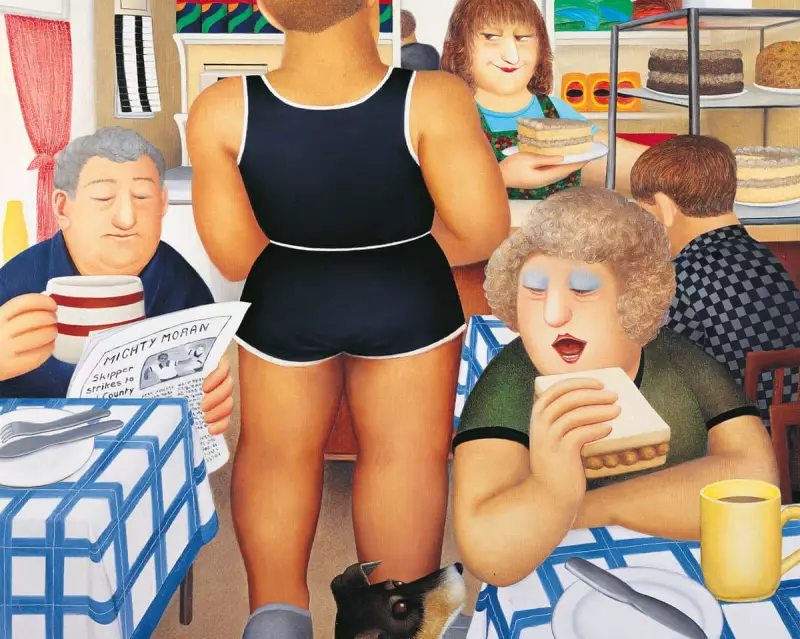
Cook's artistic journey began in Plymouth, where she ran a guesthouse on the historic Hoe waterfront during the 1970s. Initially, her paintings were somewhat tentative and messy, but by 1974, she had developed her distinctive, confident style. Her characters became instantly recognisable: plump figures with bursting bosoms, cartoonish dot eyes, and sausage-like noses. Their uniformity, distinguished mainly by hairstyles and outfits, gave them a universal quality that resonated widely.
Her breakthrough came in 1975 when an antique-dealer friend offered to sell some paintings to clear space. This led to a rapid rise: a show at Plymouth Art Centre that same year, followed by a major exhibition at London's Whitechapel Gallery in 1976. Soon, her work graced magazine covers, she authored children's books, and received an OBE, achieving mainstream success while often being overlooked by the high art establishment.
The Hallmarks of Cook's World: Laughter, Community and Sauce
Cook's art presents a world brimming with life and laughter. Her scenes depict boozy revellers, giggling hen parties, pool-playing girls in miniskirts, and raucous karaoke nights. It's a celebration of pubs, gay bars, cabarets, and public spaces where private desires are joyfully expressed. The exhibition features her famously bawdy works, including two hilarious paintings of whip-wielding dominatrixes and a series of playful self-portraits exploring personal fantasies.
Her sharp humour shines through in details like graffiti reading "Nigel is a wanker" behind an elderly couple eating chips, or a rival football fan being strangled in the background of a goal celebration. Yet alongside the sauciness, Cook captured everyday moments with affection: bingo halls, Dyno-Rod workers, cheeky sailors smoking, market shoppers, and smiling nurses—all depicted with characteristic warmth and wit.
Unexpected Depth: Family, Love and Artistic Inspirations
Beyond the laughter, the exhibition reveals Cook's more earnest and emotional side. Intimate family paintings show her son and husband felting a shed roof, her granddaughter on a swing, and her daughter-in-law bringing tea—scenes filled with genuine, unsentimental love. The exhibition also explores her artistic inspirations, noting influences from Old Masters like Bruegel and Rubens, and displays her experiments with sculpture, including playfully painted toilet seats.
A companion exhibition at Plymouth's Karst gallery features contemporary artists like Olivia Sterling, Flo Brooks, and Rhys Coren, whose works share thematic or aesthetic links with Cook's celebration of everyday life and marginalised communities.
Legacy: Celebrating the Extraordinary in the Ordinary
While many artists documented the bleakness of working-class England, Cook offered a refreshing alternative: a vision of resilience, community, and joy. Her body-positive depictions allowed diverse people—sailors, strippers, LGBTQ+ individuals—to see their lives reflected in art. Her message was simple yet profound: "Cheer up, mate, have a pint!"
Cook's work asserts that the ordinary isn't just potentially extraordinary—it is extraordinary. Life, in her view, is amazing, filled with laughter, joy, and fun. Her art reminds us that being alive is precious and fantastical, worth celebrating at every opportunity. Beryl Cook: Pride and Joy runs at The Box, Plymouth until 31st May, offering a timely tribute to an artist who found brilliance in Britain's everyday moments.