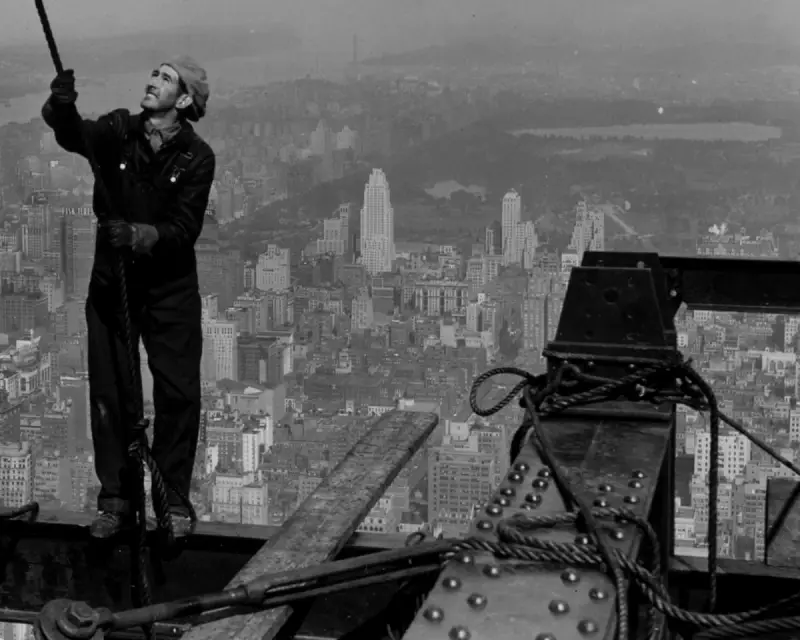
Perched on a steel cable high above the bustling streets of Manhattan, a rugged figure in workman's dungarees reaches out to secure a bolt. The vertiginous drop below offers a view of the Hudson River and the sprawling New York cityscape. A fall from this dizzying height would mean an 11-second plunge to the ground.
Capturing Daredevils on Film
This iconic photograph, known as 'The Sky Boy', was taken by the renowned photographer Lewis W. Hine. It immortalises the breathtaking courage of the men who constructed the Empire State Building between 1930 and 1931. Hine was commissioned to document the skyscraper's breakneck 13-month construction, creating a portfolio that ranged from formal portraits to dynamic action shots of workers drilling foundations, wrestling with steel, and navigating beams as the 102-storey colossus rose.
Today, the building's legacy often celebrates the architects, Shreve, Lamb and Harmon, and financiers like Alfred Smith. Yet the 3,000 labourers who toiled on site each day have remained largely anonymous. They were a tight-knit fraternity of Scandinavians, Irish-Americans, and Kahnawà:ke Mohawks – self-described "roughnecks" who, as one contemporary writer noted, spent their days "strolling on the thin edge of nothingness."

Putting Names to the Faces
A new book, 'Men at Work: The Untold Story of the Empire State Building and the Craftsmen Who Built It' by Glenn Kurtz, seeks to change that. Kurtz was inspired by a small plaque in the building's lobby honouring 32 men with craftsmanship awards. "I was astonished to learn that no one had ever inquired about the men pictured," he says.
His research, delving into census data, union records, and family histories, was challenging. Employment records were rarely kept, and workers' private lives went undocumented. This obscurity even extends to the official death toll; while five fatalities are officially recorded, Kurtz's findings suggest at least eight people died, including seven construction workers and a passerby, Elizabeth Eager.
Kurtz brings several figures into sharp relief. There was Victor 'Frenchy' Gosselin, a 'connector' famed for catching suspended beams. Hine photographed him nonchalantly straddling a hoisting ball, an image later used on a U.S. stamp. Gosselin died in a car accident at 46. Others include Vladimir Kozloff, a union secretary who fought for worker protections, and Ferruccio Mariutto, a terrazzo craftsman who likely later died from asbestos exposure.
The Enduring Mystery of The Sky Boy
The book saves its most compelling speculation for last: the identity of the anonymous 'Sky Boy'. Through photographic comparison, Kurtz proposes he may have been Dick McCarthy, a second-generation American of Irish descent living in Brooklyn, who died in 1983. "We may never know the truth," Kurtz admits, "but I'd say I have 50% confidence in my conjecture."
Ultimately, Kurtz argues that architectural history has marginalised the actual human cost and skill behind great buildings. "Their skill, their training, and the specific conditions of their workplaces, are all profoundly important," he states. "They are how every building gets built." The book serves as a long-overdue tribute to the 3,000 individuals whose bravery and labour literally shaped the skyline of New York.