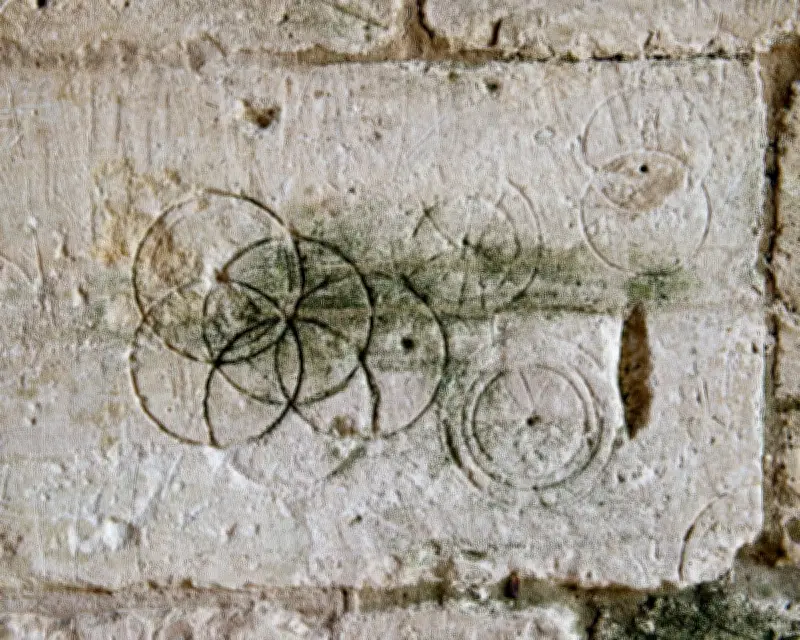
A leading architectural historian has argued that symbols long identified as 'witches' marks' or 'ritual protection symbols' on historic English buildings are actually the working marks of stonemasons, with no evidence of mystical meaning.
Historian challenges popular interpretation
Jennifer Alexander, professor of architectural history at Warwick University, says daisy wheels or hexafoils are simply geometric exercises by apprentices learning to use compasses on stone. 'Do you remember at school when you were first given a pair of compasses and you made a daisy wheel? It's that,' she told the Guardian. 'There are hundreds of such marks and they tend to be of varying degrees of skill. It's much more the sort of thing you'd use to train apprentices with.'
Alexander ridiculed the identification as 'witches' marks', stating: 'Anything on a stone building that looks like a design gets picked up as these damn things now. There's absolutely no evidence they were ever used like that.'

English Heritage and Historic England claims
In 2024, English Heritage announced that research at Gainsborough Old Hall in Lincolnshire revealed 'a staggering array of carved ritual protection, or apotropaic marks – sometimes called witches' marks – the most identified at any of our 400 sites'. They described simple circles and overlapping Vs as traps for demons or calls to the Virgin Mary. In 2016, Historic England asked the public to hunt for witches' marks 'that date back to times when belief in witchcraft and the supernatural was widespread'.
Historic England's website acknowledges that the significance of hexafoils is disputed, noting that 'their interpretation as a ritual protection mark is the most widely accepted theory at present'. However, Alexander counters that such marks on barns, including a 14th-century one at Bradford-on-Avon, indicate these buildings were used as schoolrooms or mason training shops.
Stonemason marks and building history
Alexander explains that marks like capital W or M are mason ciphers used to identify work or assembly order. 'There are things to ward off the evil eye, but they are a more generic thing... These are parts of the mechanisms by which buildings are constructed,' she said. Her book, 'Stonemasons' Marks', published by Routledge ahead of the International Medieval Congress, explores how marks reveal insights into buildings and their builders.
Historic England responded: 'We welcome new research that adds to our understanding of these marks. The more we learn about them, the richer our picture of the people who made and used these places becomes.' English Heritage added: 'We welcome debates such as this, which encourage fresh perspectives on the past, and look forward to seeing where future research leads.'