Niemeyer's Final Masterpiece: The Leipzig Sphere Restaurant
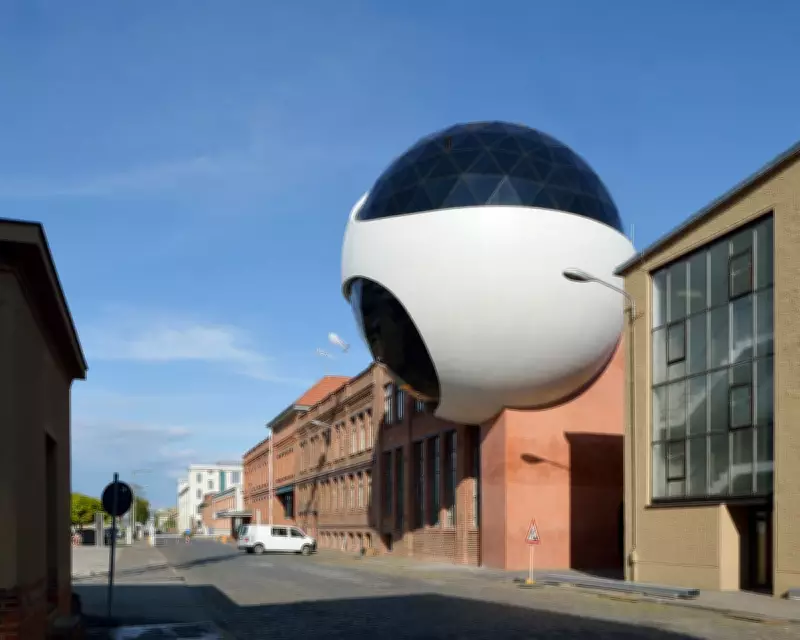
Perched among old brick buildings in an industrial neighborhood of Leipzig, eastern Germany, a giant white sphere appears to hover over a former boiler house. Is it a giant's golf ball, an alien spacecraft, or a fallen planet? This extraordinary structure is the Niemeyer Sphere, the final design of world-renowned Brazilian architect Oscar Niemeyer, created when he was 103 years old. It stands as a mesmerizing restaurant that combines space-age aesthetics with a surprising location among used-car dealerships and construction equipment rental outlets.
A Vision from the Future
Twelve meters in diameter, the Niemeyer Sphere is often described as Niemeyer's most surprising creation. The architect, who valued the sensation of newness in art above all else, designed buildings that seem both futuristic and otherworldly. Since its opening in June 2020, the Sphere has remained a hidden gem, largely unnoticed due to the Covid pandemic, yet its journey from concept to completion spanned two decades.
Photographer Margret Hoppe meticulously documented the construction process, and her exhibition, The Spirit of Past Future, now showcases these shots alongside work by Armenian artist Nvard Yerkanian. This exhibition explores modernist architecture, including Bauhaus structures and buildings by Le Corbusier, who once employed the young Niemeyer as a draftsman. The Sphere serves as a crowning achievement in Niemeyer's illustrious career.
The Story Behind the Sphere
The Sphere's origins trace back to 1994, when West German entrepreneur Ludwig Koehne purchased a heavy machinery factory for a symbolic one Deutsche Mark during the privatization of East German companies. Renaming it Techne Sphere, Koehne envisioned a restaurant on the roof of the factory's two-story canteen, leveraging the existing kitchen facilities for events and refined dining.
In 2007, Koehne traveled to Brazil and fell in love with Niemeyer's iconic Brasília buildings, such as the Palace of the Dawn and the Cathedral of Brasília. Inspired, he wrote to Niemeyer in 2011 and met him in person. Upon returning, Koehne secured a commitment from chef Tibor Herzigkeit to stay on for at least ten more years, ensuring the project's continuity.
Design and Construction Challenges
Niemeyer sketched the initial design—a round ball with windows at the top and bottom—at age 103, but passed away in 2012 before finalizing it. Koehne, feeling honored by the sketch, collaborated with executive architect Harald Kern and Jair Valera, Niemeyer's longtime right-hand man, to bring the vision to life. After extensive planning, testing, and hiring specialized companies, construction began in 2017.
One of the biggest challenges was the southwest-facing windows. To prevent overheating in summer while maintaining aesthetic appeal, the team sought "invisible shading" that aligned with Niemeyer's architecture. Merck developed liquid crystal glass technology, crafting 144 unique triangular panes that can be dimmed from a soft gray to nearly black. Kern describes them as "like walk-in sunglasses," enhancing the dining experience by allowing guests to see details in the clouds as their eyes adjust.
Niemeyer's Architectural Legacy
In his 1988 Pritzker Prize acceptance speech, Niemeyer emphasized beauty, fantasy, and surprise in architecture, rejecting rigid rules in favor of creativity and technology. He pioneered the use of curves and rounded shapes, inspired by nature, and favored concrete and glass to create illusions of lightness. The Sphere continues this tradition, with white concrete and dark windows by day, and brightly lit windows against shadowy concrete at night.
Niemeyer always embraced new technologies, such as movable panels in his early projects. Valera and Kern believe he would have appreciated the liquid crystal glass for its functionality and sleek design. The Sphere features three levels: a technical area at the bottom, a bar on the middle floor serving kombucha and gin, and a top floor with designer chairs for enjoying drinks with rooftop views. An interior wall displays a red-line drawing by Niemeyer, a signature flourish.
A Cultural Hub
Beyond the Sphere, the Techne Sphere complex includes two art galleries and hosts occasional outdoor concerts. The opening ceremony featured a cello suite by Johann Sebastian Bach, Leipzig's most famous citizen. Valera noted at the opening that Niemeyer sought simplification through elegance and lightness in this project, combining his artistic interests in curves and surprise.
The Spirit of Past Future exhibition runs at Techne Sphere Leipzig until March 22, offering a deep dive into this architectural wonder. The Niemeyer Sphere stands as a testament to innovation, blending history, art, and technology in a unique dining setting.