Until October, 12 disused 'slipper churches' (Pantoffelkirchen) in Germany's Ruhr region are hosting Manifesta, the travelling art biennale. These churches, built close to housing developments after World War II, are now declining sharply, with up to 300 disused or derelict and 100 sold off in the last year alone. The biennale aims to reimagine social infrastructure in communities ravaged by deindustrialization, mass unemployment, and environmental decline.
Ruhr's Decline and Manifesta's Response
The Ruhr conurbation, the third-largest urban area in western Europe, was heavily bombed during World War II, destroying about 80% of its sprawl. Reconstruction led to the Diocese of the Ruhr building hundreds of Pantoffelkirchen. Today, the region is poorer than east Germany after decades of deindustrialization and welfare state dismantlement. Gelsenkirchen has the highest vote for the far-right AfD in western Germany and the highest unemployment rate. Manifesta curator Josep Bohigas stated, 'I don’t care about churches, I care about neighbourhoods. [The churches] were built for people who are no longer there.'
Art in Churches: Mixed Results
Some installations struggle to compete with the architecture. In Essen's St Gertrud, deconsecrated and used by the School of Fine Arts, upturned pews become abstract sculptures by Nasan Tur. The flagship Kulturkirche Liebfrauen in Duisburg, a modernist building from 1958 turned arts centre in 2011, features a two-screen film by Elizabeth Price juxtaposing WWII bombing memories with postwar modernist Catholic churches built for Irish immigrants in Britain.

Guest Worker Stories in Slipper Churches
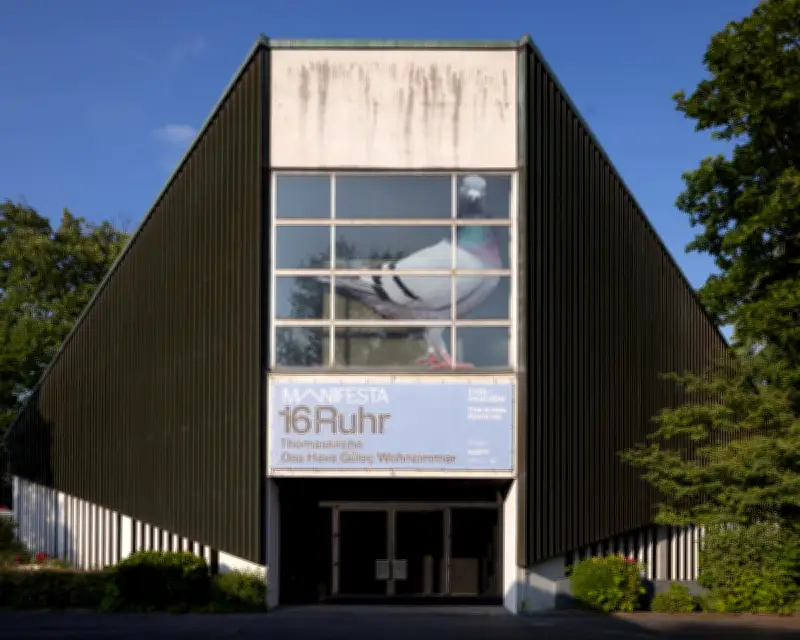
The most powerful projects are curated by Gürsoy Doğtaş, an art historian whose parents were Turkish guest workers. Two churches in Gelsenkirchen were renamed: St Bonifatius as the Ferdane Satır Tea Garden, after one of seven Turkish guest workers murdered in a 1984 arson attack; and Thomaskirche after Hava Güleç, a local factory worker. St Bonifatius (1963) has become an art museum of the guest worker experience. At Thomaskirche, a massive printed pigeon by Gülbin Ünlü overlooks Judith Raum's film about the Baghdad Railway, contrasting German industrialists' views of docile Ottoman workers with Turkish guest workers' struggles 70 years later. The church features public weaving workshops and art by workers like Abuzer Güler and Hanefi Yeter, whose 'When the Earth Burns' (1984) hangs in St Bonifatius.
Polish Migration and Community Projects
In Bochum's disused Gethsemane church, designed by Otto Bartning and built from rubble in 1947, Polish curator Krzysztof Kosciuczuk presents ironic works on migration. Outside, a bouncy castle shaped like a church bell by Marina Naprushkina reads 'We’ll Never Go Back!'
Basketball Court with a Twist
In Bochum's tiny St Ludgerus (1960s), Catalan artists Cabosanroque installed a basketball court where missing the net triggers a blast from the church organ. Visitors sit in pews watching local youth and biennale-goers try to miss goals, highlighting surrealism and incongruity.
Diversity as a New Consensus
Manifesta director Hedwig Fijen described the churches as places where architects and congregations tried 'to imagine a different kind of society' after 'years of war, genocide and destruction.' The micro-modernist slipper churches were based on a consensus no longer present. This montage of protest, whimsy, and spatial experiment suggests diversity might create equally extraordinary spaces if given money and time. Manifesta 16 Ruhr runs until 4 October.