A major new exhibition in Canada is challenging long-held Western perceptions of architecture in communist China, revealing a period of startling innovation, secretive industrial projects, and intense ideological debate over national style.
Beyond the Drab Facade: A Nation Building Its Identity
The exhibition, titled How Modern: Biographies of Architecture in China 1949–1979, is currently on display at the Canadian Centre for Architecture (CCA) in Montreal. It meticulously documents the three decades following the founding of the People's Republic, a period often dismissed as one of monotonous, state-produced buildings.
Curated by Shirley Surya of Hong Kong's M+ museum and Professor Li Hua from Southeast University, the show draws on a rich trove of official archives and privately held materials. Some items were smuggled out of China decades ago and are being shown publicly for the first time.

These artefacts paint a picture of a surprisingly dynamic era where architecture was a central instrument in socialist nation-building, shaping cities, industry, and collective identity. The story it tells also provides crucial context for President Xi Jinping's current crackdown on "weird buildings" and his push for a distinctly Chinese architectural style.
The 'Big Roof' Debate and Orwellian Design Shifts
The exhibition opens with the monumental project of Tiananmen Square and Mao's campaign for the Ten Great Buildings. This initiative, which included the Great Hall of the People and Beijing Railway Station, aimed to create a new aesthetic described as "socialist in content, national in form."
This often meant crowning modern structures with traditional Chinese overhanging tiled roofs, known as the "big roof." The scale and speed were staggering: over 1,000 architects participated, and the ten buildings were completed in under a year. By 1959, a Royal Institute of British Architects exhibition noted that a mind-boggling 350 million square metres of buildings had been erected in China in just ten years.
However, the party's design mandates were notoriously fickle. The career of architect Zhang Kaiji, featured in an oral history, illustrates this. His Sanlihe government office complex in Beijing, begun in 1952, was originally designed with the mandated big roofs. Yet, after a speech by Soviet leader Nikita Khrushchev criticising architectural waste, China's ministry suddenly denounced the style.
An editorial in the People's Daily attacked its "severe wastefulness." Consequently, the central block of Sanlihe was completed in 1955 without its elaborate roof, forever dubbed "the big roof that lost its hat." The new slogan became "Function, economy, and (when possible) beauty."
Secret Factories and Scarcity-Driven Innovation
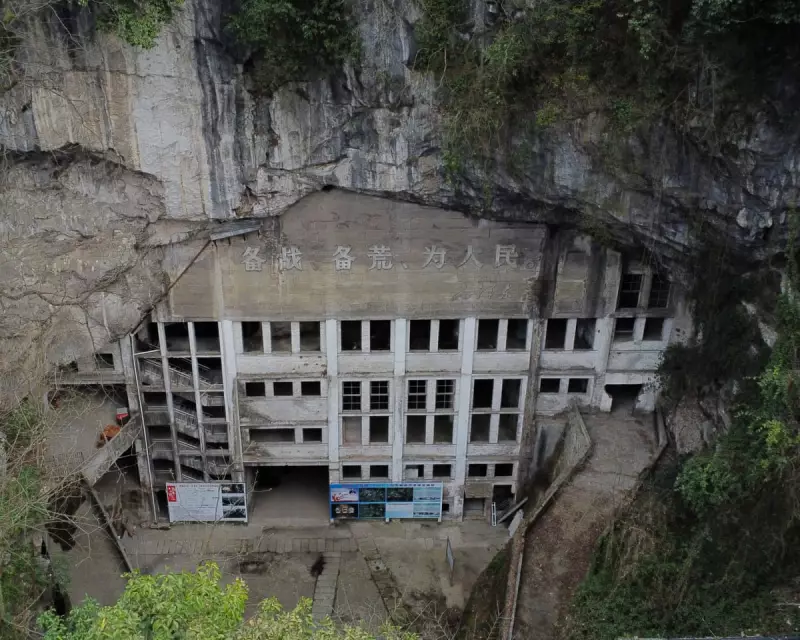
One of the exhibition's most captivating sections reveals the clandestine Third Front campaign of the 1960s and 70s. This was a secretive government effort to relocate critical industrial and military facilities to China's remote interior for strategic security.
Projects were ingeniously hidden. The Second Automobile Works in Hubei was dispersed across 27 different sites, each concealed in a valley. Most remarkably, Factory 544, which produced artillery fuses, was built inside a vast cave complex in Hunan—a setup described in the exhibition as worthy of Batman's comrade Bruce Wayne.
Widespread material shortages also spurred remarkable ingenuity. Architects experimented with industrial byproducts like soot, slag, and fly ash to create building blocks. Bamboo was used as a substitute for steel in long-span structures, notably in the bamboo hall at East China Normal University—a testament to a period of lean, low-carbon innovation born of necessity.
While the exhibition has been noted for somewhat glossing over the period's darker realities of famine and political violence, it undeniably unveils a complex and inventive chapter of architectural history. How Modern runs at the Canadian Centre for Architecture in Montreal until 5 April.