The architectural world mourns the passing of Frank Gehry, the visionary designer who died at the age of 96. Renowned for his crumpled, titanium-clad forms that defied gravity and logic, Gehry rose from a neighbourhood provocateur to a global 'starchitect', forever changing the skyline of cities from Bilbao to Los Angeles.
The Birth of a Starchitect: Bilbao and the 'Bilbao Effect'
Gehry's career reached its zenith with the completion of the Guggenheim Museum Bilbao in 1997. Confronting post-industrial decline, the Spanish city gambled on Gehry's radical vision. The result was a building of exhilarating complexity, sheathed in 33,000 wafer-thin titanium sheets that shimmered like fish scales. It became an instant global icon, attracting 1.3 million visitors in its first year alone.
This success catalysed the famed 'Bilbao Effect', a term coined for urban regeneration driven by iconic cultural architecture. The project propelled Gehry, then in his late 60s, into the rarefied 'starchitect' firmament, a label he publicly claimed to despise.

From LA Concert Halls to Global Spectacles
Building on this momentum, Gehry delivered the Walt Disney Concert Hall in Los Angeles in 2003. Conceived as a cluster of stainless steel volumes resembling billowing sails, its warm, timber-lined auditorium was praised for its intimacy. For Gehry, who moved to LA from Toronto at 17, it represented a crowning achievement in his lifelong dialogue with the city.
His method was as unique as his forms. He pioneered a process of creating handbuilt models, later digitised using aerospace software, allowing sculpture to become architecture. This technological liberation fuelled a global era of uninhibited, often preposterous, form-making throughout the 1990s and 2000s, with Gehry at the forefront.
Notable projects from this period include Prague's Dancing House ('Fred and Ginger') and Chicago's Jay Pritzker Pavilion. However, the pursuit of replicating Bilbao's magic led to mixed results. The Fondation Louis Vuitton in Paris (2014) was criticised by some as a bloated spectacle with shoddy workmanship, while Seattle's Experience Music Project proved a disappointment.
Humble Beginnings and Late-Career Contradictions
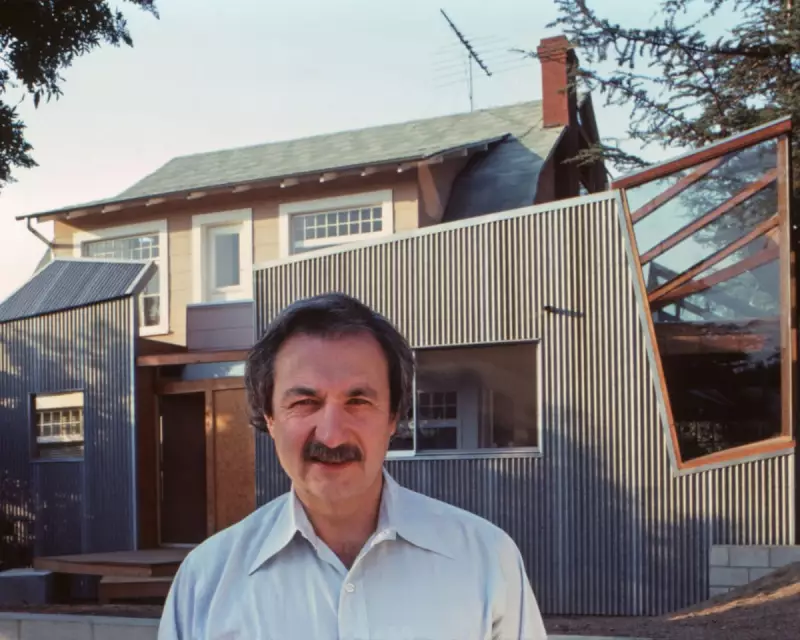
Gehry's journey to global fame began modestly and controversially with his own home. In 1977, he purchased a pink stucco house in Santa Monica, California, and proceeded to envelop it in corrugated metal and chain-link fencing, outraging his neighbours. This early work, imbued with a gritty, populist spirit, drew parallels with artists like Robert Rauschenberg.
Despite building extensively in Europe, the UK remained largely resistant to his aesthetic. His first British project was the surprisingly sober Maggie's Centre in Dundee (2003), modelled on a traditional Scottish cottage. Later, his involvement in luxury housing near London's Battersea Power Station felt formulaic to some critics.
In his later years, Gehry became a grand, occasionally irascible, figure. At a 2014 press conference in Spain, when accused of creating 'spectacle architecture', he silently flipped his middle finger at the audience. He later apologised, but remained fiercely critical of contemporary design, once declaring that "98% of what is built and designed today is pure crap".
Frank Gehry's legacy is a complex tapestry of breathtaking artistic innovation and commercial spectacle. He leaves behind a world of cities forever marked by his singular, uncompromising, and crumpled vision.