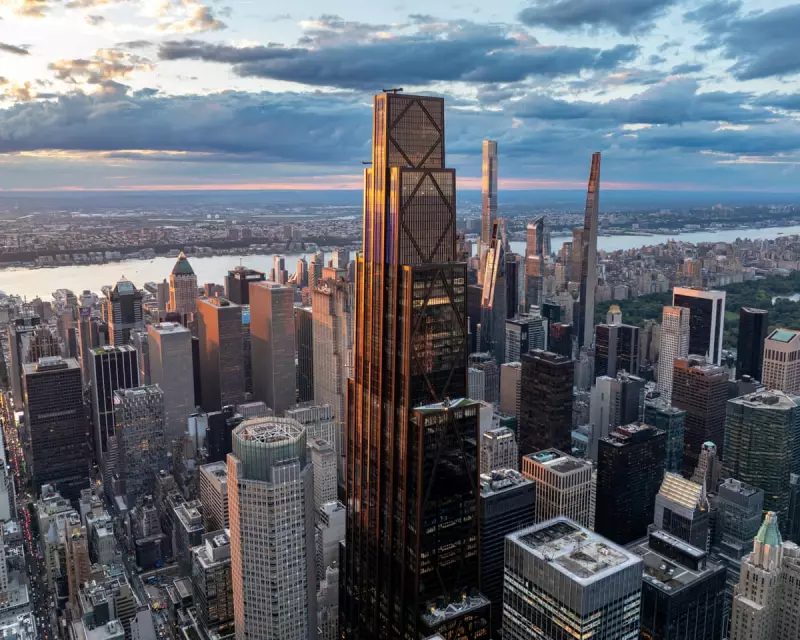
A monstrous new presence has muscled its way onto the iconic Manhattan skyline. The new global headquarters of JP Morgan Chase, the world's largest bank, is a 423-metre tall, bronzed behemoth that critics are labelling an "eco obscenity" and a "brawny bronzed bully." Designed by Foster+Partners, the tower's sheer bulk and extravagant use of materials mark a dramatic and controversial shift in corporate architecture.
A Fortress of Finance and Steel
The building, which cost an estimated $4 billion, is a physical manifestation of the bank's colossal financial power. With a market capitalisation of $855 billion, JP Morgan made over $1 billion a week in profit last year. Chairman Jamie Dimon's famous "fortress balance sheet" now has a literal fortress to match.
Architecturally, the tower is defined by excess. It contains a staggering 95,000 tonnes of structural steel – 60% more than the taller Empire State Building. One engineer calculated that this amount of steel, flattened, could wrap the entire world twice. The building rises in bulky, stepped sections, resembling several towers strapped together, casting a long shadow over slender neighbours like the Chrysler Building.

At street level, the building erupts with fans of exposed steel columns, described by some as clutching the base like "Nosferatu fingers." These columns splay out to avoid underground train tracks, holding the swollen mass above new privately owned public spaces. The effect is domineering, a sentiment echoed by an incongruous granite cliff-face artwork by Maya Lin on Madison Avenue.
Theatre, Control, and a Questionable Legacy
Inside, the scale remains overwhelming. A 24-metre-high lobby features walls of Italian travertine and a grand staircase flanked by Gerhard Richter paintings. In a surreal touch, a 12-metre-high US flag in the lobby flutters perpetually in an artificial indoor breeze, an artwork by Lord Foster himself intended to reflect external conditions.
The tower is a "city within a city" for its 10,000 employees, featuring a 19-restaurant food court, fitness centres, a medical clinic, and a pub. Office floors use circadian lighting to create a controlled environment, a strategy some compare to a Las Vegas casino, designed to keep workers at their desks. This aligns with Dimon's much-publicised drive to end hybrid working.
Perhaps the most galling aspect for critics is the building's origin story. To make way for this colossus, JP Morgan demolished the 52-storey Union Carbide building at 270 Park Avenue. Designed by Natalie de Bois of SOM and fully refurbished in 2012, it was hailed as a green renovation success. In 2019, it became the tallest building ever intentionally demolished, replaced by a structure almost twice the height but with only eight extra floors.
A New Breed of Supertall – Is London Next?
The tower's existence was enabled by a 2017 zoning change in East Midtown, aimed at competing with new developments like Hudson Yards. The rules allowed the sale of "air rights" from landmarked buildings. JP Morgan acquired 65,000 sq m of air rights from Grand Central Terminal and 5,000 sq m from St Bartholomew's Church, inflating its plot's potential.
Worryingly for urban planners, the JP Morgan tower is not an anomaly but a harbinger. Two more steroidal supertalls by Foster+Partners and SOM have been approved for nearby Park Avenue, promising to further crowd the skyline with bulky forms.
The implications for the UK, specifically London, are direct. Last week, JP Morgan announced plans for a 280,000 square metre European headquarters in Canary Wharf. This will be the largest office building in the capital, containing more space than the Shard, the Gherkin, and the Walkie-Talkie combined. The design, also by Foster+Partners, has only been glimpsed but hints at a bulging glass form wrapped in curved bronze fins. New York's brawny, bronzed bully may soon have a formidable sibling on the banks of the Thames.