A New Landmark for Houston's Ismaili Community
On a warm autumn day in southern Texas, monarch butterflies flutter through the gardens of Houston's newly inaugurated Ismaili Centre. These delicate yet resilient creatures, embarking on an epic migration to Mexico, serve as a fitting metaphor for the centre itself—a building that took seven years to construct and is designed to endure for over a century. This landmark provides a dedicated space for Houston's 40,000-strong Ismaili Muslim community, one of the largest in the United States, to practise their faith and engage in shared activities.
The Vision of Architect Farshid Moussavi
The creative force behind this tranquil and timeless structure is the acclaimed architect Farshid Moussavi. Renowned for her refusal to be confined to a single signature style, Moussavi's portfolio is remarkably diverse. It ranges from the florid, ornamental glass façade of the John Lewis store in Leicester to the laconic, austere brick box of the Zabludowicz Collection extension in London. For Moussavi, each project represents a fresh start. "Each project is different," she explains, "because it deals with different circumstances and a different set of possibilities."
While her previous American work, the Cleveland Museum of Contemporary Art, is a glittering black cuboid, the Ismaili Centre presents a stark contrast. Described by Moussavi as a "tapestry of stone," the building is an ensemble of spaces that subtly abstracts and refines the essence of Islamic architecture. It incorporates traces of Persian tradition, such as perforated stone screens and eivans—open-columned verandas designed to offer shade from Houston's intense heat. These elements encourage movement between the interior and exterior, enhancing the building's permeability and connection to its surroundings.

A Global Network and a Forward-Looking Design
As the seventh Ismaili Centre to open globally in the last four decades, the Houston site joins a network that spans from Dushanbe in Tajikistan to Vancouver, Canada. This reflects the widespread geographic and cultural plurality of the Ismaili diaspora. The Ismailis are a Shia Muslim sect with origins in the ninth century, now comprising approximately 12 million adherents in more than 70 countries, guided by a hereditary spiritual leader, or imam.
The centres are intended as places for spiritual reflection, cultural exchange, and public dialogue. Unlike the London Ismaili Centre, which opened in 1985 with a more direct appropriation of Islamic motifs, Moussavi's Houston iteration offers a nuanced, forward-looking approach. "The idea was not to resort to representational mimicry," Moussavi states. "Our project has been about using architectural instruments, such as geometry and the use of light, order, repetition and structure as ways to create certain kinds of spatial experiences. The aim is not to evoke nostalgia, but to look forward: a renewal rather than a reproduction."
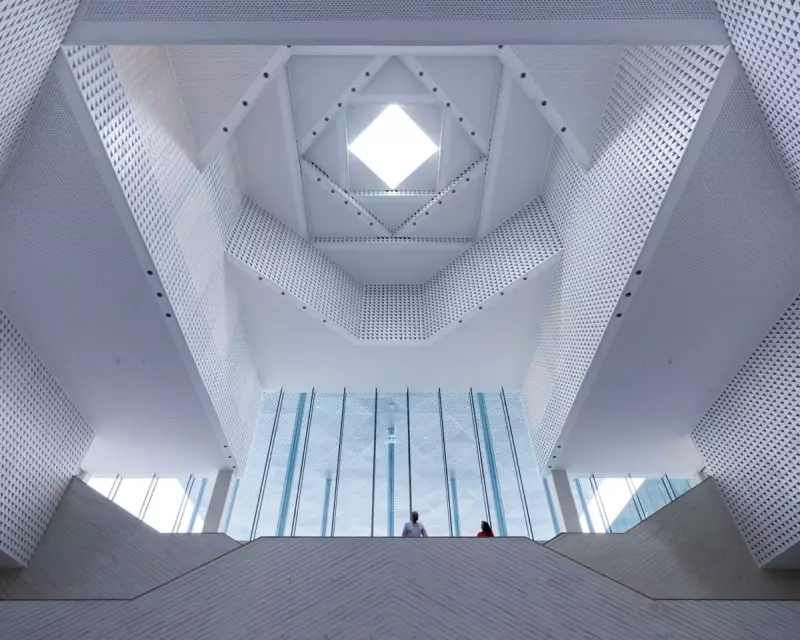
A unifying triangular grid is the central geometric motif, weaving its way throughout the five-storey building and its gardens. This pattern appears in screens, light fittings, floors, and furniture, creating a deep sense of order that Moussavi describes as generating "experiential serenity and simplicity."
Architectural Details and Spiritual Heart
The building's exterior is a non-structural stone screen, a delicate carapace made from small square pieces threaded together with steel rods. "It's as if you're weaving a carpet on a loom," Moussavi explains, resulting in something light and delicate despite its stone material. The screen's weave changes based on the function of the enclosed space, with triangular or scallop-shaped cut-outs that create dynamic shadow patterns inside.

At the centre of the building lies the jamatkhana, or prayer hall, a voluminous, column-free space that can accommodate 1,500 people. Its ceiling, made of two layers of gauzy aluminium lit from behind, shimmers and appears to dematerialise, contributing to a boundless spirit. The floor is covered with a patterned ivory carpet, a colour associated with the Persian city of Nain. Instead of a traditional ornate mihrab, the direction of worship is indicated by a simple, vertical band of light.
The colour blue, significant in Persian architecture, is used throughout in various shades, connecting the building to the Texan sky. The landscape, designed by Thomas Woltz, is an integral part of the project. It features exclusively native species laid out as a "transect of Texas," evolving from desert cacti to Gulf Coast flora, mirroring the adaptability of the Ismaili community.
Deeply rooted in its community, the centre saw many locals assist in its construction or donate materials. Now open, it will be largely staffed by volunteers. "It really is a community project in every sense of the word," says Moussavi. "We've provided the community with the hardware – the building itself – and now, I'm sure, the software, the people and activities, will bring it to life."