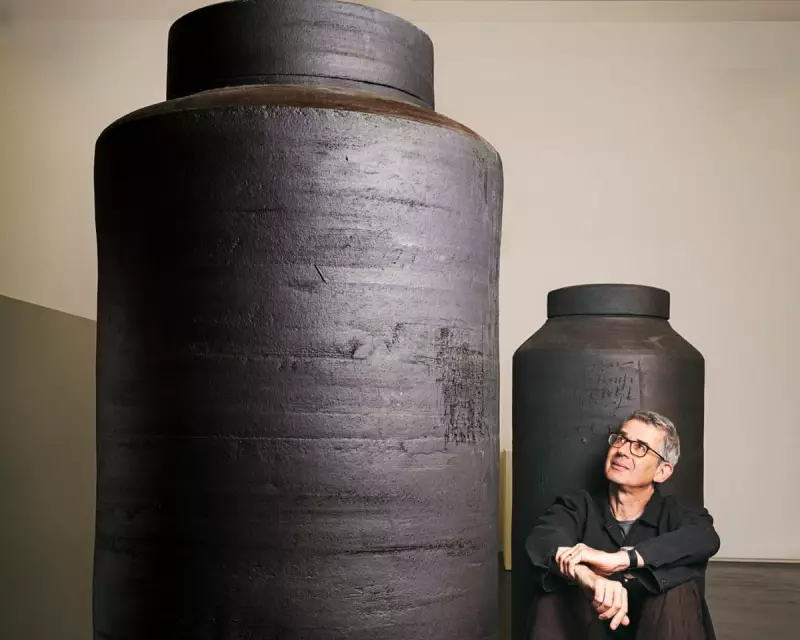
In the pristine white expanse of his London studio, potter and writer Edmund de Waal stands as a study in contrasts – a dark, neat silhouette against the blinding cleanliness required for working with porcelain. The former gun factory, now transformed into an architectural haven of calm, serves as the creative nucleus for one of Britain's most celebrated ceramic artists.
The Battle Against Dust and the Persistence of Clay
De Waal passionately defends the immaculate condition of his workspace, explaining that for potters, cleanliness isn't merely aesthetic but essential for survival. "It's porcelain," he emphasises. "Dust and dirt are the enemy." For centuries, potters have fought against contaminants that could cause works to explode in kilns or develop faults. The traditional threat of potter's lung – silicosis caused by clay dust – makes vigilance necessary.
This preoccupation with dust connects to deeper themes in de Waal's writing and thinking. He references WG Sebald's observation that "ash is a redeemed substance, like dust," and considers how ceramics paradoxically embody both fragility and extraordinary durability. "You can't destroy ceramics, you can only break them," he notes, highlighting how shards and fragments survive for millennia, outlasting their creators.

An Obsession Born from Disturbance
De Waal's current creative energy focuses on Danish artist Axel Salto (1889-1961), whose work he first encountered thirty years ago. "I thought, 'I have no idea what's going on here at all. This is like nothing I've seen,'" he recalls of his initial reaction to Salto's strange, bulbous stoneware vessels. The pieces, often sprouting tentacle-like protrusions or resembling knotted growths, struck him as deeply unsettling, sparking an obsession that has now culminated in "Playing with Fire: Edmund de Waal and Axel Salto" at The Hepworth Wakefield, running from 22 November to 4 May.
What fascinated de Waal particularly was Salto's writing about the demonic in ceramics, fear in pottery, and transformation. The Danish artist drew inspiration from Ovid's Metamorphoses, seeing ceramic creation as an ongoing process of change rather than a finished state. "When you look at ceramics, you're seeing the glaze as it melts," de Waal explains, capturing Salto's vision of perpetual movement within fired clay.
Ceramics as Human Storytelling
Beyond the Salto exhibition, de Waal sees pottery as fundamental to human experience. "Every culture has mythic beginnings in squeezing clay and making form," he observes, noting that despite technological advances, a potter from 1680 would still recognise the essential processes in his studio today.
Salto's creative range extended beyond ceramics to include textile design and printing stamps, with a particular focus on repetition – a concept familiar to any potter who throws similar shapes throughout their career. The Wakefield exhibition will feature an interactive area where children can experiment with printing stamps, reflecting de Waal's belief that "play makes you alive to the world in a material way." He adds pointedly: "Stripping play and craft from children's lives is just a disgrace."
Meanwhile, de Waal's work continues internationally with "The Eight Directions of the Wind" at The Huntington in Los Angeles (until 26 October), exploring porcelain as a migratory material. The installation includes Meissen plates damaged in the Dresden bombing and repaired using kintsugi, the Japanese technique that highlights rather than hides breaks, and a new poetry library featuring 200 poets who made America their home.
As de Waal moves between exhibitions, writing his next book drawing on family correspondence with Rainer Maria Rilke, and maintaining his obsessive memory of every pot he's ever created, his studio remains a hub of creative energy – a place where dust is banished but transformation is forever welcome.