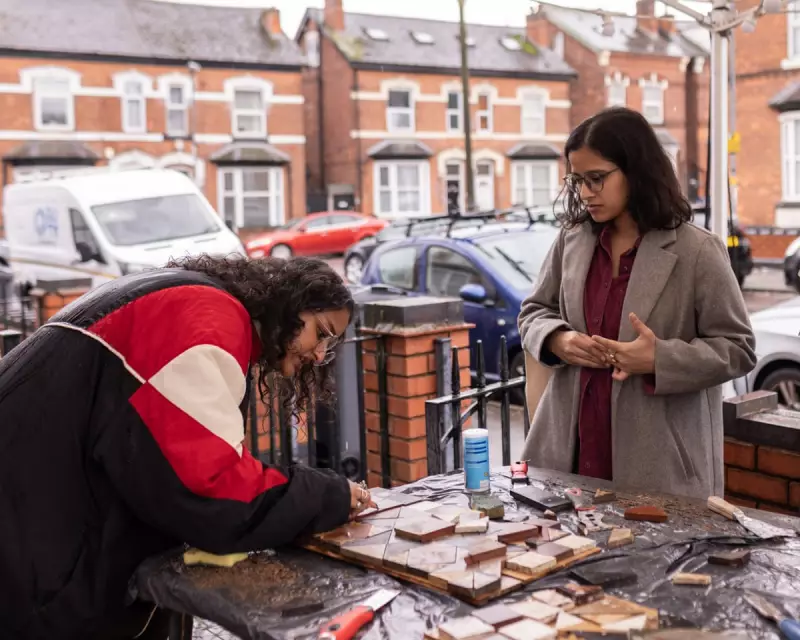
On an unassuming street in Ladywood, one of Birmingham's most deprived inner-city districts, a quiet revolution is taking place behind the door of a Victorian terrace. Number 33 Link Road, now known as Retrofit House, has been transformed into a vibrant community hub and living showcase for solving the UK's housing woes.
Purchased by the community group Civic Square, the property recently held an open week, inviting locals to explore a radical new approach to home improvement. The event featured a packed schedule of talks, DIY classes, and performances, with a timetable pinned by the front door guiding visitors to workshops on everything from biomaterials in the back bedroom to door repairs in the garden.
Beyond Net Zero: A Different Approach to Retrofit
The project represents a fundamental shift in how retrofit is communicated to communities. Immy Kaur, co-founder and director of Civic Square, explains the challenge: "A lot of people here think net zero is a waste of time, or they've lived through previous government-run home improvement schemes that were failures and don't want the disruption. When we started talking to the local community about retrofit we realised we had to go at it from a different angle."

Instead of leading with climate rhetoric, Retrofit House focuses on practical benefits that resonate immediately with residents: lowering crippling fuel bills, making homes more comfortable, and acquiring valuable DIY skills. Throughout the house, visitors can see retrofit solutions using ecological materials like lime, clay, and straw—breathable, nontoxic alternatives that improve energy efficiency and air quality while protecting against flooding and encouraging wildlife.
Filling the Void Left by Failed Government Schemes
The UK's housing stock remains among the least thermally efficient in Europe, yet government initiatives have consistently fallen short. Schemes with cheerful acronyms like the Home Upgrade Grant (HUG), Local Authority Delivery (LAD), and the Warm Homes Plan have failed to meet targets, often due to being overly prescriptive or difficult to navigate.
The consequences of poor implementation have been severe. The ECO4 scheme, for instance, became a national scandal after incompetent installation of cavity wall insulation led to widespread black mould problems in homes across the country.
Retrofit House offers an alternative model through Retrofit Reimagined, a growing national network connecting neighbourhood groups from Bristol, Cheltenham, and Wessex with organisations like design practice Material Cultures. The collaboration focuses on sharing skills and knowledge so residents can make informed decisions about retrofit solutions and either do the work themselves or find properly trained local builders.
Building Skills and Community, Not Just Better Houses
Summer Islam, a partner at Material Cultures, describes the project's broader vision: "As an architect, you're conditioned to be a professional consultant, but this project is beyond building performance. It is about quality of life, social value, environmental impact and what's important to a household."
The house serves as both showroom and training ground, where builders from the West Midlands gain hands-on experience working with natural materials and installing retrofits. "Looking at the work through social value," Islam continues, "it's not about how many people use the building but how much knowledge can you embed locally through turning everything into a learning opportunity. How many apprentices can you have? How many workshops can you run? And everyone is really hungry for that opportunity."
Currently funded by philanthropic organisations including the Joseph Rowntree Foundation, Civic Square operates on the mantra: "we may not have deep pockets but we have many hands." Kaur suggests that charities with large endowments are increasingly willing to support such initiatives as they seek to make positive social impacts.
The group remains open to future collaboration with local government but is cautious about engaging too soon. "Local government don't have capacity for this," Kaur notes wryly, "they've had enough of a problem sorting out the bins."

By establishing Retrofit House as a successful exemplar first, Civic Square hopes to demonstrate what's possible and encourage policymakers to be bolder in their approach to housing improvement—potentially shifting council procurement rules in the process.