The White House has launched an urgent mission to break America's dependence on Chinese rare-earth metals, with Treasury Secretary Scott Bessent recently showcasing what he called a landmark achievement in US manufacturing.
The First US Rare-Earth Magnet in 25 Years
Returning from South Carolina last week, Bessent brandished a small piece of metal that he proclaimed was the first rare-earth magnet manufactured in the United States in a quarter of a century. Speaking to Fox Business, he declared this development as crucial evidence that America is finally ending what he described as "China's chokehold on our supply chain".
The breakthrough comes from South Carolina company eVAC's new rare-earth mineral processing centre. Bessent emphasised that this development marks a significant step toward the nation becoming independent again in this critical sector.

China's Overwhelming Dominance
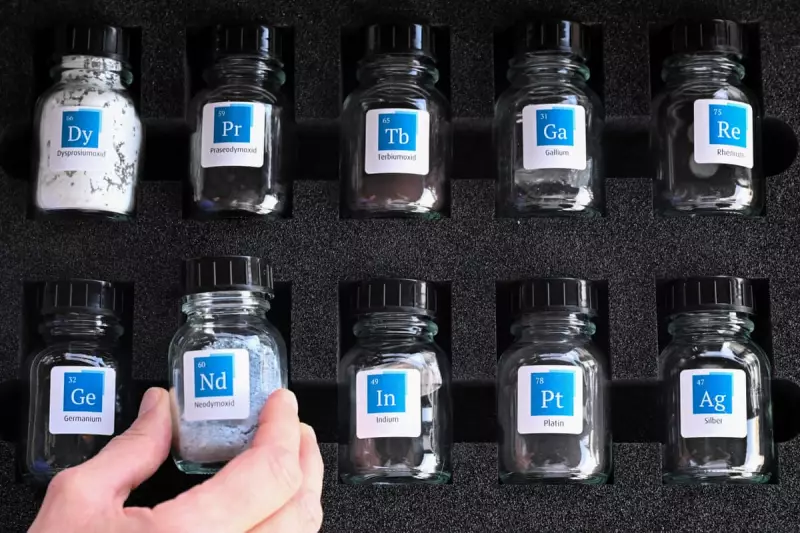
The challenge facing the United States is substantial. China currently controls approximately 70% of global rare-earth mining and commands over 90% of global processing capacity. For specific minerals like dysprosium, used in chip production, and samarium, essential for military applications, Chinese refinement dominance reaches an astonishing 99%.
Adam Webb, head of energy raw materials at Benchmark Mineral Intelligence, explained the critical nature of these materials: "These materials are used in electric motors for EV cars but also in guidance systems that have obvious applications for the defense department. Anything that has a decent magnet in it uses rare earths."
The US imported 80% of the rare earths it used in 2024, according to the US Geological Survey, highlighting the scale of American dependency.
Global Scramble for Alternatives
The Trump administration has responded with a multi-pronged strategy involving tariffs and international agreements. These tariffs prompted China to restrict rare-earth exports to the US, pushing Donald Trump to sign deals with Australia, Malaysia, Cambodia and Japan.
Although the US and China have since brokered a trade truce on rare earths, America faces a difficult race to catch up with China's substantial head start.
North America's measured and indicated resources of rare earths include 3.6 million tons in the US and more than 14 million tons in Canada - significantly less than the 44 million tons estimated in China.
Significant developments are underway domestically. In July, the Pentagon became the largest shareholder in MP Materials, the operator of the Mountain Pass mine in California, located about 60 miles from Las Vegas. The department plans to open a new "mine-to-magnet" plant, called 10X, to manufacture magnets crucial for F-35 fighter jets, drones and submarines.
Additional deposits are being explored in California, Wyoming and Missouri, while internationally, the administration has focused on Greenland, Brazil, and Ukraine, where Trump made a deal earlier this year.
Doug Burgum, the US Secretary of the Interior, highlighted the competitive challenge during a speech at the Hamm Institute for American Energy in April: "You're competing against state capital because China is picking these strategically as areas that they want to invest in." He suggested the US could utilise a sovereign wealth fund to speed production.
Despite Trump's optimistic assertion to reporters that "in about a year from now, we'll have so much critical mineral and rare earths that you won't know what to do with them," experts caution that achieving independence will take considerably longer.
Webb notes that while the US has taken significant steps, the nation cannot be "self-reliant in the short term because it takes time to bring a mine online and build refining capacity." The administration's efforts face historical challenges - previous US attempts to support domestic production floundered when China lowered prices, rendering unsupported rare-earth development uneconomic.

The race to secure these critical materials continues to accelerate, with the recent $500 million deal between Pakistan and American company US Strategic Metals for access to minerals such as antimony and copper representing just one part of a broader global strategy to counter Chinese dominance in this crucial sector.