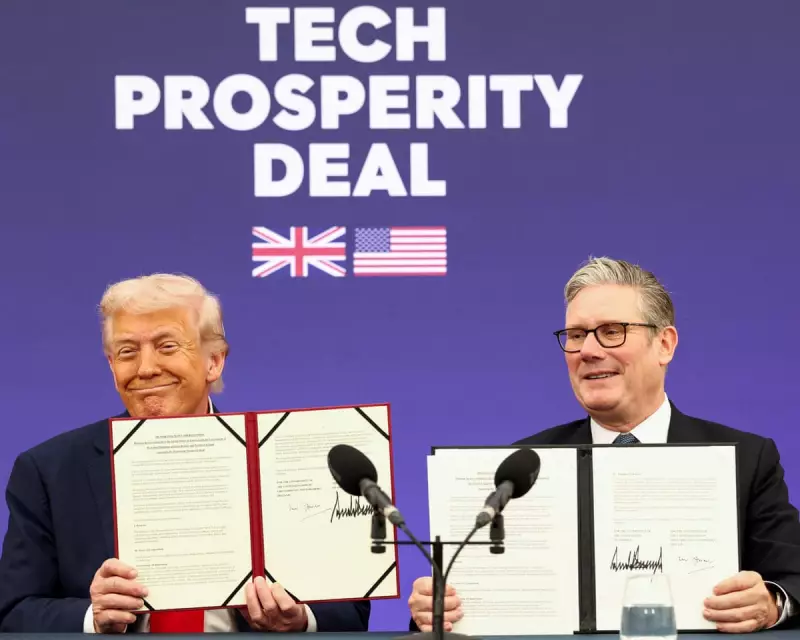
The UK government has insisted that a major $40bn technology partnership with the United States is not dead, despite negotiations being officially paused. This comes amid a simultaneous chilling of relations between the US and the European Union, with the Trump administration threatening economic penalties against European tech firms.
"Active Conversations" Continue on Stalled Tech Pact
Downing Street has pushed back against reports that the Tech Prosperity Deal is permanently stalled. A spokesperson for Prime Minister Keir Starmer's office told the BBC that the UK remains in "active conversations with US counterparts at all levels of government" regarding the wide-ranging agreement.
The deal, previously heralded as historic, aims to foster cooperation between the technology industries of both nations. However, it was put on hold after the US accused the UK of failing to lower key trade barriers. These points of contention include the UK's digital services tax on American tech giants and certain food safety rules that limit agricultural exports.

The New York Times first reported the British confirmation that the negotiations had hit a roadblock. Both the White House and 10 Downing Street did not provide immediate comment on the latest developments.
Trump Administration Threatens EU with Retaliatory Measures
The uncertainty surrounding the UK-US deal unfolded on the same day that the Trump administration issued a stark warning to the European Union. The Office of the US Trade Representative threatened European tech companies with economic penalties if the EU refuses to roll back what it termed "discriminatory actions."
In a post on the social media platform X, the US trade office accused the EU and some member states of "discriminatory and harassing lawsuits, taxes, fines and directives against U.S. services." It named companies like Accenture, DHL, Spotify, and Siemens, which it said had operated freely in the US market for decades.
"If the E.U. and E.U. Member States insist on continuing to restrict, limit, and deter the competitiveness of U.S. service providers through discriminatory means, the United States will have no choice but to begin using every tool at its disposal to counter these unreasonable measures," the statement read.
A Broader Transatlantic Tech Tension
The US retaliation follows recent regulatory action by the EU against major tech platforms. Most notably, Elon Musk's X platform was hit with a $140m fine for breaches of the Digital Services Act, including issues related to its 'blue checkmark' system and ad transparency.
A spokesperson for the European Commission, Thomas Regnier, responded to the US threats by stating that EU rules "apply equally and fairly to all companies" operating within the bloc. "We will continue to enforce our rules fairly, and without discrimination," he told the New York Times.
This episode underscores a significant divergence in regulatory philosophy. The European Union has demonstrated a far greater willingness than the US to regulate, investigate, and penalise large technology companies—a stance that has become a major point of contention with the current American administration.
The future of the UK-US Tech Prosperity Deal now appears intricately linked to these wider geopolitical and trade tensions, leaving a key pillar of Keir Starmer's economic strategy in a state of delicate suspension.