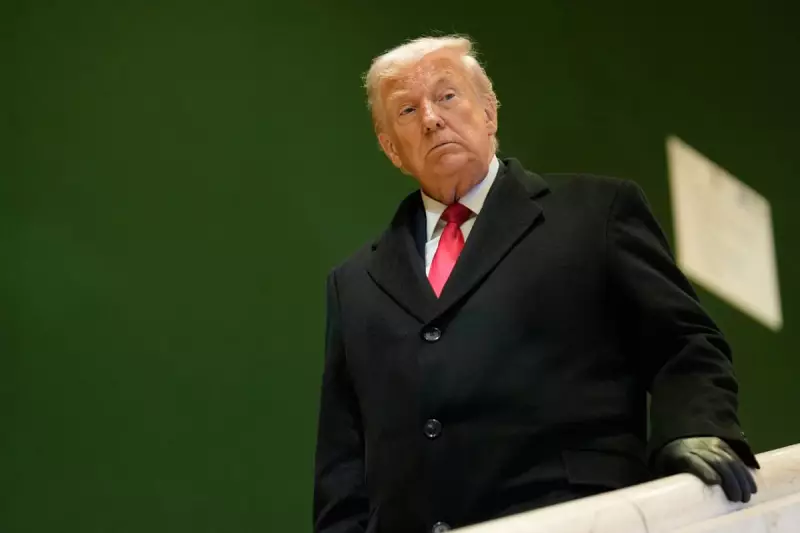
In a significant policy reversal, US President Donald Trump has withdrawn his threat to impose sweeping tariffs on eight European nations, claiming progress towards a "framework" agreement concerning Greenland. The announcement came after what Trump described as a "very productive" meeting with NATO Secretary General Mark Rutte on Wednesday.
Retreat from Aggressive Trade Stance
Just four days after vowing to introduce steep import duties on Denmark, Norway, Sweden, France, Germany, the United Kingdom, the Netherlands and Finland, the president backed down from his confrontational position. Trump had initially threatened to implement 10% tariffs from 1 February, with potential escalation to 25% from 1 June, in response to these countries' support for Greenland's continued status as an autonomous Danish territory.
The president announced his decision on his Truth Social platform, stating: "Based upon this understanding, I will not be imposing the Tariffs that were scheduled to go into effect on February 1st." However, he provided no specific details about the supposed "framework of a future deal" he claimed to have established regarding Greenland.

European Response and Market Reactions
The original tariff threat had prompted strong reactions across Europe, with senior politicians declaring they "will not allow ourselves to be blackmailed" and economists warning of potential economic consequences. European Union leaders had threatened to deploy the bloc's anti-coercion instrument, known colloquially as the "trade bazooka," which would have allowed extraordinary retaliatory trade sanctions.
Financial markets responded positively to the withdrawal of tariff threats. Following Trump's announcement, global markets recovered from earlier losses, with the benchmark S&P 500 rising 1.2% in New York trading. The Dow Jones industrial average climbed 1.2% to 49,080.22, approaching the significant 50,000 milestone for the first time.
Contradictory Statements and Historical Context
Trump's reversal appears particularly contradictory given his statements earlier the same day at the World Economic Forum in Davos, Switzerland, where he extolled the benefits of US tariffs. Addressing assembled delegates, he declared: "You're all party to them – in some cases, victims to them. But in the end, it's a fair thing, and most of you realize that."
This pattern of making extreme tariff threats followed by retreats has become characteristic of Trump's trade policy. Most notably last spring, he hailed the beginning of a new economic era for the United States, only to subsequently shelve a substantial wave of planned tariffs.
Greenland Obsession and National Security Claims
Trump's recent preoccupation with Greenland has unsettled international officials in recent weeks, following the US intervention in Venezuela. The president has advanced controversial claims that Denmark owes Greenland to the United States because of American defence of the territory during the Second World War – assertions that historians have thoroughly debunked.
In his Davos speech, Trump insisted the US would not use military force to acquire Greenland but demanded "immediate negotiations," stating: "We want a piece of ice for world protection, and they won't give it. We've never asked for anything else." He has repeatedly framed the potential acquisition as essential for national security purposes.
Domestic Economic Concerns
Concern about Trump's aggressive trade strategy extends beyond international relations to domestic economic stability. His tariff policies have repeatedly raised fears about potential impacts on the US economy. Wall Street experienced its worst trading day since October on Tuesday, immediately following Trump's initial threat to impose tariffs over the Greenland issue.
The president, who pays close attention to stock market movements, acknowledged the recent dip in his Wednesday speech, attributing it to "Iceland" – apparently meaning his pursuit of Greenland. He simultaneously claimed credit for the series of record highs achieved since his return to office while recognising the market volatility caused by his trade policy announcements.

This latest episode demonstrates the continuing volatility of US trade policy under the Trump administration and its significant impact on both international relations and global financial markets.