Trump Issues Stark Warning to Canada Over China Trade Relations
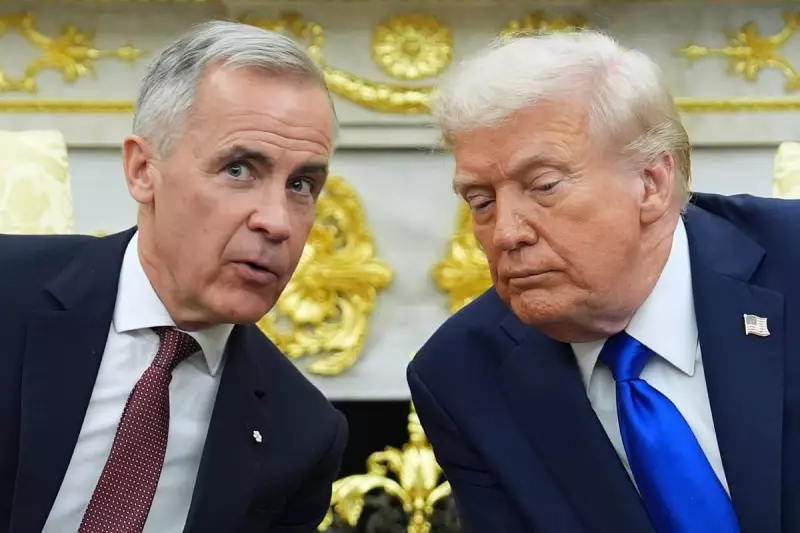
In a significant escalation of trade tensions, former US President Donald Trump has threatened to impose a 100% tariff on all Canadian imports if the North American nation proceeds with a trade agreement with China. The warning came via Trump's Truth Social platform on Saturday, directly targeting Canadian Prime Minister Mark Carney's administration.
Trade Ultimatum Delivered Through Social Media
Trump's message contained particularly strong language regarding the potential consequences of Canada pursuing closer economic ties with China. The former president asserted that "China will eat Canada alive, completely devour it, including the destruction of their businesses, social fabric, and general way of life." He specifically warned that if Canada becomes what he called a "Drop Off Port" for Chinese goods destined for the United States, immediate punitive measures would follow.
"If Canada makes a deal with China, it will immediately be hit with a 100% Tariff against all Canadian goods and products coming into the United States," Trump declared in his characteristically direct style. This represents one of the most severe trade threats issued between the two traditionally close allies in recent memory.

Parallel Announcement Regarding Venezuelan Oil Seizures
Simultaneously, Trump revealed details about his administration's ongoing campaign to control Venezuela's oil resources. In an interview with the New York Post published on Saturday, the former president confirmed that US refineries are processing oil seized from Venezuelan tankers. "Let's put it this way – they don't have any oil. We take the oil," Trump stated bluntly when questioned about the situation.
The oil is reportedly being refined in "various places" including Houston, according to Trump's comments. This development follows a month-long campaign during which the US military has seized seven Venezuela-linked tankers, with Trump claiming on Tuesday that his administration had taken 50 million barrels of oil out of Venezuela, selling some on the open market.
Background of Venezuelan Intervention
Trump's Latin American foreign policy has increasingly focused on Venezuela, initially aiming to remove President Nicolás Maduro from power. After diplomatic efforts failed to achieve this objective, Trump ordered US forces to conduct an overnight raid on 3 January, resulting in Maduro and his wife being brought to New York to face criminal drug-related charges.
In his Saturday interview, Trump boasted about a new weapon called "the discombobulator" that played a central role in the raid. These remarks followed White House press secretary Karoline Leavitt sharing a purported eyewitness account describing the US military using "very intense sound waves" to incapacitate Maduro's bodyguards.
Broader Implications and Reactions
The dual announcements have raised significant concerns among international observers and trading partners. Trump has historically used tariff threats as leverage in foreign policy negotiations, with mixed results – sometimes achieving concessions but frequently backing down from his most extreme positions.
The intercepted Venezuelan vessels were either under US sanctions or part of what authorities describe as a "shadow fleet" of ships that disguise their origins to move oil from sanctioned producers including Iran, Russia, and Venezuela. Trump has indicated plans to control Venezuela's oil resources indefinitely through a $100 billion plan to rebuild the country's dilapidated oil industry, a proposal that has drawn skepticism from environmental groups and major oil companies alike.
These developments represent significant shifts in US foreign policy under Trump's leadership, with potential ramifications for global trade relationships and energy markets. The stark warning to Canada particularly underscores the administration's aggressive approach to trade negotiations and its determination to prevent what it perceives as economic threats through third-party arrangements.