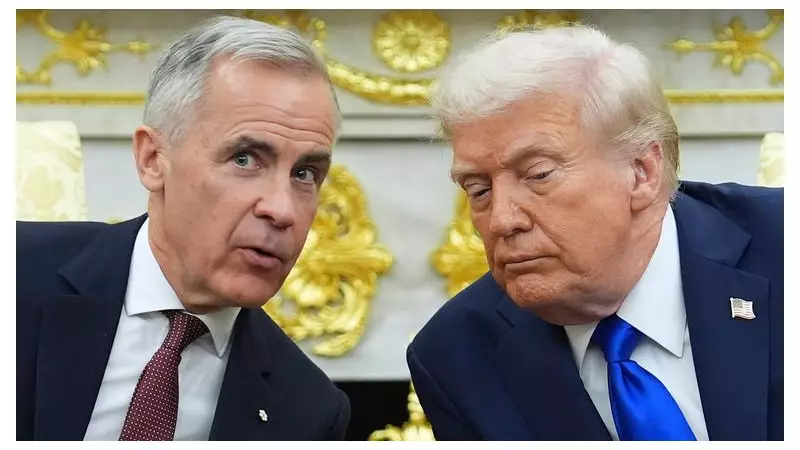
In a dramatic escalation of trade tensions, former US President Donald Trump has issued a stark warning to Canada, threatening to impose a 100% tariff on all goods imported from the country. This move comes in direct response to Canada's proposed trade agreement with China, which has sparked fierce criticism from the American leader.
Trump's Social Media Ultimatum
Taking to his Truth Social platform on Saturday 24th January 2026, Trump delivered a blistering message aimed directly at Canadian Prime Minister Mark Carney. "If Canada makes a deal with China, it will immediately be hit with a 100% Tariff against all Canadian goods and products coming into the USA," declared the former president in his characteristically confrontational style.
The proposed Canada-China agreement, negotiated earlier this month, would see reduced tariffs on Chinese electric vehicles in exchange for lower import taxes on Canadian agricultural products. While Trump initially appeared supportive of the deal, his position has dramatically hardened.

"China Will Eat Canada Alive"
In his social media post, Trump employed characteristically vivid language to express his concerns about the potential consequences of the Canada-China agreement. "China will eat Canada alive, completely devour it, including the destruction of their businesses, social fabric, and general way of life," he warned.
The former president specifically objected to what he perceived as Canada potentially becoming a "Drop Off Port" for Chinese goods destined for the United States market. "If Mr Carney thinks he is going to make Canada a 'Drop Off Port' for China to send goods and products into the United States, he is sorely mistaken," Trump stated unequivocally.
Deteriorating Diplomatic Relations
The tariff threat represents the latest development in what appears to be a rapidly deteriorating relationship between Trump and the Canadian leadership. Notably, Trump referred to Prime Minister Carney as "Governor Carney" in his post, continuing a pattern of unconventional naming that he previously employed with Carney's predecessor, Justin Trudeau.
This diplomatic friction occurs against a backdrop of existing trade tensions. Carney has yet to reach an agreement with Trump to reduce tariffs already imposed on key sectors of the Canadian economy. However, Canada has thus far been somewhat protected from the full impact of these measures by the Canada-US-Mexico Agreement, which is scheduled for review this year.
Davos Divergence
The tariff announcement came amid an escalating war of words between the two leaders, with tensions further inflamed by Trump's renewed push to acquire Greenland, a move that has strained NATO alliance relationships.
Speaking at the World Economic Forum in Davos, Switzerland earlier this week, Prime Minister Carney called for a new international alliance to counter what he described as American and Chinese belligerence. The former Bank of England governor suggested that Canada could serve as an example demonstrating that nations need not bend toward autocratic tendencies.
Trump, addressing the same forum, offered a contrasting perspective, asserting that "Canada lives because of the United States." Following these divergent statements, the former president revoked his invitation for Carney to join his proposed "Board of Peace," an initiative originally conceived to address the Gaza conflict but now envisioned as tackling broader global disputes.
Cartographic Controversy
Earlier in the week, Trump further inflamed tensions by posting an altered map on social media that depicted Canada, Venezuela, Greenland, and Cuba as part of United States territory. This provocative imagery, combined with the tariff threat and diplomatic friction, suggests a significant deterioration in US-Canada relations under the current political climate.
The situation remains fluid, with Canadian officials yet to issue a formal response to Trump's latest tariff threat. As trade negotiations continue and diplomatic relations face increasing strain, the economic relationship between these North American neighbours appears to be entering a particularly challenging phase.