The Dawn of a New Geopolitical Era: EU-India Trade Pact Finalised
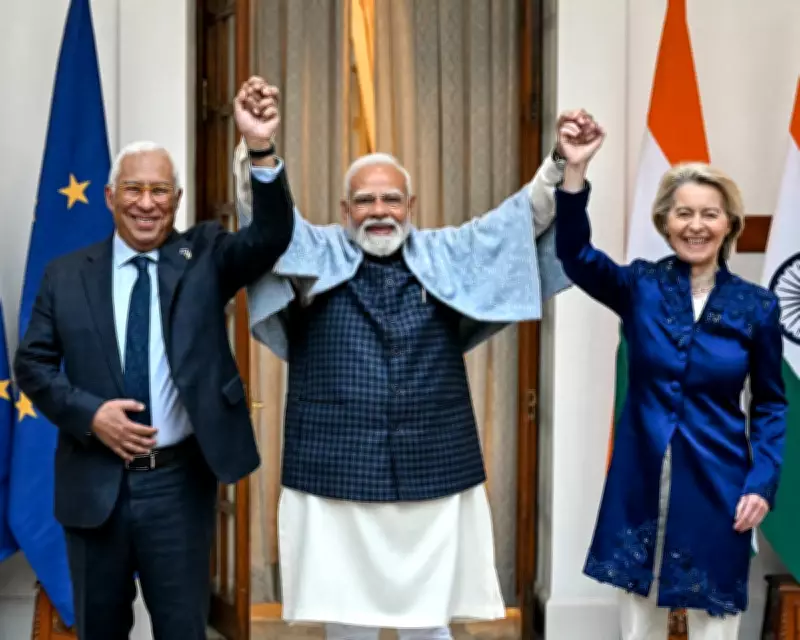
In a historic moment captured in New Delhi on 27 January 2026, European Council President António Costa, Indian Prime Minister Narendra Modi, and European Commission President Ursula von der Leyen announced what has been termed the 'mother of all deals'. This monumental agreement, emerging from nearly two decades of intermittent negotiations, promises to unite approximately 2 billion consumers and account for a quarter of global GDP.
A Journey Two Decades in the Making
The origins of this partnership trace back to 2007, a year marked by the launch of the first iPhone, the simmering sub-prime mortgage crisis, EU expansion, and India's ascent to a trillion-dollar economy. Initial trade talks between Delhi and Brussels commenced then but faced repeated hurdles over contentious issues including automobiles, alcohol, agriculture, and dairy products, leading to an abandonment in 2013.
Negotiations resumed in 2022 as the post-pandemic global economy sought to de-risk and diversify supply chains away from China. However, the final impetus for completion came not from Asian dynamics but from transatlantic pressures. The agreement was sealed after several months of unusually accelerated talks, culminating in this week's signing ceremony.

Trump's Tariffs and the Acceleration of Strategic Autonomy
The sudden breakthrough after years of stagnation is inextricably linked to the policies of Donald Trump. His administration's revival of territorial claims over Greenland in December 2024, even before his second inauguration, sent shockwaves through Europe, fostering a sense of isolation amid strained transatlantic relations.
Further chaos ensued with Trump's first-day imposition of punishing tariffs on Canada and Mexico, which expanded into global 'liberation day' taxes affecting 90 nations. India faced a steep 50% tariff rate, including an additional 25% levy due to its purchase of discounted Russian oil. Recent tariffs targeting the EU and UK over NATO troop deployments to Greenland have cemented a perception, reflected in public opinion surveys, of the US as not merely unreliable but an outright threat.
Consequently, de-risking and decoupling have regained prominence in European strategy, with the focus shifting from China to Trump's America. This is not merely about supply chains but also about building strategic resilience against coercion, exemplified by France's ban on US video-conferencing software like Zoom in favour of domestic alternatives.
The Scope and Significance of the Agreement
The EU-India comprehensive strategic agenda extends far beyond trade, encompassing defence and security, commitments to multilateralism, mobility, and cooperation across various sectors. The trade component opens segments of India's traditionally protectionist market to European manufacturing and services exports, while Indian consumers gain access to more affordable European cars and wine.
This partnership indicates a growing convergence on multilateral institutions and enhanced engagement in the Indo-Pacific region. As the US retreats to the western hemisphere under the so-called Donroe doctrine, the Indo-Pacific, once a focal point of US strategy in Asia, is becoming increasingly accessible to EU collaboration.
A Broader Trend Towards Multipolarity
This deal is the largest of its kind but part of a wider pattern of nations forging new alliances. Brussels recently concluded a trade agreement with the South American Mercosur bloc, with others in development. India has secured pacts with the UK and New Zealand in recent months alone.
While ratification and implementation may encounter delays, as seen with the EU-Mercosur deal, the direction is clear. The world many outside the West have envisioned—characterised by multipolarity, strategic autonomy, and even de-dollarisation—is materialising, initially gradual but now accelerating.
The day preceding the summit, EU leaders were honoured guests at India's Republic Day celebrations, witnessing military parades and cultural displays. The imagery projected optimism and camaraderie, a stark contrast to the prevailing gloom in Europe. As America prioritises itself, it risks isolation, while the global order evolves unmistakably.