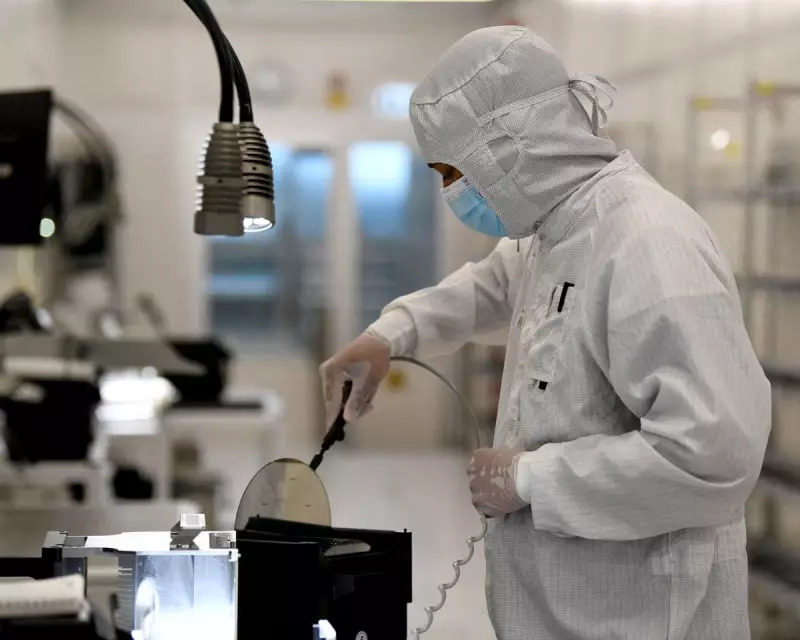
China has agreed to restart shipments of crucial Nexperia semiconductor chips to the European Union, but in a move that highlights growing trade tensions, the resumption will last for just twelve months. The temporary agreement comes after a near-crisis in European automotive manufacturing when China initially restricted exports.
The Chip Crisis That Brought Europe to Brink
The situation reached critical levels in late September when the Dutch government made the dramatic decision to take over Nexperia, a Chinese-owned chip manufacturing facility. This intervention almost paralysed the entire European car industry, demonstrating the continent's vulnerability to supply chain disruptions.
Tensions between Brussels and Beijing appeared to ease over the recent weekend as Chinese authorities confirmed they would relax restrictions on automotive chip exports to EU nations. The announcement brought immediate relief to car factories across Europe and beyond, though the respite may prove temporary.

According to Andrew Small, a senior fellow at the German Marshall Fund and former China adviser within the European Commission, Europe faces "rolling crises" in its relationship with China. "We can buy a bit of time, but there is a sense that we are entering into a situation where we are going to be dealing with rolling crises from now on," he warned.
Strategic Dependencies and Trade Weaponisation
The chip supply agreement contains significant limitations that maintain China's leverage over European industry. The resumed exports will only cover civilian applications and extend for a single year, leaving the door open for Beijing to disrupt supplies again should it wish to interfere with the EU's reviving defence sector or apply pressure to the automotive industry.
"China is repeatedly now taking steps that does not actually stop industries from functioning but just chokes supplies," Small explained. "If this kind of stranglehold persists, it just puts Europe under a constant sword of Damocles."
The Nexperia situation represents just one facet of a much broader trade imbalance between the EU and China. The trade deficit currently stands at approximately €300 billion in China's favour, with recent EU tariff measures, including last year's electric vehicle levies, proving insufficient to stem the flow of Chinese imports.
Rare Earths and Manufacturing Vulnerabilities
Beyond semiconductors, Europe faces critical dependencies in other strategic materials. In April, Chinese export controls on essential materials caused significant slowdowns in automotive manufacturing. One German politician revealed earlier this year that a major manufacturer had approximately 100,000 completed vehicles awaiting window magnets before they could be shipped.
By June, the situation had escalated to what industry insiders described as "full panic" as manufacturers scrambled to source essential magnets. More recently, disturbing reports emerged that German companies, which import 95% of their rare earths from China, were being compelled to provide detailed confidential business information to Chinese authorities - data not even shared with the German government - to secure essential supplies.
Jens Eskelund, chair of the European Chamber of Commerce in China, highlighted that while consumer goods like plastic garden chairs or Christmas decorations from platforms like Shein don't pose strategic concerns, the real threat lies in China's growing dominance in clean technology sectors including automotive, solar, and wind industries.
"Europe is still a leader, or maybe last year was a leader within the production of wind turbines," Eskelund noted, "but if something does not happen, Europe will not be producing wind turbines five years from now."
EU Response and Future Challenges
The European Union has officially pursued a policy of "de-risking" rather than "decoupling" from China, as outlined by European Commission President Ursula von der Leyen in March 2023. However, critics argue that the bloc has been slow to address fundamental imbalances in the relationship.

Noah Barkin, an adviser to the China-watching thinktank Rhodium Group, suggested that "the Nexperia and rare-earths crises could and should jolt Europe out of its de-risking stupor." He particularly criticised the "inertia" in Berlin regarding rebalancing the relationship with China.
Barkin warned of a likely scenario where "China gives US firms preferential access to rare earths to pacify Trump while keeping the Europeans on a tightly controlled drip-feed."
EU officials express frustration that while they continuously examine trade defence mechanisms - including last week's anti-subsidy investigation into Chinese tyres - member states aren't sufficiently supporting their industries in diversifying supply chains.
There are indications that Brussels and Paris are preparing for a more assertive stance. Last month, von der Leyen cautioned that the EU stood "ready to use all of the instruments in our toolbox to respond if needed," a veiled reference to the never-used Anti-Coercion Instrument (ACI) passed in 2023.
French President Emmanuel Macron, who previously advocated using the ACI against the United States, is now openly pushing for its deployment against China if necessary. "This is economic coercion. We need to act," he declared following October's EU summit.
However, Germany remains unlikely to support such aggressive measures. Joachim Taiber, an advanced research fellow and automotive industry expert at Imperial College, highlighted the practical challenges, noting that BMW alone sells nearly 800,000 vehicles annually in China.
"You could completely decouple, emulate the US and say we are not going to use any Chinese components," Taiber explained, "but that is the alternative extreme and unworkable. It would have a disastrous impact on the economy."
The scale of Europe's dependency becomes starkly apparent when considering rare earth minerals. The EU currently operates no rare-earth mines, while US Treasury Secretary Scott Bessent recently stated that America is approximately "two years" away from establishing its own supplies, with companies like General Motors already partnering with mining operations.
Nigel Stewart, director of the Centre for Sectoral Economic Performance at Imperial College London, emphasised that China controls 96% of global magnet supply. He estimated it could take Europe a decade to replicate what Xi Jinping has achieved - controlling the entire supply chain from mine to assembly line.