Carney Denies Pursuing Free Trade with China as Trump Issues Tariff Warning
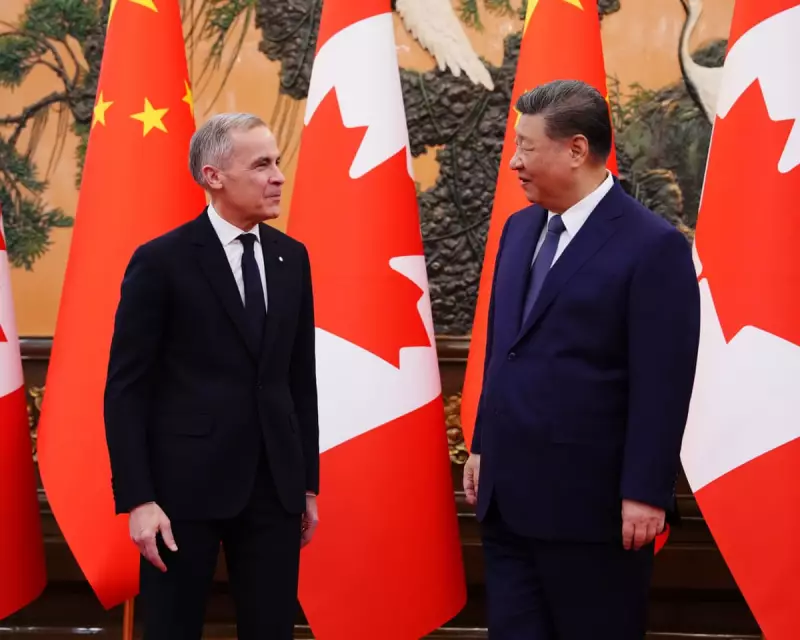
In a significant diplomatic development, Canada's Prime Minister Mark Carney has firmly stated that his country has no intention of pursuing a free trade agreement with China. This declaration came during a meeting with Chinese President Xi Jinping at the Great Hall of the People in Beijing on 16 January 2026, and was made in direct response to threats from former US President Donald Trump.
Clarifying the Recent China Agreement
Carney emphasised that the recent agreement with China is merely a targeted tariff reduction on specific sectors that had previously faced increased duties. He explained that under the existing free trade agreement with the United States and Mexico, there are binding commitments not to pursue free trade deals with non-market economies without prior notification.
"We have no intention of doing that with China or any other non-market economy," Carney asserted. "What we have done with China is to rectify some issues that developed in the last couple of years."

Trump's Aggressive Tariff Threat
The Canadian leader's comments came as Donald Trump threatened to impose 100% tariffs on all goods imported from Canada if the country proceeded with a comprehensive trade deal with Beijing. Trump made this threat through a social media post, warning that Canada must not become a "Drop Off Port" for Chinese goods entering the United States.
US Treasury Secretary Scott Bessent reinforced this position on ABC's This Week programme, stating: "We can't let Canada become an opening that the Chinese pour their cheap goods into the US." Bessent questioned Carney's motivations, suggesting the prime minister might be "virtue-signalling to his globalist friends at Davos."
Details of the Canada-China Tariff Agreement
The recent agreement between Canada and China involves several key components:
- Canada has reduced its 100% tariff on Chinese electric vehicles to 6.1%
- An initial annual cap of 49,000 Chinese EV exports to Canada has been established
- This cap is expected to grow to approximately 70,000 vehicles over five years
- In exchange, China is expected to begin investing in Canada's automotive industry within three years
Carney noted that the initial cap represents about 3% of the 1.8 million vehicles sold annually in Canada, and that no such restrictions existed before 2024.
Broader Geopolitical Context
This trade dispute occurs against a backdrop of escalating tensions between Carney and Trump. The Canadian prime minister has emerged as a leading voice among middle powers seeking to counterbalance US influence under Trump's leadership.
Speaking at the World Economic Forum in Davos, Carney warned about coercion by great powers without specifically naming Trump, stating: "Middle powers must act together because if you are not at the table, you are on the menu." His remarks received widespread international attention and praise, effectively upstaging Trump at the global economic gathering.
The situation has been further complicated by Trump's repeated challenges to Canadian sovereignty, including suggestions that Canada should be absorbed into the United States as a 51st state. Trump recently posted an altered map on social media showing Canada, Venezuela, Greenland and Cuba as part of US territory.
Recent Trade History Between Canada and China
The current agreement follows a period of trade tensions between the two nations:
- In 2024, Canada mirrored US policy by imposing a 100% tariff on Chinese electric vehicles
- Simultaneously, Canada implemented a 25% tariff on Chinese steel and aluminium
- China responded with 100% import taxes on Canadian canola oil and meal
- Additional Chinese tariffs of 25% were placed on Canadian pork and seafood
The recent agreement represents a mutual effort to de-escalate these specific trade disputes while maintaining broader strategic independence.