Financial markets on both sides of the Atlantic experienced significant turbulence on Tuesday, with Wall Street recording its most severe single-day drop since October. The sell-off was triggered by renewed economic uncertainty following former President Donald Trump's threats to impose tariffs on eight European countries.
Market Reaction to Trade Threats
US stocks faced substantial pressure during their first trading session since Trump's tariff announcement, coming after markets were closed on Monday for the Martin Luther King Jr. Day public holiday. The benchmark S&P 500 index closed down 2.1%, while the Dow Jones Industrial Average finished 1.8% lower. The technology-focused Nasdaq index fell even more sharply, declining by 2.4%.
Major technology companies bore the brunt of the selling pressure, with Amazon shares dropping 2.9% and both Tesla and Nvidia falling more than 3%. These declines wiped billions of dollars from their respective market valuations, contributing to the broader market downturn.
European Markets Follow Downward Trend
The market weakness extended across the Atlantic, where European indices also registered losses. The UK's FTSE 100 index dropped 0.7% on Tuesday, following a smaller decline the previous day. France's CAC 40 fell 0.6%, Germany's DAX declined 1%, and Italy's FTSE MIB was down 1.1%.
Currency markets also reflected the uncertainty, with the US dollar weakening by 0.9% against a basket of major currencies. Meanwhile, investors sought traditional safe-haven assets, pushing gold prices above $4,700 per ounce for the first time and silver to a fresh high of $95.52 per ounce.
Trump's Tariff Ultimatum
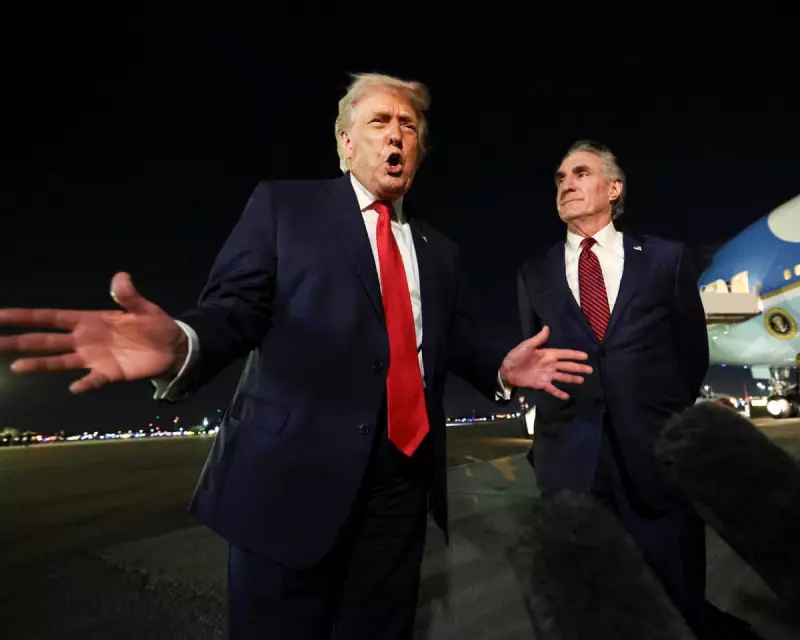
The market turmoil stems from Trump's social media announcement on Saturday, in which he threatened tariffs against eight European nations: Germany, France, Denmark, the United Kingdom, Sweden, the Netherlands, Norway, and Finland. The proposed tariffs would begin at 10% on February 1st, potentially escalating to 25% by June 1st.
Trump explicitly linked these tariff threats to his administration's pursuit of acquiring Greenland, stating they would remain in place "until such time as a Deal is reached for the Complete and Total purchase of Greenland." He further complicated global trade dynamics by threatening 200% tariffs on French wines and champagne, reportedly in response to French President Emmanuel Macron's reluctance to participate in Trump's proposed Gaza peace initiative.
Official Responses and Market Analysis
At the World Economic Forum in Davos, US Commerce Secretary Howard Lutnick attempted to downplay concerns about an impending trade war. While defending US tariff policies, he suggested the situation would likely be resolved through diplomatic channels rather than escalating into full-blown economic conflict.
"We are here to make a very clear point: globalisation has failed the west and the United States of America," Lutnick stated during a panel discussion. "It's a failed policy. The fact is, it has left America behind. It has left American workers behind."
Lutnick characterized Trump's tariff approach as a diplomatic tool, explaining: "Trump uses tariffs as a way for him to say: 'Hey, you know, you need to talk to us.' What I see happening is diplomacy and talking at the table, rather than action."
International Concerns and Calls for Calm
UK Chancellor Rachel Reeves, participating in the same Davos panel, emphasized the importance of maintaining strong international alliances while acknowledging economic security concerns. "For all of your strengths, we do also need to preserve some of the things that the US has benefited from, in the Nato alliance, and the western alliance," she remarked, adding that this preservation served American national interests.
Reeves urged diplomatic restraint regarding Greenland, stating: "We absolutely want to de-escalate. The future of Greenland is for the people of Greenland."
US Treasury Secretary Scott Bessent also appealed for calm, urging European nations not to retaliate against the proposed tariffs. "I would say this is the same kind of hysteria that we heard on 2 April. There was a panic," he commented, referencing previous market reactions to trade announcements. "What I am urging everyone here to do is sit back, take a deep breath, and let things play out."
Analyst Perspectives on Market Volatility
Market analysts expressed concern that official reassurances had failed to calm investor nerves. Kathleen Brooks, Research Director at brokerage XTB, noted: "Overall, this is a man-made crisis, and the continued sell-off on Tuesday suggests that US threats to Greenland and their effects on financial markets could have further to go if the situation does not de-escalate soon."
The market reaction highlights how geopolitical tensions and trade policy uncertainties continue to influence global financial stability, with investors remaining sensitive to developments that could disrupt international commerce and economic cooperation.