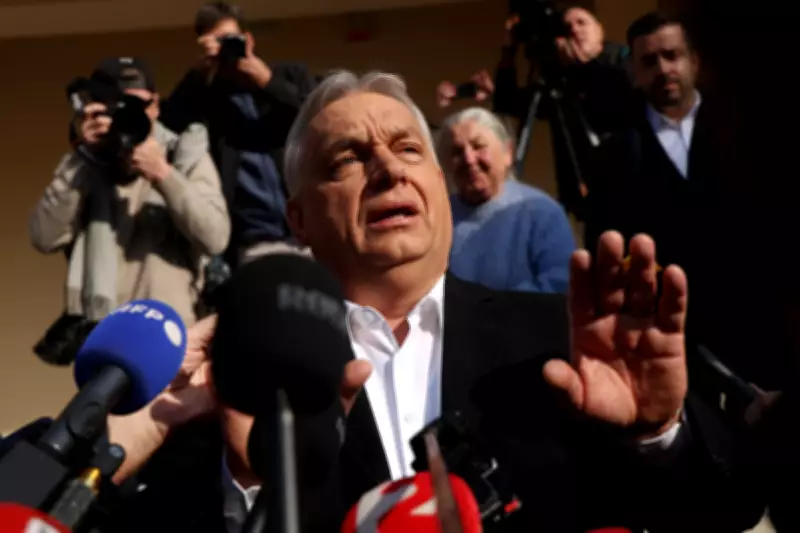
Hungarian Financial Markets Rally After Historic Political Shift
Hungarian-listed stocks reached unprecedented heights during early trading on Monday, following the dramatic election defeat of Prime Minister Viktor Orban after sixteen consecutive years in power. The sweeping victory of opposition leader Peter Magyar and his Tisza party triggered immediate positive reactions across financial markets, signaling investor confidence in the political transition.
Record-Breaking Market Performance
Budapest's benchmark BUX index surged by 3.3 percent immediately upon market opening, eventually stabilizing with a 2.7 percent gain to reach 136,481 points. This remarkable performance established a fresh record high for the Hungarian stock index, reflecting widespread optimism about the country's economic prospects under new leadership.
The market gains were primarily propelled by three key stocks that demonstrated significant upward momentum. Financial service provider OTP Bank experienced a three percent increase, contributing to its impressive 80.7 percent growth over the past twelve months. Meanwhile, oil company MOL rose by 1.2 percent, and pharmaceutical firm Gedeon Richter gained 1.4 percent, showcasing broad-based market enthusiasm.
Currency and Bond Market Strengthening
Beyond equity markets, Hungary's national currency achieved a four-year peak against the euro, appreciating by 2.4 percent to reach 365.6 euro by 9:00 AM in Budapest. This represents the strongest valuation since 2022, while the currency also jumped 1.7 percent against the US dollar. Hungarian dollar bonds emerged as the top performers across emerging markets, further highlighting the comprehensive financial market response to the political change.
Investor Positioning Pays Dividends
Financial institutions that anticipated the political shift are now reaping substantial rewards from their strategic positioning. Danske Bank AS confirmed it had been purchasing Hungarian assets for the previous three months, anticipating voters would replace Orban with Tisza party leader Peter Magyar. Industry analysts noted that Magyar's super-majority victory, granting his party a two-thirds parliamentary majority, would likely enable sustained market momentum.
Matthias Siller, co-portfolio manager of Barings emerging EMEA opportunities investment trust, commented: "The election win for Peter Magyar's TISZA party will represent a structural break for Hungary, with meaningful macro, regional and equity-market implications." He added: "A constitutional super-majority would allow Tisza to cleanly dismantle the current governance framework without prolonged parliamentary obstruction... compress Hungary's structural risk premium, unlock growth capital, and reshape regional dynamics."
While most stocks experienced gains, companies with close connections to the previous administration reported significant declines over the past month. Asset management firm Opus Global dropped 13.6 percent, while IT company 4iG fell 17.9 percent, illustrating the market's differentiation between political affiliations.
Unlocking European Union Funding
Magyar's ascent to power carries significant implications for Hungary's relationship with the European Union and access to crucial funding. Approximately €20 billion in EU funds remained frozen by Brussels due to rule-of-law concerns under Orban's administration, with €3 billion considered permanently lost. The financial strain from this funding blockage contributed to a recession during the 2023/24 tax year and subsequent economic stagnation.
Holger Schmieding, chief economist at Berenberg, explained: "On one major count, a new Hungarian government could probably make a major positive difference for the Hungarian economy shortly. But with a government in Hungary that promises to play by EU rules again, the EU could soon start to disburse some of the €9.5 billion in cohesion funds earmarked for Hungary that Brussels is currently holding back." He continued: "How fast and to which extent a new government will change domestic policies remains to be seen. Still, the relegation of Orbán to the opposition benches will likely make Hungary a better place for domestic and foreign investment."
Strategic International Realignment
The Tisza party has committed to pursuing euro area membership and reducing Hungary's borrowing costs, which currently rank among the highest in the European Union. The yield on ten-year Hungarian bonds has averaged approximately seven percent over the previous twelve months, highlighting the potential for significant improvement through policy changes.
In his victory address on Sunday evening, Magyar declared: "Hungarians said yes to Europe again today. Our place has been in Europe for 1,000 years and will remain so. My first journey will be to Poland to restore 1,000-year-old friendship. My second will be to Vienna and third to Brussels to bring back EU funds that belong to Hungarians. Hungary will once again be a strong ally of Europe and NATO."
Financial analysts anticipate continued outperformance in Hungarian stocks, contingent upon the new government's success in securing access to European Union funds and maintaining market confidence through consistent policy implementation. The comprehensive market response suggests investors view the political transition as a transformative moment for Hungary's economic trajectory and international relationships.