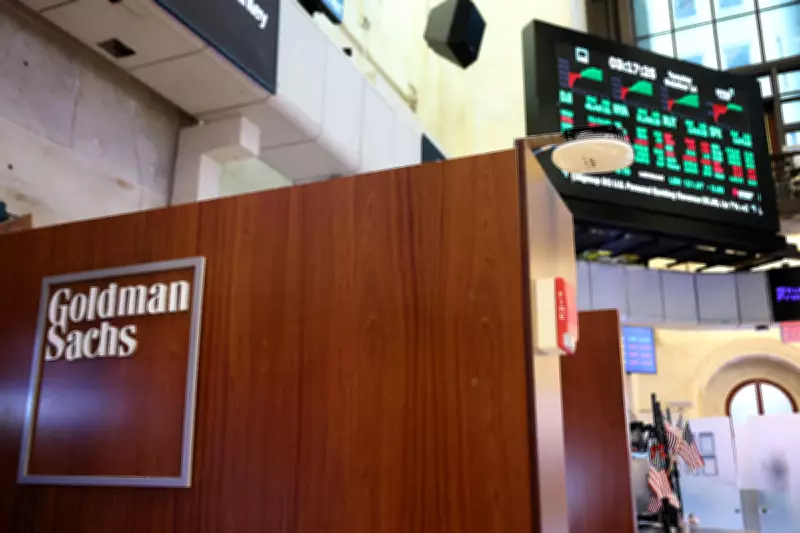
Goldman Sachs Shatters Trading Record with $5.3bn Haul Amid Iran Volatility
Goldman Sachs has posted a monumental equities trading performance, smashing its all-time quarterly record as the Wall Street giant capitalized on market turbulence triggered by escalating tensions in the Middle East. The banking behemoth's stock division generated a staggering $5.3bn (£3.9bn) in revenue during the first quarter of the year, decisively surpassing the previous high of $4.3bn set in the final quarter of 2025.
Market Frenzy Drives Record Profits
The financial markets experienced significant upheaval following the outbreak of war in the Middle East, with investors rapidly divesting equity positions amid mounting inflationary concerns that sparked widespread selling activity. This market frenzy proved exceptionally lucrative for Goldman Sachs, enabling the institution to secure $5.6bn in pre-tax profit—a substantial 19 percent increase from comparable periods.
Investment banking operations as a whole demonstrated remarkable strength, enjoying a nearly 20 percent surge to reach $12.7bn compared to the same timeframe in 2025. This impressive growth was primarily propelled by a dramatic 48 percent escalation in fees generated from heightened merger and acquisition volumes. Additionally, wealth management revenue climbed 10 percent to $4bn, with the bank attributing this success to elevated management fees resulting from increased assets under supervision.
Mixed Performance Across Divisions
Despite these extraordinary achievements, not all segments of Goldman Sachs' operations met expectations. The fixed-income, currency, and commodities trading division delivered $4bn in revenue, falling short of projections and representing an approximate 10 percent decline from the corresponding period last year. This underwhelming performance created a notable contrast within the bank's overall results.
Headline revenue reached $17.2bn, reflecting a solid 14 percent increase. Nevertheless, Goldman Sachs shares experienced a 4.1 percent decline during pre-market trading, mirroring broader market sell-off trends. Axel Rudolph, chief technical analyst at IG, provided insight into investor sentiment, stating: "In this environment 'solid' isn't quite enough to keep investors interested."
Concerns Over 'Peak Earnings' Emerge
Goldman's stock has demonstrated extraordinary performance over the past year, skyrocketing more than 85 percent to approximately $908 per share. Rudolph elaborated on market expectations, noting: "After such a strong run in the share price, investors were clearly looking for something exceptional, not just good." He further expressed concern that "the bigger issue is that Goldman's results feel like a snapshot of a world that may already be fading," suggesting the numbers risk being perceived as "peak earnings" following the volatility-fueled boom in market trading activity.
David Solomon, chairman and chief executive of Goldman Sachs, emphasized the bank's resilience, stating the institution had delivered "even as market conditions became more volatile." He highlighted that "the geopolitical landscape remains very complex—so disciplined risk management must remain core to how we operate."
Strategic Outlook and Cautions
In March, Solomon projected that momentum in merger and acquisition activity would persist despite disruptions caused by the US-Israeli military engagement with Iran. He indicated that evolving regulatory conditions had created "greater likelihood" for corporate boards to execute strategic transactions and achieve scale. However, the bank issued a cautionary note on Monday, revealing that its backlog of fees had experienced a slight decrease compared to the preceding quarter, suggesting potential headwinds ahead.
The extraordinary trading performance underscores how geopolitical instability can create lucrative opportunities for financial institutions with sophisticated risk management capabilities, while simultaneously raising questions about sustainability in an increasingly volatile global landscape.