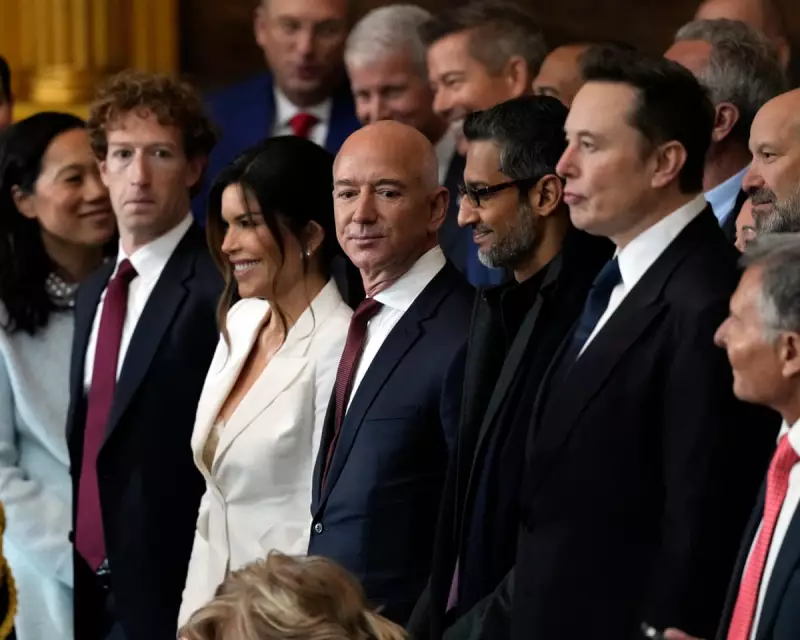
One year after their notable presence at Donald Trump's presidential inauguration in Washington DC, the leaders of Silicon Valley's most influential companies continue to navigate a complex political landscape that has yielded substantial rewards for their enterprises.
Unprecedented Alliance Between Tech Titans and Political Power
On 20 January 2025, Mark Zuckerberg of Meta, Jeff Bezos of Amazon, Sundar Pichai of Google, and Elon Musk of various ventures including xAI stood alongside Donald Trump as he assumed the presidency for a second term. This visual representation of tech industry support marked a significant departure from previous political alignments, with these executives having contributed financially to Trump's campaign in what many observers described as an unprecedented demonstration of corporate political engagement.
Throughout the subsequent twelve months, these technology companies have enjoyed considerable benefits from their association with the Trump administration. The president has directed billions of dollars in government funding toward tech initiatives while incorporating chief executives into diplomatic negotiations that have resulted in lucrative international agreements. This symbiotic relationship reached a notable milestone when Trump signed an executive order prohibiting individual states from passing legislation to regulate artificial intelligence, a move that significantly benefited major tech corporations.
Datacenter Expansion Creates Political and Economic Challenges
As the second year of Trump's current term commences, the rapid expansion of datacenters across the United States and Europe presents both opportunities and complications for political leaders. President Trump has expressed particular concern about how these energy-intensive facilities might affect electricity markets and, consequently, his party's electoral prospects in upcoming congressional elections.
"I never want Americans to pay higher electricity bills because of Data Centers," Trump declared recently, highlighting the tension between technological advancement and economic considerations. His administration has taken concrete steps to address these concerns, including a joint announcement with Microsoft that the company would pay full property taxes and forego electricity rate discounts in communities hosting its datacenters.
The situation has grown more complex as Trump attempts to balance his deregulatory agenda with practical energy realities. While promising to reduce electricity costs by fifty percent, his administration has simultaneously blocked renewable energy projects that could have provided power for millions of American homes, instead promoting expanded fossil fuel extraction. This approach has raised questions about whether energy prices might actually increase rather than decrease, potentially undermining political support.
European Approaches to Datacenter Growth
Across the Atlantic, European governments are grappling with similar challenges related to datacenter expansion. Germany, which hosts the continent's highest concentration of these facilities, has adopted a different strategy from the United States by agreeing to subsidize industrial electricity use until 2028 while reducing grid fees for both businesses and consumers. Notably, German regulations require datacenters to source half their electricity from renewable sources, though public skepticism about compliance persists.
The United Kingdom faces particularly acute challenges as home to Europe's second-largest concentration of datacenters. With electricity rates already among the world's highest and continuing to increase, the expansion of datacenter construction threatens to exacerbate existing cost of living pressures. Despite these concerns, the Department for Science, Innovation and Technology has proposed offering electricity discounts to datacenters in designated "AI growth zones" to encourage further investment.
Ireland's experience serves as a cautionary tale for other nations, with datacenter electricity consumption surpassing that of all urban homes by 2024. The resulting strain on power infrastructure led to significantly higher costs for Irish consumers and prompted the government to temporarily ban new datacenter connections to Dublin's grid, a restriction that has only recently been lifted.
Australia's Social Media Ban and Global Implications
Beyond energy concerns, technology policy continues to evolve in response to social considerations. Australia's implementation of a social media ban for users under sixteen has attracted international attention, with lawmakers in the United Kingdom and elsewhere considering similar measures. Although Australian authorities report that millions of accounts have been deactivated or restricted since the ban took effect in December, opposition politicians question its effectiveness, noting that age-verification tools remain relatively easy to circumvent.
This policy experiment occurs against a backdrop of ongoing debate about technology's role in society, with issues ranging from artificial intelligence regulation to environmental compliance continuing to shape the relationship between tech companies and governments worldwide. As these discussions progress, the alliance between Silicon Valley leadership and political power established at that January 2025 inauguration continues to influence policy directions and corporate fortunes in measurable ways.