
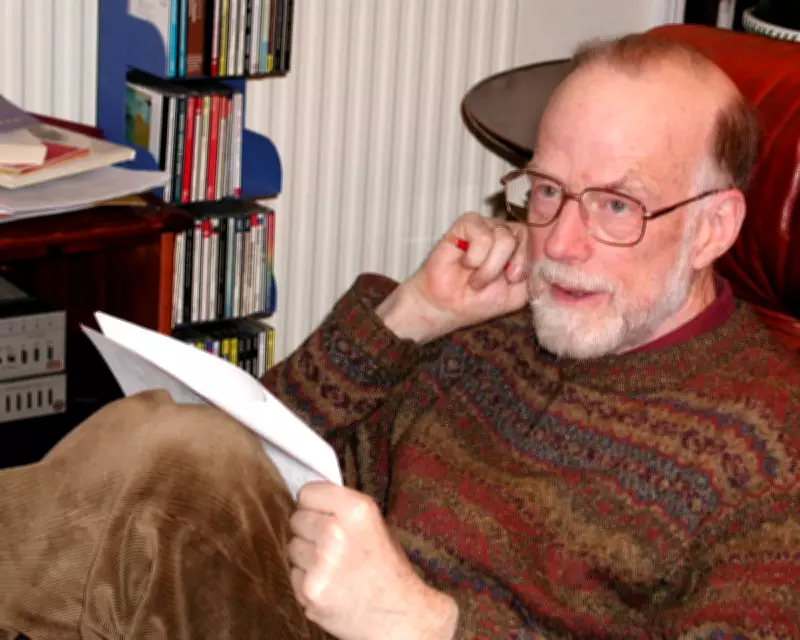
Sir Tony Hoare: The Modest Genius Who Engineered Modern Computing
Sir Tony Hoare, who passed away at the age of 92, was characteristically modest about his monumental impact on computer programming. He once remarked, 'I just found some really good people, then I let them get on with it.' Yet, his work fundamentally transformed program development from an arcane craft into a rigorous engineering profession. Hoare made pioneering contributions across multiple domains, including program verification, algorithm design, language semantics, and concurrency theory. Initially theoretical, many of his ideas eventually became embedded in sophisticated tools that support large-scale programming practices worldwide.
Groundbreaking Algorithms and Logics
In 1961, Hoare devised the Quicksort sorting algorithm, which remains widely used today for organizing data efficiently. It stands as an archetypal example of a divide-and-conquer approach. After leaving the computer industry in 1968 to become a professor at Queen's University Belfast, he began work that led to the development of Hoare logics. These logics enable software engineers to verify a program's formal correctness, ensuring it behaves as intended. His concise formalization of logical inference rules made this accessible to non-specialist programmers, revolutionizing software reliability.
Academic Leadership and Theoretical Innovations
In 1977, Hoare moved to Oxford University as professor of computation and head of the Programming Research Group. Under his leadership, the group expanded from a small academic team into a fully fledged computer science department. At Oxford, he pioneered work on communicating sequential processes (CSP), which revolutionized the description and analysis of concurrent and distributed systems. CSP provides a logical framework for understanding systems of any scale, with applications in checking software for inadvertent problems and vulnerabilities to malicious hacking.
Early Life and Career Foundations
Born in Colombo, Ceylon (now Sri Lanka), to British parents, Hoare was educated at the Dragon School in Oxford and King's School in Canterbury. He earned a double first in classics from Merton College, Oxford, in 1956, where he engaged in informal studies on symbolic logic and computation. After national service in the Royal Navy, where he learned Russian, he attended Moscow State University, influenced by mathematician Andrey Kolmogorov. In 1960, he joined Elliott Brothers as a programmer, advocating for the Algol 60 language over a proprietary one, a decision that proved commercially successful and where he met his wife, Jill Pym.
Collaborations and Industry Impact
Hoare's ability to bridge fundamental research and practical applications led to key collaborations. With Inmos in the early 1980s, he contributed to the Transputer design, a chip combining processor, memory, and communication hardware, programmed in the Occam language based on CSP. Later, a collaboration with IBM helped the company regain control of its transaction processing system, earning Queen's awards for technological achievement in 1990 and 1992. His election to the Royal Society in 1982 marked recognition of programming as a science, and after retiring from Oxford in 1999, he joined Microsoft Research in Cambridge, focusing on scalable verification methods.
Legacy and Honors
Hoare received numerous accolades, including knighthood in 2000, the Turing Award in 1980, the Kyoto Prize in 2000, the IEEE von Neumann Medal in 2011, and the Royal Medal of the Royal Society in 2023. His book, Unifying Theories of Programming, co-authored with He Jifeng, advanced the idea of combining theories to make formal verification scalable. He is survived by his wife Jill, children Tom and Jo, and granddaughters Jhansi and Maya, with another son, Matthew, predeceasing him in 1981. Charles Antony Richard Hoare's legacy endures as a cornerstone of modern computing, ensuring software reliability and innovation for generations to come.




