
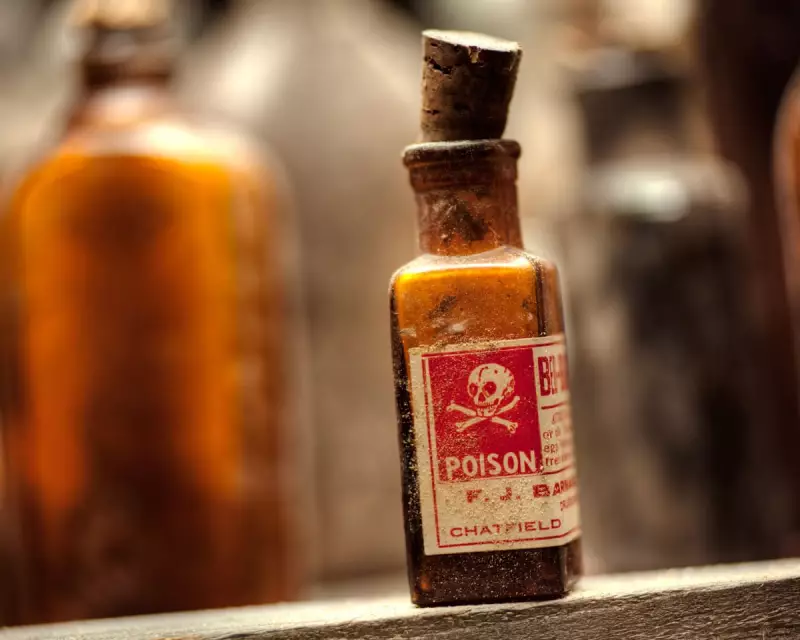
The Royal Drink-Off That Ended in Tragedy
In a remarkable twist of fate that has puzzled mathematicians and logic enthusiasts for decades, two poison manufacturers both met their demise during what should have been a straightforward royal competition. The legendary lateral thinking puzzle, recently rediscovered and published in Mathematics Magazine, continues to challenge readers with its clever application of basic game theory principles.
The Puzzle's Origins and Rules
This brilliant puzzle traces its origins to Michael Rabin, the celebrated computer scientist who first posted it to an electronic bulletin board at Carnegie Mellon University in the late 1980s. The puzzle remained relatively obscure until recently, when puzzle enthusiast Timothy Chow of the Centre for Communications Research in Princeton, New Jersey, brought it back into the spotlight through his academic publication.
The scenario presents a fascinating set of conditions in a faraway land where specific facts are universally known. The rules governing poisons are particularly crucial: anyone who ingests poison will die within an hour unless they subsequently consume a stronger poison, which miraculously acts as an antidote and restores complete health.
The story centres on Smith and Jones, the only two poison manufacturers in the kingdom, each producing several types of poison with different strengths. Critically, neither has access to the other's poisons, and nobody knows which manufacturer produces the strongest poison overall.
The Queen's Deadly Challenge
The Queen, determined to settle the question of who produces the superior poison, summons both manufacturers to her palace and issues a chilling ultimatum. She commands them to return in one week, each bringing a vial of their own poison for a ceremonial drink-off.
The ceremony would follow a specific sequence: both participants would first take a swig from the other's vial, then drink from their own vial. They would then be observed for one hour to determine the outcome. The Queen explicitly states that bringing their strongest poison would be in their best interests, as the manufacturer with the superior poison would survive while the other would perish.
Both Smith and Jones depart deeply troubled, neither confident about having the strongest poison and both desperate to ensure their survival. They spend the entire week contemplating their strategy before returning for the fateful ceremony.
To everyone's astonishment, despite following the Queen's instructions precisely and under careful observation, both Smith and Jones collapse and die within the hour. The Royal Coroner confirms both deaths resulted from poisoning, leaving observers baffled about what could have possibly gone wrong.
The Mathematical Brilliance Behind the Tragedy
The solution to this puzzle involves basic game theory and requires lateral thinking rather than mathematical complexity. Both participants, acting in their own self-interest based on what they anticipate the other will do, make rational decisions that ultimately lead to their mutual destruction.
This classic puzzle demonstrates how seemingly straightforward situations can produce unexpected outcomes when participants must make strategic decisions without complete information. The puzzle has gained renewed attention through Timothy Chow's recent article, introducing it to a new generation of puzzle enthusiasts and mathematicians.
The enduring appeal of this lateral thinking challenge lies in its elegant simplicity and surprising resolution, making it what many consider an all-time classic in the puzzle world. Its recent publication in Mathematics Magazine has sparked fresh interest in this decades-old brain teaser that continues to challenge conventional thinking patterns.




