
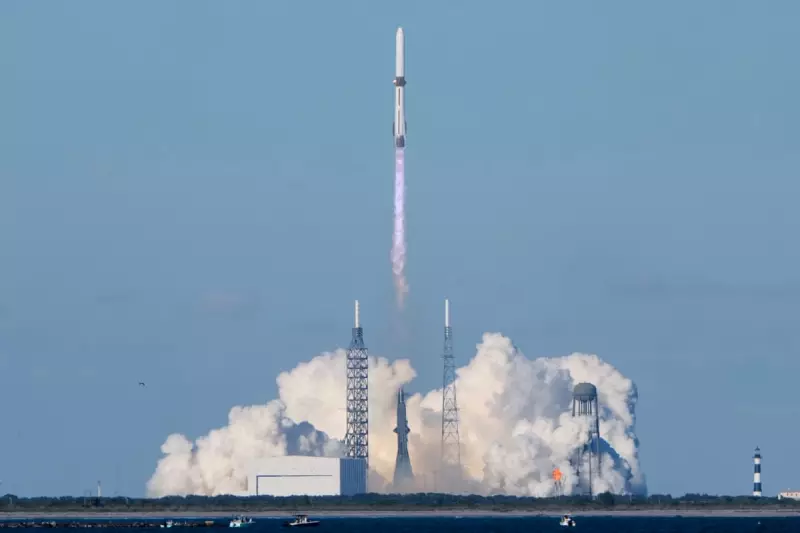
In a landmark decision that reshapes the future of interplanetary exploration, NASA has selected Jeff Bezos' space company Blue Origin to launch a critical mission to Mars. The contract award represents a significant victory for Blue Origin's New Glenn rocket programme, positioning the company as a major player in deep space missions.
NASA's Strategic Partnership with Blue Origin
The space agency announced on Wednesday that it has chosen Blue Origin to provide launch services for its EscaPADE Mars mission, scheduled for liftoff in August 2028. This decision marks a pivotal moment for both organisations, coming just months after Blue Origin's New Glenn rocket successfully reached orbit for the first time following years of development delays.
Under the terms of the $112 million fixed-price contract, Blue Origin will be responsible for launching NASA's twin spacecraft to study the Martian atmosphere. The mission involves two small satellites that will orbit Mars and analyse how solar wind strips away the planet's atmosphere, providing crucial insights into planetary evolution.
This partnership represents a strategic shift for NASA, which has traditionally relied on established providers like United Launch Alliance and SpaceX for such high-stakes interplanetary missions. The selection of Blue Origin signals growing confidence in the company's capabilities despite its relatively recent entry into orbital launch services.
New Glenn's Crucial Role in Deep Space Exploration
Blue Origin's New Glenn rocket, named after pioneering NASA astronaut John Glenn, stands nearly 100 metres tall with a seven-meter diameter fairing. The heavy-lift launch vehicle is designed to carry substantial payloads to various orbits, making it ideally suited for Mars missions requiring significant propulsion capability.
The EscaPADE mission will leverage New Glenn's powerful upper stage to send the twin spacecraft on their trajectory toward the Red Planet. This marks one of the first major interplanetary missions assigned to a commercial provider still in the early stages of proving its orbital capabilities.
Rob Meyerson, former president of Blue Origin, emphasised the significance of this contract, stating that "winning a Mars mission demonstrates real credibility" for the New Glenn programme. The mission success could establish Blue Origin as a reliable partner for future NASA deep space exploration initiatives.
Competitive Landscape and Future Implications
This contract award places Blue Origin in direct competition with Elon Musk's SpaceX, which has dominated the commercial space sector in recent years. While SpaceX has focused heavily on its Starship programme for eventual Mars colonisation, Blue Origin has secured a tangible Mars mission that will fly years before Starship's planned interplanetary voyages.
The EscaPADE mission had originally been scheduled to launch on a different rocket in 2024 but faced delays and required finding a new launch provider. NASA's selection of Blue Origin came after evaluating multiple proposals, with the agency concluding that New Glenn offered the best combination of capability, schedule reliability and value.
Industry analysts note that this contract could signal the beginning of a new era in space exploration, where NASA increasingly partners with commercial providers for scientific missions beyond Earth orbit. The success of this Mars mission could pave the way for more ambitious public-private partnerships in exploring the solar system.
As the 2028 launch window approaches, both NASA and Blue Origin will be working intensively to ensure mission success. The partnership represents not just a single mission, but potentially the dawn of a new chapter in how humanity explores our neighbouring planets.




