
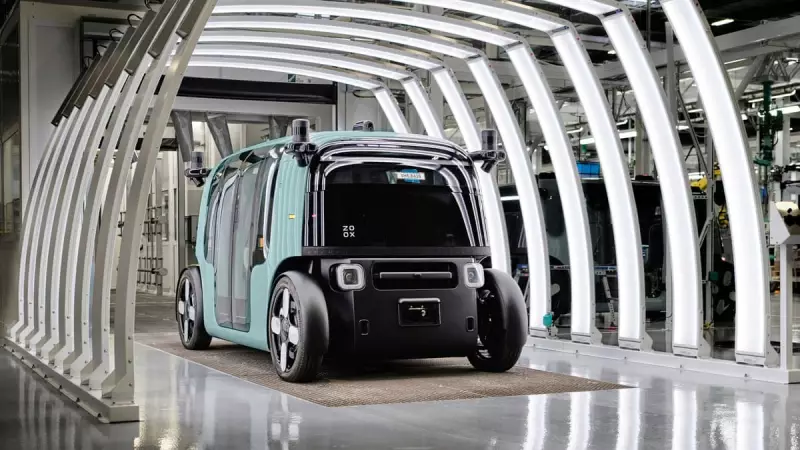
In a significant move within the autonomous vehicle sector, Amazon's subsidiary Zoox has officially launched its robotaxi service in San Francisco. This strategic expansion directly challenges the early lead established by Google's self-driving car unit, Waymo, in the competitive market for passenger transport without human drivers.
A Cautious Rollout with Big Ambitions
The service, announced on a Tuesday, will initially be confined to a few major neighbourhoods within the city. Access is currently restricted to individuals who previously signed up on a waiting list. Riders will experience Zoox's distinctive, gondola-shaped robotaxis, which notably lack a steering wheel.
This launch in San Francisco comes less than three months after the Amazon-owned company initiated its first-ever ride-hailing service along the famous Las Vegas strip. A key differentiator for Zoox is its pricing strategy: the company is not charging passengers for rides. This stands in contrast to Waymo, which has been charging fares since its debut in Phoenix five years ago.
These free rides represent a major milestone for Zoox as it prepares for a future where it will charge fares, much like Waymo and traditional ride-hailing giants Uber and Lyft. This effort is part of Amazon's broader attempt to make serious inroads in autonomous driving technology, a journey that began in 2020 when the e-commerce giant acquired Zoox for $1.2 billion.
The Regulatory Hurdle and the Established Competition
Before Zoox can begin charging customers, it must first receive approval from California regulators. The company has submitted an application for this permission, a clearance that its rival Waymo successfully obtained in August 2023 after addressing safety concerns raised by San Francisco officials.
Since receiving that green light, Waymo's robotaxis have become a familiar sight on the streets of San Francisco. For some tourists, a ride in a self-driving car has become a must-do activity, alongside a trip on the city's historic cable cars, which have been operating for 152 years.
Waymo, which originated as a secret project within Google back in 2009, has significantly expanded its operations. It now operates robotaxis in San Jose, Los Angeles, Atlanta, and Austin, Texas, with plans to expand into New York City, Washington DC, and London next year.
Scaling Up for a Nationwide Presence
In a clear sign of its accelerating growth, Waymo recently announced that its robotaxis have begun extending their routes beyond city streets and on to highways in San Francisco, Los Angeles, and Phoenix, Arizona. Furthermore, on the same Tuesday Zoox made its announcement, Waymo revealed plans to expand into five more US cities: Dallas, San Antonio, and Houston in Texas, and Miami and Orlando in Florida. Passengers, however, will not be able to request rides in these new cities until next year.
Not to be outdone, Amazon is gearing up to bring Zoox's robotaxis to other major metropolitan areas, with confirmed plans for Austin and Miami. To support these ambitious expansion goals, Amazon has converted a former bus factory into a state-of-the-art robotaxi plant in Hayward, California, located about 25 miles (40km) south-east of San Francisco. Zoox has high hopes for this facility, with plans to eventually manufacture up to 10,000 robotaxis there annually.




