
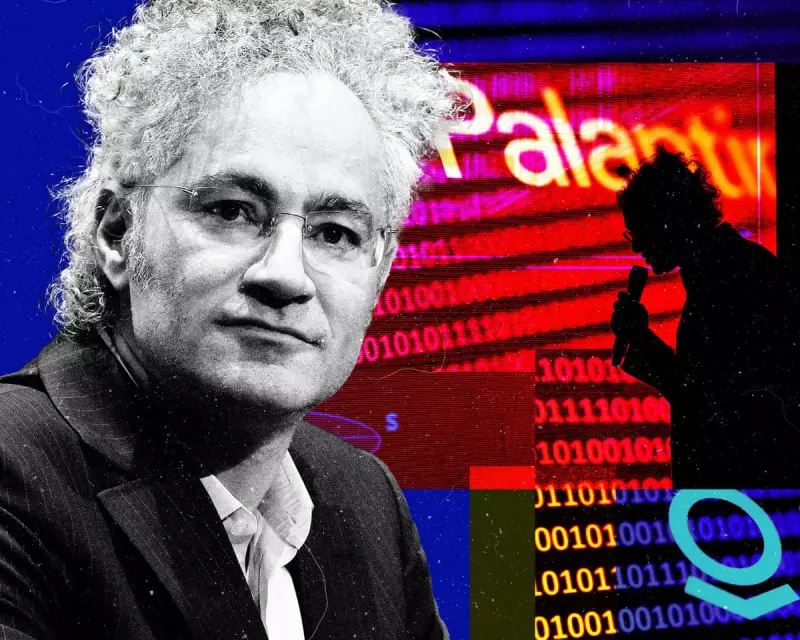
Alex Karp, the unconventional chief executive of data analytics firm Palantir Technologies, recently declared his company "the most important software company in America and therefore in the world." This bold statement comes as Palantir's controversial technology becomes increasingly embedded in government operations worldwide, raising serious questions about privacy and state surveillance.
The Man Behind the Surveillance Empire
At 58 years old, Karp presents a striking figure with his unkempt grey hair and rapid-fire speaking style. His eccentric personality shines through in media appearances, where he displays a mix of combative conviction and almost childish mannerisms. During one CNBC interview, he simultaneously shook both fists while complaining about short sellers targeting Palantir, whose share price has soared nearly 600% in the past year.
According to Michael Steinberger, author of the new biography The Philosopher in the Valley, fear fundamentally drives Karp. "One of the many fascinating things about Palantir is the way that it is the embodiment, in a lot of ways, of Karp," Steinberger reveals. "He created Palantir to make the world safer for himself, or for people like him."
Palantir's Global Reach and Political Connections
Palantir's AI-powered data analysis technology sits at the centre of numerous global controversies. In the United States alone, its systems support Immigration and Customs Enforcement deportations, the Pentagon's unmanned drone programme, and police departments' profiling of potential criminals. The company's software also plays roles in conflicts worldwide, being used by the Israel Defense Forces in Gaza and by Ukrainian forces against Russia.
In the UK, Palantir has become integral to Labour's plans for modernising both the armed forces and the NHS. When Keir Starmer visited Washington in February, his first stop after the White House was Palantir's office, where Karp demonstrated the company's latest military technology.
The company's name derives from J.R.R. Tolkien's Lord of the Rings mythology, where palantíri are "seeing stones" used for surveillance. Karp has often spoken of Palantir's mission in terms of "saving the shire," with employees sometimes referred to as "hobbits."
From Outsider to Tech Titan
Karp's background reveals a complex personality shaped by feeling like an outsider. The son of a Jewish paediatrician father and African American artist mother, he grew up in a leftwing, intellectually privileged Philadelphia household. He has described thinking, "If fascism comes, I will be the first or second person on the wall."
His dyslexia and attention deficit hyperactivity disorder have significantly influenced his worldview. "It fucked me but also gave me wings to fly," he told Steinberger about his dyslexia. To help with focus, he practises tai chi and has been known to lead classes for employees.
Karp's path to tech leadership was unconventional. After meeting Peter Thiel at Stanford Law School, Karp pursued a PhD in neoclassical social theory in Frankfurt, seeking to understand how Germany descended into barbarism. When he rejoined Thiel to help lead Palantir in 2004, he couldn't write code but brought knowledge of ontology – how information is structured and organised.
Political Evolution and Ethical Questions
Karp's political journey has been marked by significant shifts. While Thiel enthusiastically supported Donald Trump's 2016 campaign, Karp expressed disdain, saying, "I respect nothing about the dude. It would be hard to make up someone I find less appealing." He voted for Hillary Clinton in that election and backed Kamala Harris in 2024.
However, since Trump's re-election, Karp has moved toward accommodation. He wrote a $1 million cheque for Trump's inauguration and Palantir donated $5 million toward Trump's military parade in June. Karp now describes himself as "an independent who admires what Trump has done on many things."
Steinberger observes that Karp's definition of "western values" appears to have evolved. "When I first met him in 2019, he was talking about defending liberal democracy," Steinberger notes. "Now, he sees it much more as just a collection of countries bound by a shared Judeo-Christian heritage, and, to varying degrees, by an attachment to free enterprise."
This philosophical shift has drawn criticism from former employees, who published an open letter titled "The Scouring of the Shire" in May, accusing Palantir's leadership of abandoning its founding ideals.
The Technology and Its Implications
Palantir maintains that it doesn't collect or store data but provides software helping organisations make better use of their own information. Steinberger compares Palantir's technology to a toaster: "If you burn your toast, you don't blame the toaster."
The company argues it has built-in guardrails and "civil liberties protections" to prevent abuses, though these claims are difficult to verify independently. With contracts worth billions across US military and government agencies including the CIA, FBI, and National Security Agency, Palantir's potential influence continues to grow.
Karp envisions Palantir becoming as dominant as IBM was in the 1960s, shaping how governments and private companies operate. In a recent shareholder letter, he wrote, "We are still in the earliest stages, the beginning of the first act, of a revolution that will play out over years and decades."
As Palantir's technology becomes more deeply embedded in global security infrastructure, questions about its impact on privacy and civil liberties seem certain to intensify, placing the unconventional CEO at the centre of one of the most important technological debates of our time.




