
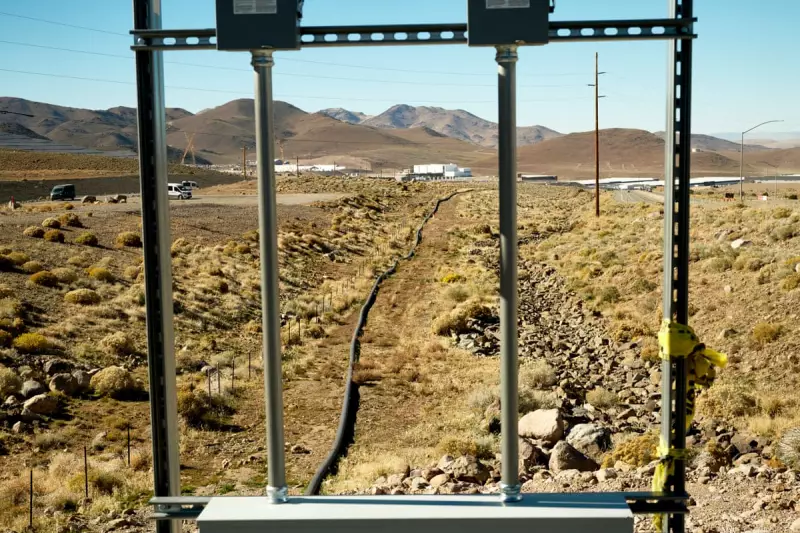
Hidden behind the sagebrush-covered hills of the Nevada desert, a vast new metropolis of technology is rising from the dust. What was once a 19th-century gold rush boomtown is now the epicentre of a 21st-century scramble: the race to build the infrastructure for artificial intelligence.
The Desert's Digital Transformation
The Tahoe-Reno Industrial Centre (TRIC) in Storey County spans more than 100,000 acres—a landmass larger than the city of Denver. This sprawling business park, once traversed by prospectors like Mark Twain, now hosts a colossal buildout of data centres. Miles of concrete buildings house millions of computer servers for tech titans including Google, Microsoft, and Apple, while Tesla's Gigafactory produces electric vehicle batteries nearby.
The area, historically dubbed "The Richest Place on Earth" for its mineral wealth, is again one of Nevada's fastest-growing economies. This new boom is fuelled not by pickaxes, but by processing power. Global spending on AI data centres is projected to hit nearly $7 trillion by 2030, according to McKinsey and Company—almost double the UK's GDP.
Kris Thompson of Gilman Commercial Real Estate, the park's exclusive broker, recalls the site's humble beginnings. "When I first came up here, there was nothing but desert dirt trails, coyotes, and rabbitbrush," he said. Today, yellow cranes and rumbling semi-trucks dominate the landscape along the 18-mile USA Parkway that cuts through the park.
The High Cost of Computing: Water and Power Strains
This frenzied construction, buoyed by hundreds of billions in venture capital, comes at a significant environmental cost. AI's hunger for resources is immense: a single ChatGPT query uses nearly ten times more electricity than a standard internet search. Furthermore, the supercomputers require intensive cooling, often using evaporative systems that consume vast amounts of water.
In Storey County, which averages just 11 inches of rainfall a year, this thirst is a central concern. US data centre water use has tripled in a decade to over 17 billion gallons annually, a figure expected to near 80 billion gallons by 2028, driven largely by AI server proliferation.
The Pyramid Lake Paiute Tribe, which has lived downstream for millennia, is on the frontline. Tribal Chairman Steven Wadsworth voiced profound worries. "Nevada is completely over-allocated on its groundwater resources. It's the driest state in the union," he stated, pointing to the dried-up basin of neighbouring Lake Winnemucca as a stark warning of what happens when water flows are disrupted.
To address this, the industrial park built a $100 million reclaimed water reservoir, pumping effluent via a 21-mile pipeline. While seen as an alternative to drawing directly from the Truckee River—Pyramid Lake's source—environmentalists remain sceptical. "This place is being touted as the epicenter of the energy revolution... But they're never going to be making water," said Kyle Roerink of the Great Basin Water Network.
Powering the Future: An Energy Dilemma
The demand for electricity is equally staggering. The International Energy Agency estimates global data centre power consumption could double by 2026, equalling Japan's annual usage. In the US, where about 60% of electricity comes from fossil fuels, this surge threatens climate goals.
At the heart of TRIC sits Switch's "Citadel" campus, home to the largest data centre in the US. The facility, with walls topped by iron stakes and stringent security, has a capacity of 130 megawatts—enough to power 100,000 homes. Switch states its operations are powered by renewable energy, and it has invested heavily in green financing.
Tech giants like Google and Microsoft are also investing in solar, wind, and nuclear power. However, their latest sustainability reports reveal significant increases in carbon emissions since 2019. Meanwhile, utilities are delaying coal plant retirements and building new natural gas units to meet demand. "We just don't have the power capacity to keep running all of these things," warned Chairman Wadsworth, noting frequent summer brownouts on the Pyramid Lake reservation.
The development's pioneers, like Lance Gilman—a property developer and brothel owner—envisioned a fast-tracked industrial haven. Their model of pre-approved permits famously attracted Tesla in 2014. "That speed is everything. In this economy, if it takes you two or three years to get a permit... your product could be obsolete," Thompson explained.
As Thompson drives past wild horses grazing near construction sites, he sees a symbol of the new residents. "These tech rogues see themselves in the wild horses. They're independent, they're running free." Yet, this modern stampede of technology, much like the gold rush before it, is reshaping the landscape, promising untold riches while testing the limits of the desert's fragile resources.




