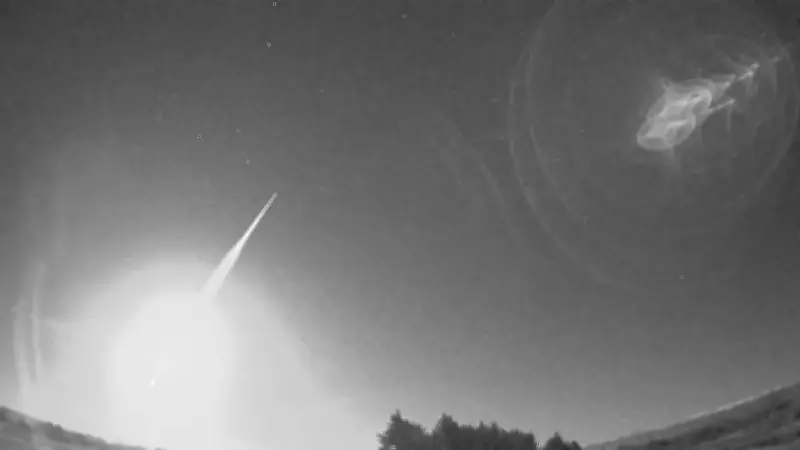
Two large suspected meteors have flashed and boomed across New Zealand’s skies in recent days, delighting those who glimpsed the celestial events and sending some animals into a frenzy.
Fireball lights up North Island
A fireball was seen over parts of the North Island just after 10.20pm on Tuesday night, after a separate one streaked across South Island’s skies on Sunday evening. Footage captured on dashcams, security cameras and specialist meteor cameras showed North Island’s skies lighting up with a large flash, with dozens of people taking to social media to describe the “huge boom” that accompanied it.
“Absolutely insane. I thought it was a plane on fire,” one commentator wrote. “It was huge, the ball was orange with a purple tail. We saw black soot coming off it,” wrote another. One person said it was the biggest they had seen: “It had a tail that stretched most of the sky and had brilliant colours.” Another wrote they heard “a loud low rumble” that disturbed birds in the area, while one witness said their “cows went nuts”.

Expert observations
Steve Wyn-Harris, who recently became director of Fireballs Aotearoa, an organisation made up of geologists, astronomers and citizen scientists who track meteors and meteorites, was relaxing in his spa in Hawke’s Bay when the sky lit up. “I saw a big flash in the sky and thought, ‘No, that can’t be a fireball – this would be too good to be true’,” he said. He initially thought it was lightning, until his phone started pinging with eyewitness reports. “More importantly, what’s exciting about this is people heard the sound, the sonic boom,” he said, which means the meteor reached relatively close to the ground.
On Sunday night, South Island residents reported a similar streak of light.
Call for meteorite hunters
Fireballs Aotearoa is encouraging residents in the lower North Island to keep their eyes peeled for debris – called meteorites – from Tuesday’s suspected meteor and to contact the group if they find anything. “Look out for a black stone that wouldn’t ordinarily be there,” Wyn-Harris said.
Just 10 confirmed meteorites have been found in New Zealand in the past 150 years, but many more will have fallen and never been found. Retrieving one can be difficult: New Zealand has a small population that is unlikely to spot most meteors entering the atmosphere, has rugged and dense terrain that can hinder the hunt for debris, and there is a lack of infrastructure to help triangulate the location of a landing. But that is changing, Wyn-Harris said. Fireballs Aotearoa has 200 cameras set up around the country, and an increase in security cameras and dashcams could help efforts to retrieve meteorites. “We’ve got some of the best coverage in the world, which is why we’re seeing these things now,” he said.