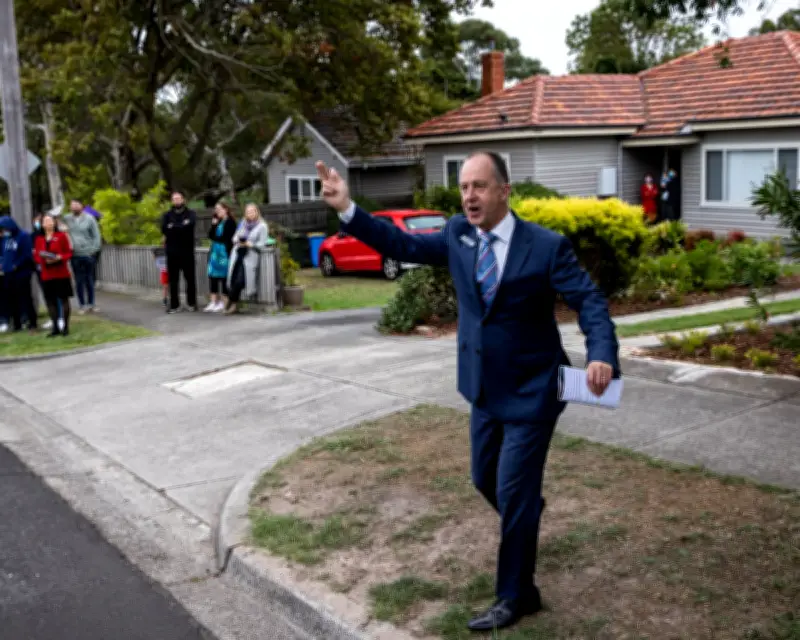
Australian property auctions are losing their appeal, with new data revealing a sharp decline in auction listings despite a significant rise in overall property listings. According to SQM Research, total property listings across Australia have surged by 22.8% over the past 12 months, yet auction listings have fallen by approximately 20% compared with the same period last year. This divergence highlights a notable shift in vendor preference toward private treaty sales, a trend that experts say reflects broader market weaknesses and changing economic conditions.
Auctions Decline Amid Market Weakness
Recent falls in auction clearance rates have triggered dramatic media headlines featuring words like “horror,” “failure,” and “wipe out.” Data from Cotality shows that in the four weeks ending 28 June, 6,895 properties—accounting for 30.3% of home sales across Australian capital cities—were sold via auction. However, this marks a clear decline in auction popularity, with clearance rates dropping from around 70% in September last year to below 50% in June and July.
Gerard Burg, head of research at Cotality, attributes this decline to a “weakening in market conditions across the country.” He points to a combination of factors, including affordability pressures, interest rate rises, hits to household incomes, and confidence issues related to the Iran conflict and policy changes in the federal budget. “This points to the decline in property demand,” Burg said, noting that vendors are also slower to adjust their expectations to reflect these market conditions.

Why Auctions Are Falling Out of Favor
Michael Fotheringham, an independent housing expert and former head of the Australian Housing and Urban Research Institute, explains that internationally, auctions are not the norm. “In a lot of countries, it’s a straightforward private sale,” he says. In the US, auctions are typically a last resort for distressed sellers or mortgage foreclosures. In the UK, auctions make up only about 3% of all property sales, though 2025 saw a record high of 28,975 dwellings sold by auction.
Fotheringham notes that auctions are traditionally used for scarce commodities like high-end art or antiquities, where demand outstrips supply. “Sadly, that is how we see housing in this country since property speculation has been so rampant over the last few decades,” he adds. Government policies, such as capital gains tax concessions and negative gearing, have favored speculative purchasing by investors, uncoupling the relationship between purchase price and rental yield, and encouraging investors to outbid first home buyers.
Do Auctions Push Up Prices?
The impact of auctions on house prices is a subject of debate. Some, like the Victorian Greens, argue that auctions are “designed to push up house prices by pressuring buyers into paying more.” The party has proposed banning street auctions altogether, with housing spokesperson Gabrielle de Vietri stating, “The goal is to start moving away from an auction culture altogether towards a more transparent, fair system that works for people looking for a place to live.”
However, research from UNSW and the University of Sydney, based on more than 480,000 residential property transactions in New South Wales and Victoria between January 2007 and December 2019, found that auctions command a premium of only about 0.7% compared with private treaty sales. “It’s probably less than what people think,” says UNSW’s associate professor Kristle Cortés, noting that the additional costs of hiring an auctioneer and staging the property make auctions quite expensive.
The research also found that about one in five auctions in Australia ends without a sale. Homes that fail to sell at auction subsequently sell for about 1.3% less than comparable properties sold by private treaty, translating to a loss of roughly $9,000 to $10,000 based on average home prices. Rainy days and less experienced agents were linked to higher failure rates, while a successful auction in an area often led to more auctions in the vicinity.

Future of Auctions and Market Regulation
Despite the decline, auctions remain a popular method in certain segments. Bianca Dacic, a Victorian mortgage broker, notes that some agencies gear their brands towards auctions because it’s “a done deal.” She explains that auctions create a due date for negotiation, encouraging agents to qualify buyers and foster competition.
Fotheringham believes that auctions do push prices upward through competitive bidding, which benefits agents. However, he cautions against banning auctions outright, as they can be a transparent sales method. Instead, he calls for tighter regulations, including addressing dummy bids, vendor bids, and the relationship between reserve prices and advertised price ranges. “I think we can continue to improve how real estate auctions are regulated,” he says.
As Australia’s housing market adjusts to economic pressures, the shift away from auctions signals a broader change in buyer and seller behavior. With total listings up and auction listings down, the market is clearly favoring private treaty sales, a trend that may persist as long as market conditions remain weak.