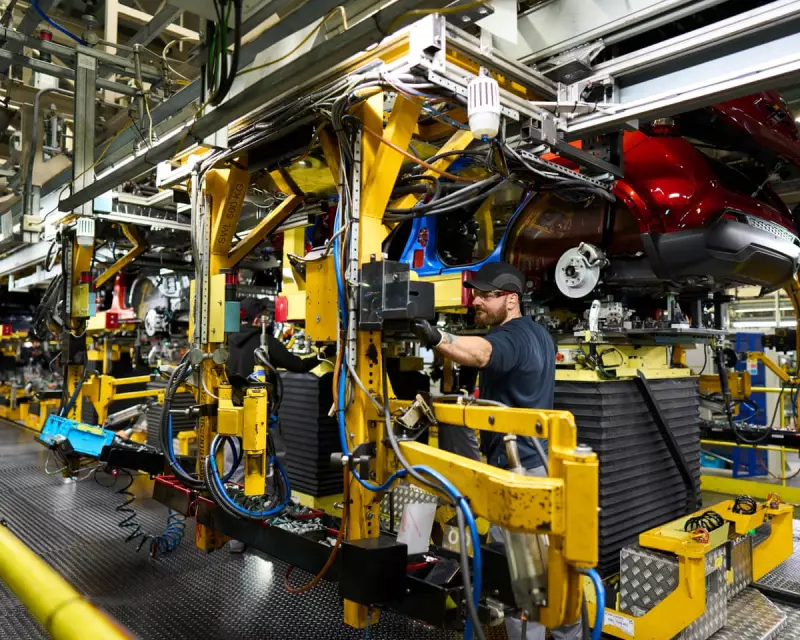
Nissan has officially launched production of its third-generation Leaf electric vehicle at its massive plant in Sunderland, marking a significant £450m upgrade for Britain's largest car factory. The move comes at a pivotal moment for the global automotive industry, which is scaling back its once-ambitious transition timelines.
A Future-Proofed Factory for an Uncertain Market
At the heart of the Sunderland facility's overhaul is a new, highly automated battery "marriage station." Here, robotic arms precisely lift and secure the crucial battery pack into the car body, bolting it in place in under sixty seconds to maintain the production line's relentless flow. This upgrade is designed to allow the factory to build both the new Leaf and existing hybrid models like the Qashqai and Juke on the same assembly line.
"We've future-proofed for the transition to fully electric vehicles – when the time comes," explained Guy Reid, the plant's engineering general manager. The investment ensures the facility won't need major modifications again as Nissan's electric lineup potentially expands.
Global Headwinds Force a Strategic Retreat
However, the celebratory launch contrasts sharply with a broader industry pullback. Just two years ago, Nissan pledged to sell only electric cars in Europe by 2030. Now, the company's European boss, Massimiliano Messina, refuses to commit to a firm date. "If I might give a number, it will be wrong," he stated, suggesting the full transition might not be complete until 2050.
This shift in tone mirrors a wider trend. The European Union recently diluted its 2035 ban on new petrol and diesel cars, while the UK softened its Zero Emission Vehicle mandate in April. This global slowdown, driven by industry lobbying and concerns over consumer uptake, has provided manufacturers with more leeway to continue selling hybrid vehicles.
The Sunderland plant itself is operating well below its 600,000-vehicle annual capacity, producing only 282,000 cars last year. The adjacent AESC battery gigafactory, built to supply Nissan, has also scaled back its ambitions. Currently running just one of four production lines, its planned output has been reduced from 38GWh to 15.8GWh per year.
Government Support and an Uncertain Future
Securing this investment was a major priority for the UK government, which provided substantial state aid. Disclosures show a £101m direct grant was awarded in 2022 for a "new all-electric vehicle," one of the largest subsidies since Brexit. Nissan itself invested £450m in the plant upgrades.
This support likely helped protect Sunderland from job cuts announced elsewhere in Nissan's global operations earlier this year. Nevertheless, questions remain about how to fully utilise the plant's capacity. Company executives have floated the idea of building vehicles for Chinese partner Dongfeng, but Messina confirmed there is "nothing concrete" on that front yet.
For now, Nissan's immediate focus in Sunderland is on the new Leaf, which remains the UK's only volume-produced electric car. The company hopes this model, born from a turbulent period following the arrest of former chief Carlos Ghosn, can help it regain market share in an increasingly cautious and competitive electric vehicle landscape.