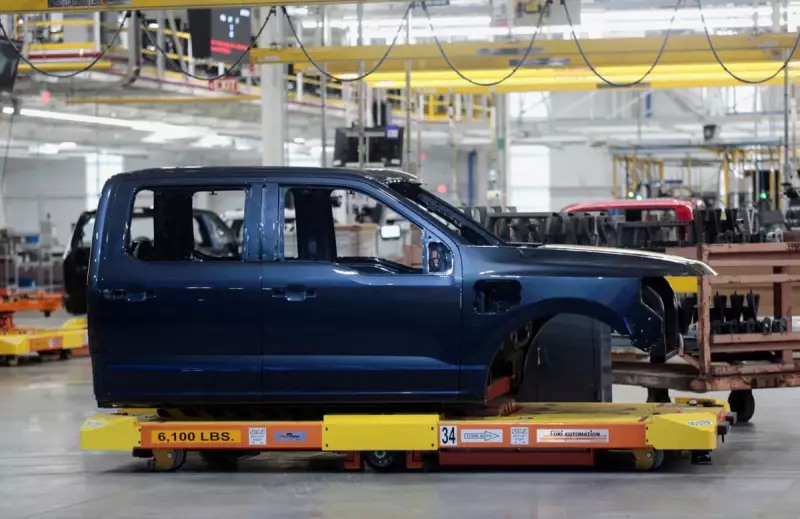
In a seismic shift for the American automotive industry, Ford Motor Company has announced a staggering $19.5bn (£15.4bn) writedown and the cancellation of several high-profile electric vehicle (EV) models. The move marks a dramatic retreat from its ambitious electrification strategy, driven by weakening consumer demand and a significant change in the US political landscape under President Donald Trump.
The Financial and Strategic Pivot
The Detroit-based automaker confirmed the decision on Monday, stating the financial hit will be spread out from the fourth quarter of this year through to 2027. A substantial $8.5bn of the total is directly linked to scrapping planned EV models. This includes the cessation of the purely electric version of its flagship F-150 Lightning pickup truck, which launched with great fanfare in 2022.
Instead of the battery-powered Lightning, Ford will pivot to producing an extended-range electric vehicle (Erev), a type of hybrid that uses a petrol-powered generator to recharge its battery. Furthermore, the company is axing its next-generation electric truck, codenamed T3, and a range of planned electric commercial vans.
Ford's strategy is now firmly refocused on petrol and hybrid models, with an expectation that its global mix of hybrids, extended-range EVs, and pure EVs will reach 50% by 2030, up from 17% today. Andrew Frick, head of Ford's gas and electric-vehicle operations, stated the rationale clearly: "Rather than spending billions more on large EVs that now have no path to profitability, we are allocating that money into higher-returning areas."
Political Winds and Market Realities
This corporate U-turn is the most potent example yet of the auto industry recalibrating in response to the Trump administration's policies. The outlook for electric vehicles dimmed considerably this year as federal support was pulled and tailpipe-emissions rules were eased, encouraging carmakers to sell more traditional petrol-powered cars.
The direct impact on demand has been stark. US sales of electric vehicles plummeted by around 40% in November, following the expiration of a long-standing $7,500 consumer tax credit on September 30. The administration's recent tax and spending bill also included a freeze on fines for automakers violating fuel-economy regulations.
Sales figures for the F-150 Lightning tell their own story. The company sold 25,583 units through November this year, a 10% decrease from the same period in 2023, despite initially ramping up production to meet 200,000 orders.
Future Plans and Workforce Impact
The cancellation effectively kills Ford's entire announced second-generation EV lineup. The T3 truck was destined for a new complex in Tennessee but will now be replaced by new petrol-powered trucks starting in 2029 at the same site. This shift will result in some near-term layoffs at a jointly owned battery plant in Tennessee, though Ford stated it eventually plans to hire thousands of workers for its new focus.
For its future electric ambitions, Ford is shifting focus to more affordable models developed by a skunkworks team in California. The first model from this project is slated to be a midsize EV truck priced around $30,000 (£23,700) and go on sale in 2027, to be built at Ford's Louisville plant.
The remaining portions of the colossal $19.5bn writedown include $6bn tied to dissolving a battery joint venture with South Korea's SK On and $5bn in "program-related expenses." This strategic retreat underscores the high-stakes volatility in the global transition to electric transport, where billions in investment can be swiftly redirected by market forces and political change.