
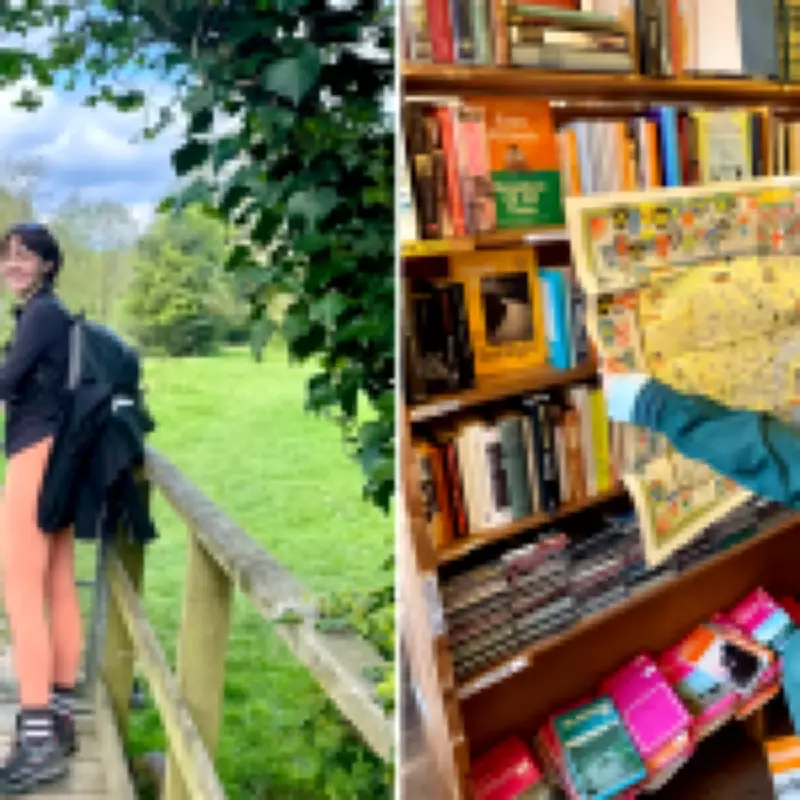
Eighteen miles in, there's nothing around us but grassy fields and buzzards overhead. We haven't seen another person for hours, and for the first time in what feels like forever, my brain goes quiet.
One week earlier, I'd received a troubling notification: my average daily screen time had reached 7 hours and 39 minutes. In that time, I could've finished a book, run an ultramarathon, or deep-cleaned my flat, balconies and all. Instead, I'd spent it doomscrolling. Everything online had started to feel loud, relentless, urgent. So I decided to detox. I left my phone at home and took a long walk in Shropshire. No Instagram. No Google Maps. No checking the news every 15 minutes. Just me, my backpack, my flatmate, Alice, and several days hiking through the countryside.
A journey through the Shire
Often overshadowed by the Lake District and the Yorkshire Dales, Shropshire rarely makes the list of Britain's most popular walking destinations. But that's exactly what appealed to me. The county, which hugs the Welsh border, feels blissfully untouched. And the Shropshire Way – a 200-mile walking route that weaves along hills, valleys, market towns and ancient castles that is said to have inspired Tolkien's Shire – seemed like the perfect place to really switch off.
Walking the Shropshire Way
The Shropshire Way is a scenic, long-distance walking route that loops through the Shropshire countryside. It is designed as a 'figure of eight' with Shrewsbury at its centre, showcasing the county's varied geology. Four new, rail-friendly routes are now available, with each one starting and finishing at a train station.
- Heart of the Hills and Far from the Crowds – Shrewsbury to Bishop's Castle; Distance: 26 miles (2-3 days); Difficulty: Moderate to challenging
- Three Castles and One Quiet Sun – Ludlow, Bishop's Castle, Clun and Craven Arms; Distance: 32 miles (3-4 days); Difficulty: Challenging
- The Wrekin Rises and the Iron Bridge Beckons – Wellington, Ironbridge and Much Wenlock; Distance: 20 miles (2-3 days); Difficulty: Moderate
- Meres, Mosses and Canals Unfold – Circular from Shrewsbury via Ellesmere & Wem; Distance: 36 miles (3-4 days); Difficulty: Easy to moderate
The elephant in the room
There are several trails to choose from, but ours – 'Three Castles and One Quiet Sun' – begins at the market town of Bishop's Castle. Once a junction of old drover's routes, the town is a jumble of colourful houses, independent cafes and antique stores. It is home to March of the Elephants, a public art trail, and a nod to the town's association with elephants (more on that later). We're staying at the Castle Hotel, a cosy 18th-century inn perched at the top of the hill. Wooden floors, thick rugs, and oak panelling throughout give it a cosy, lived-in vibe. Without my screen to retreat to, I notice myself paying more attention to everything around me. We browse antique stores – Rosies, Empires & Eagles, Old Time – before stopping for coffee and a look at second-hand books in Yarborough House. It's there that I encounter the first flaw in my digital detox plan: I have absolutely no idea how to use a physical map. By the time I was old enough to travel independently, Google Maps had already become an extension of my brain. I feel untethered, but there's something oddly thrilling about it, too.
Back to the elephants. As we wander around town, we spot elephant motifs everywhere: painted onto shopfronts, sculpted into signs and hidden in ironwork. Back at the hotel, we ask why. The answer is strange. Bishop's Castle was once home to Robert Clive, better known as Clive of India, whose emblem became the elephant upon his return. Unrelatedly, during World War II, travelling circuses moved their animals to the area to avoid the air raids. One elephant ended up staying behind and could be seen wandering the town's streets long after the circus had left. Its old stable, we discover, became part of the Castle Hotel. We happen to be staying in that very room. Tiny elephant figurines decorate the space, paying homage to its previous resident.
The quietest place under the sun
The following morning, we set off on the first stretch of our walk: 12 miles (18km) of rolling hills, open farmland and wooded valleys between Bishop's Castle and Clun. The trail is well signposted, so we follow the buzzards across fields and country lanes. Without my phone, I note that I feel more present than I have in years. Herds of sheep graze on green pastures, little lambs shyly hiding behind their mums. Red kites circle the distant skies, and ancient forests provide a respite from the midday sun. Still, the walk is no joke. By hour five, my calves are burning, my shoulders ache from carrying a backpack full of snacks and waterproofs. Eventually, the ruins of Clun Castle appear in the distance. Once described by poet A.E. Housman as 'the quietest place under the sun', Clun seems anything but. We've come at just the right time. It's the first day of the Green Man Festival, held over the May Day bank holiday weekend, and the town is bursting with activity. The White Horse Inn, where we're staying for the night, is packed.
Its owner, Jack Limond, flits from table to table, chatting to the locals and greeting newcomers. A long-time Clun resident and one of the organisers, he tells us the festival celebrates the ancient Gaelic Beltane tradition, marking the triumph of spring over winter. 'We're expecting more than 3000 people this year. There'll be morris dancing, music in the square,' he says. 'And if we're lucky, the Green Man will come out and defeat the Ice Queen.' There's a real sense of togetherness. Everyone's chatting excitedly over their sausages and mash, retelling old stories, discussing music, festivities, and the long-awaited summer ahead. 'It's funny, wherever you go, you meet people who know Clun. We're probably about 40 years behind the times. But that's why people like it. It's safe. Everyone helps each other. Often, you don't even need to shut your front door.' After dinner, we head to the neighbouring Sun Inn, where a folk band is playing to a crowd squeezed tightly into the pub. Everyone seems to know everyone. Strangers chat freely across tables. The 'quietest place under the Sun' turns out to be the merriest, and everyone is invited.
The long walk
The next morning, we set off early towards Bury Ditches, an Iron Age hill fort dating back more than 2,000 years. The climb is brutal, but the view from the top is worth every step. Originally, we're supposed to stop at Craven Arms and catch a train to Ludlow. But somewhere around our second lunchtime pint – and fuelled by walking-induced dopamine – we decide to continue on foot. Which is how we end up walking more than 22 miles (37km) in a single day. We lose our way a few times and have to backtrack our steps to safety. I miss my phone, but I sit in the friction and quickly start trusting my instincts. Normally, silence makes me uncomfortable. My instinct is always to fill it: with podcasts, music, scrolling, anything. But here, there's nothing demanding my attention. The rhythm of walking becomes meditative, and I realise that the quietest place under the sun isn't Clun after all. It's inside my own head.
Tips for going on a phone-free walking holiday
- Bring a physical map: Especially if you're heading into the countryside. As I quickly discovered, navigating without Google Maps is both mildly terrifying and oddly liberating.
- Print important information beforehand: Hotel bookings, train tickets, walking routes and emergency contacts are much easier to access on paper.
- Ask locals and hotel staff for help: Whether it's the weather forecast, walking directions or pub recommendations, people are usually more than happy to help – and you'll probably end up having some lovely conversations, too.
- Pack analogue entertainment: A book, cards or travel games are lifesavers during quiet evenings or long train journeys.
- Accept that you'll miss things: You won't instantly know the name of every bird or plant you come across. Make a note and Google it later.
- Tell people you'll be offline: Saves everyone worrying when you suddenly stop replying for three days.
We reach Ludlow at sunset, exhausted and slightly delirious. Dusk paints Ludlow Castle a fiery red as it dramatically towers over the town. Our final stop is the Feathers Hotel, where a hot shower and a large glass of red wine feel like the height of luxury. The next morning, my phone-free trip officially ends. Eventually, back in London, the notifications return. The news cycle rolls on. My groupchats resume at full speed. But for three days in Shropshire, I forgot to check my phone entirely. And honestly, that might be the most peaceful I've felt in years.
Getting to Shropshire
West Midlands Railway and Transport for Wales link Shropshire with key cities across the UK. For more information about the routes, as well as downloadable GPX files of the routes, check the Visit Shropshire and Shropshire Way pages. Maria Astardjieva was a guest at The Castle Hotel, The White Horse Inn, and The Feathers Hotel, but don't expect us to sugarcoat everything – our reviews are 100% independent.




