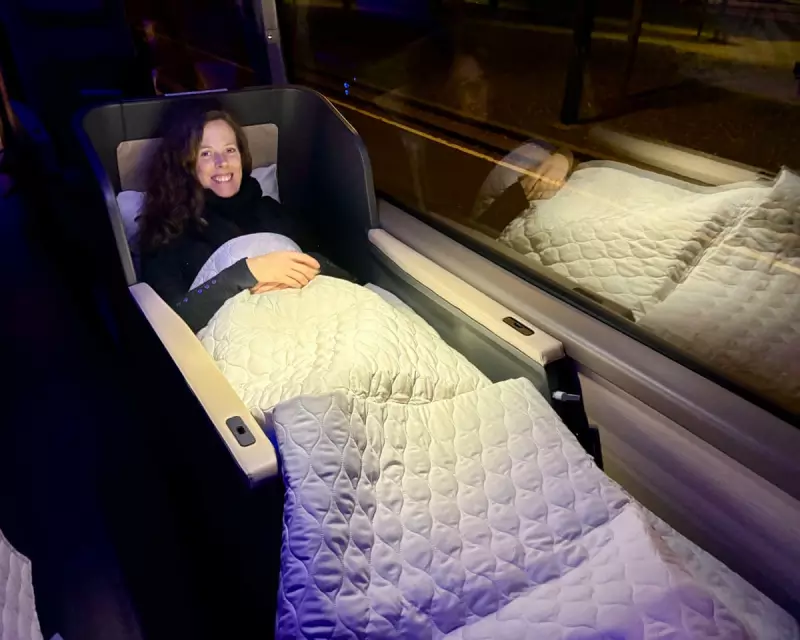
Imagine stretching out on a plush mattress, wrapped in a quilted blanket, as the landscape of Europe glides by outside your window. This isn't a first-class train cabin or a private jet; it's the revolutionary experience offered aboard the Twiliner, Europe's first fleet of flat-bed sleeper buses, which promises to redefine overnight travel with a blend of comfort and eco-consciousness.
A Bed on Wheels: Testing the Twiliner Experience
Launched last month by Swiss startup Twiliner, this service currently runs three times weekly on a 12-hour route linking Amsterdam with Zurich, passing through Rotterdam, Brussels, Luxembourg, and Basel. A second route from Zurich to Barcelona, via Berne and Girona, is set to begin on 4 December. The company's mission, as explained by co-founder and CEO Luca Bortolani, is clear: to provide a desirable alternative to flying, one of the main drivers of climate change.
The cornerstone of this ambition is the seat itself. Manufactured by Greater Manchester-based Airline Services Interiors, it transforms into a genuinely comfortable flat bed, drawing direct comparison to business class airline seating. Safety is ingeniously integrated into the sleep routine, with passengers securing their lower legs in a mesh bag clipped to seatbelt-style buckles.
For UK travellers, the journey can begin with a Eurostar from London to Brussels to connect with the bus. With Eurostar adding a fifth direct weekday service to Amsterdam this month, the Dutch capital also serves as a viable connecting hub for those venturing deeper into the continent.
Comfort and Carbon: The Sustainable Selling Point
While sleeper buses are common in Asia and South America, they've struggled to gain traction in Europe. Twiliner aims to break this pattern by coupling comfort with a strong sustainability ethos. The buses primarily run on hydrotreated vegetable oil (HVO) fuel, a renewable diesel. The company claims this results in less than 10% of the CO2 emissions of a comparable flight. Even when forced to use conventional diesel, Twiliner states its buses match the sustainability of a sleeper train per passenger kilometre.
Beyond its green credentials, the service is designed for tranquillity. A no-under-fives policy and strict guidelines on food, drink, and noise cultivate a calm environment. The upper deck houses 18 seats with panoramic views and USB ports, while downstairs offers a spacious toilet, a changing room, and self-service snacks. Complimentary earplugs, coffee, and Wi-Fi are provided.
The current fleet consists of three buses, with ambitions to expand to 25 routes by 2028, potentially including UK services. The target, according to Bortolani, is routes with high passenger traffic but lacking night trains or good connections.
The Journey: From Night-time Amsterdam to Morning Zurich
Boarding at Amsterdam's open-air Sloterdijk bus station presents a somewhat bleak start, but the arrival of the sleek, violet-lit Twiliner signals the beginning of the proper adventure. Once aboard, the excitement of fellow passengers soon gives way to sleep, facilitated by the comfortable beds.
One tester reported sleeping soundly from around 10pm, only waking to a temporary issue with high cabin heat in the early hours—a teething problem the company is addressing. The unique magic of this mode of travel is waking in a different country; arriving into Zurich on a frosty morning as the city begins to stir.
The verdict from fellow travellers like Adrien, a student from St Gallen university, captures the essence: "It's not quicker. It's not cheaper. But it's another option, and it's a good one. I slept. I feel rested." After a journey where a significant portion was spent asleep, arriving in Zurich feeling refreshed is a compelling proposition.
With tickets from 150 Swiss Francs (approx. £141) and the promise of a restful night's travel that dramatically cuts carbon footprints, the Twiliner presents a novel and thoughtful new thread in the fabric of European transport.