
It is 7:15 a.m. in a hotel in Chișinău, and I am nursing a hangover inflicted by Moldovan wine. But there is no time for that: I need to get to Comrat, capital of the Autonomous Territorial Unit of Gagauzia, for the market that finishes promptly at 3 p.m. Google Maps tells me there is no public transport route to the southern bus station, but that cannot be right, so I ask the receptionist, Diona. She taps her acrylic nails into her phone and shows me the screen with a flourish: 'You need three bus. Not good.' Time not on my side, I order a taxi through the local ride-share app, Letz. My driver pulls up in a huge Ford hatchback, but as soon as we are on the road, I fear we may not even make it to the bus station. He has his phone in one hand, watching YouTube shorts, and a cigarette in the other. Miraculously, we arrive unscathed.
I have traveled to Moldova to see what life is like in Europe's least-visited country. Ramin Mazur, a local photojournalist, tells me over a pint that 'least-visited' is just a nicer way of saying 'poorest.' And in this part of central eastern Europe, few places are poorer than Gagauzia. This little-known region is small, with just three towns and a population of 160,000 at the last census. Locals tell me they are sure it is less. Unlike Transnistria, an unrecognized breakaway state between the Moldova-Ukraine border and the Dniester River, Gagauzia is an autonomous region integrated into Moldova. That means they use Moldovan currency, follow Moldovan laws, and have Moldovan citizenship. But Gagauz identity is strong, and alongside the ghosts of past empires, the question of independence has hung over its people for decades.
The Road to Comrat
Chișinău's southern bus station is a glorified car park with a fresh fruit and veg shop and a decent selection of cafes. Dozens of white minibuses known as marshrutkas stand waiting to ferry passengers — there is no timetable as such; they just leave when they are full. 'Comrat?' I ask the girl through the ticket hatch. 'Stand 19, 86 leu.' That is £3.69 to me and you. I grab a coffee from one cafe, water and something to eat from another. I point to a pastry that looks a bit like a sausage roll. The woman behind the counter shakes her head as if to say 'you do not want that one, love.' She points to another. 'Spasiba,' I say. She smiles and seems pleased.
Marshrutkas, cheap buses that serve as public transport across much of eastern Europe, are fitted with 20 seats, including a fold-down one right next to the driver. The ceiling is carpeted, the legroom minimal. I discover that the only free seat is in the back row of four and immediately regret buying a coffee. After I squeeze in, a babushka climbs aboard and sits down in the aisle. A young man follows and stands in front of her, holding his balance with one hand on the roof. Five minutes into the journey, someone starts playing a remix of Cotton Eyed Joe through their phone speaker. Later, we are serenaded with the Macarena. The scenery is glorious, the drive nauseating, and the confines of my seat do not permit me to eat my mystery pastry. At one point, my window-side neighbor, Tatiana, takes my phone and films the vast, vivid rapeseed fields as we whizz past.
Lenin Street
Comrat has an unusual population: its residents are Turkic people who speak Russian, Moldovan, and Gagauz, and are mostly Orthodox Christians. Many are desperately poor and rely on farming to survive. One woman tells me that everyone 'has at least three types of animals at home,' but the younger generation are less willing to live such a pastoral life. Most leave to work abroad. In Comrat, the bus station is plastered with ads explaining (in Russian) how much can be earned in a month by working in Europe: Germany (€1,800), Ireland (€1,900), France (€2,000). On arrival, I tuck into my pastry. Tough as old boots. I dispose of it discreetly and take a walk down Lenin Street. There is a balloon shop, a kebab stand, a hairdressers, a spa called Beauty Paradise, and beside it, a Kbeauty store that does laser treatments. Five minutes takes me to what the internet describes as one of Comrat's top attractions: the 'I love Comrat' sign. I take a pleasant stroll through Central Park and visit St John's Cathedral, a canary yellow Orthodox church with golden onion domes that was built sometime between 1820 and 1840.
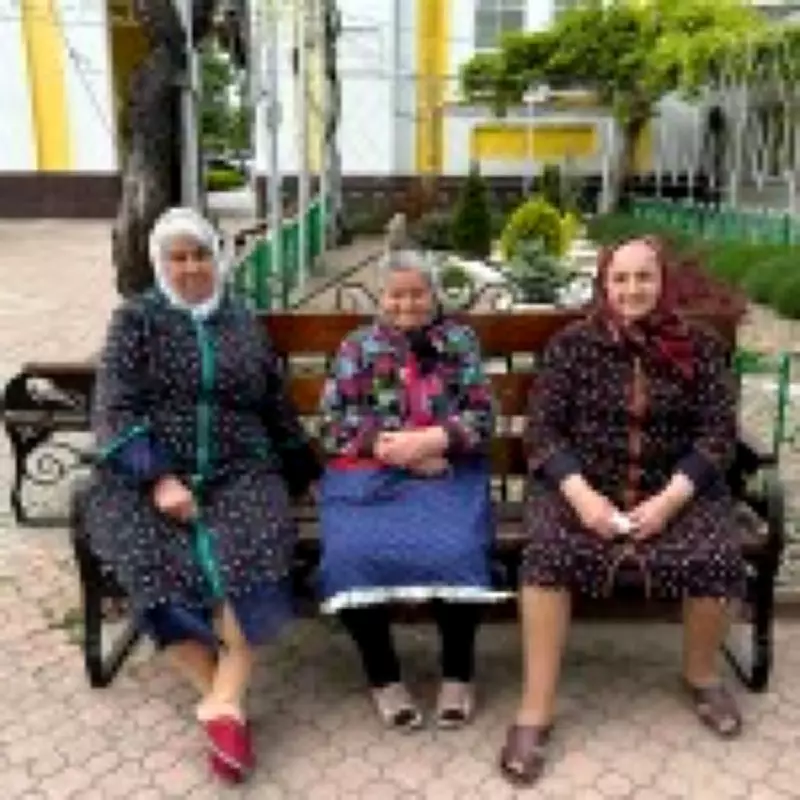
Stomach grumbling, I wander down Victory Street where the sprawling market shows me the heart of the town. I ask two street sellers with history etched into their faces if I can take their picture. One, with a megawatt smile and a mouth of gold teeth, graciously agrees. The market is a warren selling everything from locally grown cherries and great hods of goat cheese to USSR telephone sets. Perched on the stalls are enormous fish with blood seeping from their gills. Girthy coils of blackened blood pudding. Giant garlic bulbs and gorgeous, glossy strawberries. Nobody speaks much English, but everyone is lovely.
Walking Through History
After an almond cake at Pronto, I move on to the National Gagauz Museum of History and Ethnography, which is located in a Soviet building with elaborate wood carvings around the entrance. The door is open but the lights are off. 'Hello?' Two women bustle in, one finishing a mouthful of something. On go the lights. I hand over 25 leu (£1.07) and receive the most efficient museum tour ever given. Alisa, an attractive 40-something with black, waist-length hair and Amy Winehouse eyeliner, guides me through the rich ethnic tapestry that informs Gagauz identity. 'This Gagauz,' she says, pointing to a handwoven rug from the last century. 'This Turkish. This Russian. This Bulgarian. This Moldovan.' We make lively conversation through Google Translate, and I ask what she thinks about Russia, the EU, and the question of independence. 'My grandmother want Russia. Me, European Union. Gagauz no problem with Moldova. With everyone, we are getting on.' We hurtle through a millennia of memories, from ancient Ottoman coins to photographs of the Gagauzian medics who went to help in Chernobyl in 1986. She breezes past a Cyrillic sign. What is that say, I ask. 'Slava Gaguazia. Like Slava Ukraine, you know, long live Gagauzia.'
Alisa is eager for me to visit Comrat's statue of Lenin, one of only two left in the region. 'Come, please. Look.' She pulls back a white lace curtain to reveal a small bust of the revolutionary leader. 'Mini Lenin. Now you go see Big Lenin,' she says, ushering me out the door. I dutifully visit Vladimir Ilyich, and right on cue, the market is closing up on Victory Street. In buoyant mood after my strange but life-affirming afternoon, I return to the bus station and await a marshrutka to Chișinău. I sneeze as I scribble in my notebook. The man beside me says 'bless you' in Turkish, and we exchange smiles that transcend the language barrier. On the drive home, I write that once in a while, everyone should go to a place they have never heard of. Slava Gagauzia, indeed.
Getting There
Fly direct from London Luton to Chișinău with Wizz Air. Return fares from £98 in June. From Chișinău, take a marshrutka from the southern bus station to Comrat. A one-way ticket is 86 leu (around £3.70), and you can buy the same in Comrat on the way back.




