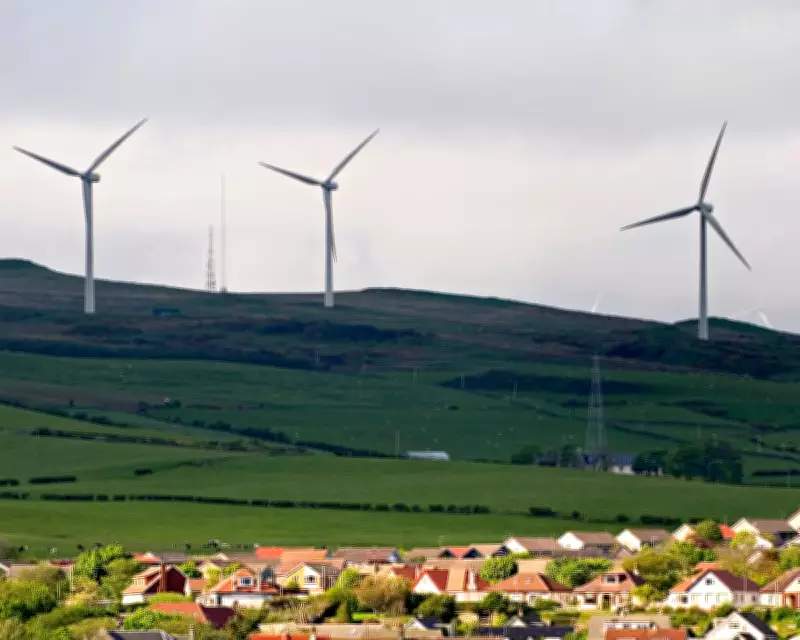
Renewable energy will bolster the UK's national security and protect the country from potential aggression or sabotage, according to the government's energy minister, Michael Shanks. He emphasized that widely dispersed wind farms and solar panels are much harder to target than large-scale fossil fuel power stations, and they are not vulnerable to supply shocks such as the current oil crisis caused by the US-Israel conflict with Iran or the soaring gas prices following Russia's invasion of Ukraine in 2022.
Decentralized Power Systems Reduce Risk
Speaking from Ukraine, where he visited UK-funded energy projects, Shanks stated: "We are dealing with a far more complex threat landscape than we've ever dealt with before. That’s true in the UK, it’s true across Europe. Building a decentralised power system with a whole series of assets is less of a risk of physical attack than large-scale power stations. Moving towards clean power is the best way to deliver our energy security in an increasingly uncertain world."
The Conservatives and Reform UK have advocated for more drilling in the North Sea rather than renewables. However, those arguments suffered a setback last week when the Guardian revealed that Fatih Birol, executive director of the International Energy Agency, advised against new exploration licences on a commercial basis. Birol noted that potential new fields already within the licensing system, such as Rosebank and Jackdaw, would have little impact on the UK's energy security or prices.

Military Experts Call for Renewable Investment
Military experts have also urged investment in wind farms and solar panels to strengthen national security. Several former military chiefs have written to governments to pursue renewables. Retired Lt Gen Richard Nugee previously stated that investing in renewable energy would make the UK more resilient. "To have a strong military deterrence, we need a resilient homeland. If we want to build a resilient country, low-carbon energy is a very important component," he said.
Shanks observed that Ukraine is building decarbonised infrastructure because solar, wind, and batteries are harder to target than large power stations. "We can learn a huge amount in the UK from what Ukraine is doing," he added. "They’re doing it at a pace I’d like to be doing it at in the UK as well."
Cybersecurity and Undersea Cables
Cybersecurity is another area of focus. Shanks noted that the UK is responding to increased threats with a national plan for energy security, working to build resilience at every part of the energy system, from the grid to individual projects, covering both cybersecurity and physical security.
Action has been taken to secure undersea cables to offshore wind farms after suspicions that Russian submarines might have been scouting them or targeting the UK's energy interconnectors. "We’ve been doing a lot of work, making sure that our undersea cables are as resilient as possible and are protected from attack," Shanks said. "We were aware of that move by Russia [and] there’s no doubt that highlights how serious the threat is. We need to redouble our efforts around that. But we do have a very robust plan in place for ensuring their security and working collectively across Europe on this."
Nuclear Power Security
Concerns about attacks on atomic power stations have arisen due to potential damage to Ukraine's nuclear reactors by Russia. However, Shanks assured that the UK has a highly secure nuclear estate. "Nuclear is a critical part of how we get off fossil fuels. With the small modular reactors, we will deliver on that. Security is right at the heart of our consideration for nuclear, as it has always been."
This week, governments from at least 56 countries are meeting in Colombia for the world's first conference on transitioning away from fossil fuels. The UK's climate envoy, Rachel Kyte, is attending. One highlight will be the convening of a scientific panel on how countries can wean themselves off fossil fuels.