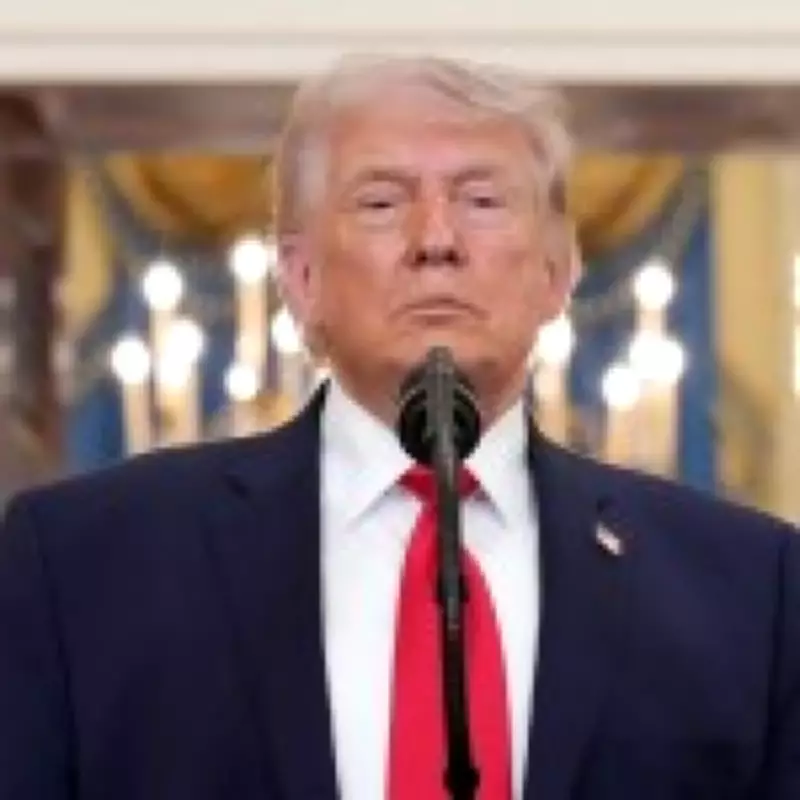
Trump's Bellicose Rhetoric Triggers Oil Market Turmoil
Global oil markets experienced significant volatility as prices spiked dramatically following a televised address by US President Donald Trump, in which he reiterated his threat to bomb Iran "back to the Stone Ages." The inflammatory remarks immediately sent Brent crude futures soaring above $107 per barrel, representing a substantial 6.3% increase that reflects deepening anxiety about prolonged Middle Eastern instability.
Market Reactions and Economic Implications
Financial markets responded swiftly to the presidential speech, with oil climbing more than $5 per barrel while stock indices declined and the US dollar strengthened. Brent crude futures rose $6.33 to reach $107.49 per barrel, while US West Texas Intermediate crude futures increased $5.28 to $105.40 per barrel. These gains reversed earlier declines and signaled renewed investor concerns about potential supply disruptions from the strategically vital Gulf region.
The timing of these market movements is particularly noteworthy, occurring shortly after both benchmarks had settled lower in the previous trading session. This volatility underscores how geopolitical tensions in energy-rich regions can create immediate and substantial impacts on global commodity markets, with potential ripple effects throughout the world economy.

Strategic Ambiguity and International Relations
During his 19-minute prime-time address, President Trump declined to outline a concrete plan for concluding the ongoing conflict, instead boasting that the job would be finished "very fast" while simultaneously suggesting military operations might continue for another two to three weeks. The president specifically identified Iran's electricity generation and oil infrastructure as potential "key targets" for future military action.
"We're going to bring them back to the Stone Ages where they belong," Trump declared, despite having previously mocked Iran's military capabilities as having been significantly degraded by US and Israeli operations. This contradictory messaging has created uncertainty about both the administration's strategic objectives and its timeline for achieving them.
International Diplomatic Tensions
The speech revealed growing strains in international alliances, particularly regarding the crucial Strait of Hormuz waterway. Trump called upon countries dependent on Gulf oil supplies to "take the lead" in securing the strategic passage, despite the UK, France, and other US allies having previously stated they would only assist with keeping the waterway open after hostilities have ceased.
"They can do it easily," Trump asserted. "We will be helpful, but they should take the lead in protecting the oil that they so desperately depend on." This position has reportedly angered the president, who has even threatened to withdraw from the 76-year-old NATO alliance over what he perceives as insufficient support from European partners.
Public Opinion and Political Context
The presidential address appears unlikely to shift public sentiment significantly, with recent polling indicating substantial domestic opposition to continued military engagement in Iran. A Reuters/Ipsos survey conducted last weekend revealed that 60% of American voters disapprove of the war, while 66% believe the United States should work to end its involvement quickly, even if that means not achieving the administration's stated objectives.
This public skepticism persists despite Trump's claims of "swift, decisive, overwhelming victories" on the battlefield and his insistence that military action has been "so powerful, so brilliant" that Iran is "really no longer a threat." These assertions were contradicted during the speech itself by air raid sirens sounding in both Doha and Tel Aviv, demonstrating Iran's continued capacity to project force across the region.
Historical Comparisons and Future Uncertainty
In an attempt to contextualize the current conflict, President Trump referenced several historical American military engagements:

- World War I (US involvement: 1 year, 7 months, 5 days)
- World War II (US involvement: 3 years, 8 months, 25 days)
- The Korean War
- The Vietnam War
- The Iraq War
Noting that the ongoing conflict in Iran has lasted just 32 days, the president seemed to be appealing for additional time to accomplish his objectives. However, his administration has reportedly been considering both escalation and de-escalation options, creating uncertainty about future policy directions that even extends to some close presidential advisers.
The combination of bellicose rhetoric, strategic ambiguity, and strained international relations has created a volatile situation with significant implications for global energy markets, diplomatic alliances, and regional stability in the Middle East.