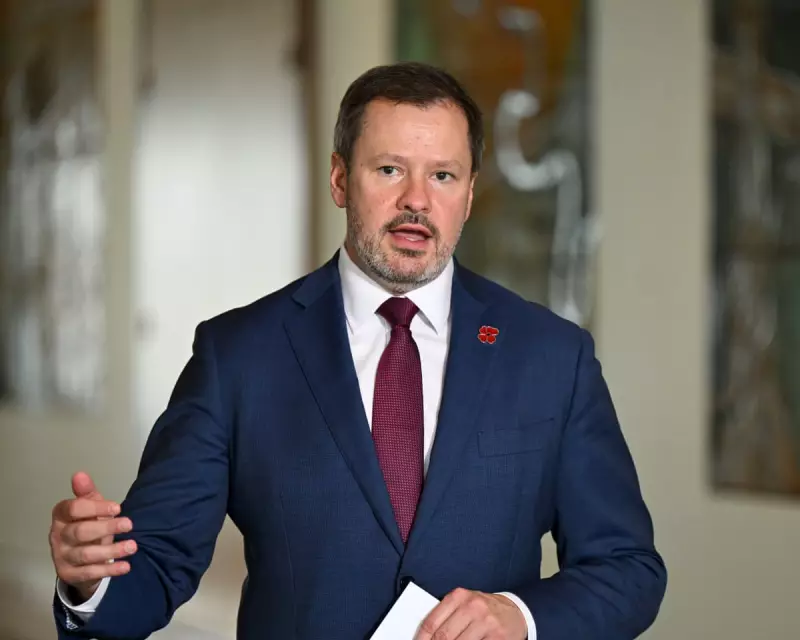
In a significant break from party lines, Labor MP Ed Husic has delivered a powerful parliamentary address demanding an end to what he describes as 'profiteering' by gas exporters and calling for decisive government intervention to secure cheaper fuel for Australian consumers.
A Fundamentally Distorted Market
The former industry minister issued a stinging rebuke of Australia's approach to gas market regulation, which he characterised as 'timid'. Husic argued that 'tinkering at the edges' of reform would not fix what he called a 'fundamentally distorted' gas market.
He emphasised that higher prices and uncertain supply for domestic users stem not from gas shortages, but from prioritisation. 'The gas that comes from beneath Australian soil is prioritised for customers offshore rather than customers onshore,' Husic told parliament.

The Scale of the Problem
The figures supporting Husic's position are stark. Australia currently exports three-quarters of the gas it produces, creating domestic supply pressures that have seen east coast gas prices triple over the past decade. This price surge followed the establishment of major LNG export terminals in Queensland, which connected the domestic market to international demand.
The situation is expected to worsen, with the energy regulator warning of an east coast gas shortfall by the winter of 2028 unless action is taken.
Husic placed blame on successive governments, stating: 'Over decades, governments have entrenched this, largely by inaction, hoping the problem would go away.'
Proposed Solutions and Political Support
Husic's comments came in support of a motion by independent MP Nicolette Boele, which called on the government to 'only allow uncontracted gas to be exported after it has been offered to the domestic market at a reasonable price'.
Boele reinforced Husic's analysis, stating plainly: 'We do not have a gas supply problem, we have a gas export problem.' She attributed any predicted shortfalls to infrastructure and distribution issues rather than production capacity.
Another independent MP, Zali Steggall, speaking in support of Boele's motion, echoed this sentiment: 'We do not need more gas approvals; what we need are rules to ensure more gas stays in Australia.'
The Institute of Energy Economics and Financial Analysis (IEEFA) supported this approach in their latest report, suggesting that 'the cheapest way to supply Australian gas consumers is instead to redirect small amounts of uncontracted LNG from exports to the domestic market', rather than developing new, higher-cost gas fields.
Industry Response and Government Position
The gas industry lobby group has indicated potential support for measures requiring exporters to set aside extra gas for domestic use, but with a significant condition: such measures must be tied to new gas developments.
Meanwhile, the Labor government appears to be moving toward its own solution. Industry Minister Tim Ayres recently signalled that an announcement on a domestic gas reserve designed to lower east coast prices is imminent, describing the ideal scenario as wanting a 'Goldilocks amount of gas' in the system.
Husic framed the issue as both an economic and sovereign imperative, stating: 'Access to stable affordable gas is not just an industrial preference, it is a sovereign capacity necessity.' He further emphasised its importance to Australia's energy transition, noting it 'will be essential to the transition to net zero'.
His central demand remains clear: 'Our gas, our prices: that should be the bedrock of our thinking.' He called for multinational gas firms to provide gas at prices in line with historic pre-pandemic levels, applying this condition to any new fields opened.