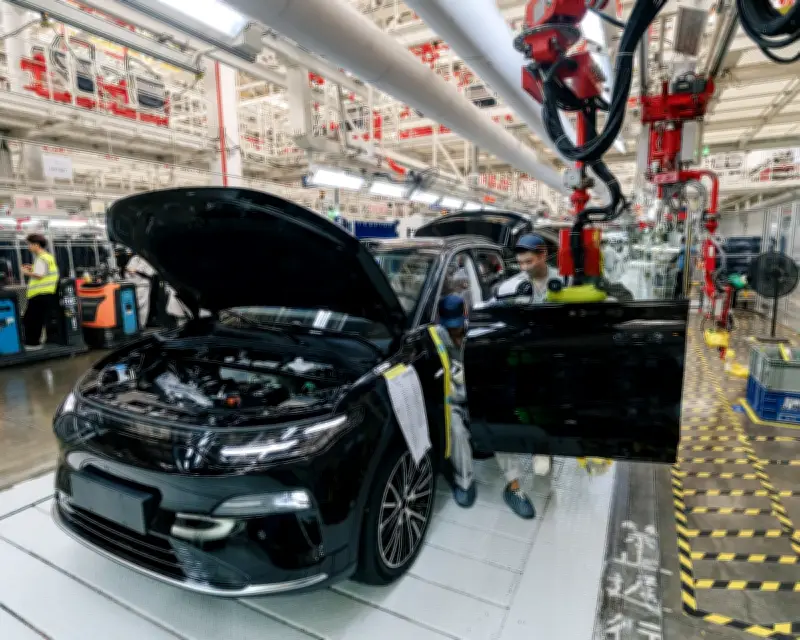
Chinese electric car sales have surged to a record high across Europe, driven by strong demand in the UK and a subsidy-fueled boom in Italy, intensifying scrutiny on tariffs and claims of market dumping.
Market Share Milestone
According to Schmidt Automotive Research, Chinese brands accounted for 14.2% of battery electric vehicle (BEV) sales in Western European markets during the first five months of 2025, up nearly five percentage points year-on-year. This translates to 171,800 units sold, meaning one in every seven BEVs sold in the region now comes from a Chinese manufacturer.
Brands like BYD, Chery, SAIC, and Xpeng have aggressively targeted Europe as part of China's broader strategy to dominate the global EV market. This surge puts pressure on traditional European automakers, who are already grappling with stricter emissions regulations that mandate higher BEV sales.

Tariff Loopholes and Anomalies
The increase in sales comes despite EU tariffs of up to 35.3% on Chinese-made EVs, in addition to the standard 10% import duty. The UK, which has declined to impose extra levies, remains the largest European market for Chinese cars, accounting for a quarter of all Chinese BEV sales across the 18 largest Western European markets.
Italy, however, presents an 'anomaly' according to Schmidt. Leapmotor, a Chinese manufacturer, capitalized on Italian government purchase subsidies by shipping thousands of its budget T03 model into the country. At one point, the T03 was priced as low as €5,000, undercutting even the most affordable rival models.
PHEV Shift and Future Outlook
Chinese manufacturers have introduced over 120 different models in Europe this year, compared to about 100 from European brands. However, Matthias Schmidt, founder of Schmidt Research, believes China's BEV market share may have peaked. He notes a strategic shift toward plug-in hybrid electric vehicles (PHEVs), which are not yet subject to EU tariffs.
'I think they are hitting a wall when it comes to pure electric models,' Schmidt said. 'They will prioritise PHEVs over the next 12 months given hybrids are omitted from extra tariffs placed on BEVs only. With that loophole set to close in the next 12 months, they will aim to maximise that gap in the door for as long as possible.'
Schmidt added, 'Given shipping capacity remains limited, more PHEVs means fewer BEVs, which have likely peaked for now. BEVs will take priority again once local EU production comes online.'
Industry Reactions and Tesla Rebound
Oliver Blume, CEO of Volkswagen, has called for changes to tariff policies, arguing that European PHEVs are uncompetitive against Chinese equivalents. German newspaper Handelsblatt reports the EU is considering extending levies to PHEVs.
Meanwhile, Tesla saw a 60% year-on-year sales rebound across Europe, recovering from a slump in 2024 attributed to backlash against CEO Elon Musk's political alliances. The Model Y was the best-selling individual model in Europe during the period, with increased demand for cheaper versions of the Model 3 and Model Y contributing to the surge.